The searing heat of the Arabian Peninsula translates to a population vulnerable to heat stress. As temperatures continue to rise, effective strategies are urgently needed to mitigate and adapt to the impacts of climate change in the region.
A promising approach is the greening of dry areas, which has been shown to modify the surface climate in several regions. Monitoring the impact of vegetation on surface temperature is important, as KAUST climatologist Matteo Zampieri explains.[1]
“As vegetation absorbs more solar energy compared to the desert, it reduces the reflectivity (albedo) of the land surface. This in turn increases the temperature of the land surface in water limited areas. So, the balance between increased evapotranspiration and reduced albedo compared to the bare soil determines the outcome of greening efforts,” he says.
“The outcomes may vary, based on the availability of water for plants as well as specific physiological processes of drought adapted plant species. While some instances of desert greening may lead to surface cooling, others can actually result in surface warming,” Zampieri warns.
To investigate the effects of managed vegetation, the researchers used satellite data to compare the surface temperature differences between planted areas and bare soil at five sites representing Saudi Arabia’s main agricultural regions. They also used a site at Al-Qirw with a mix of vegetation maintained by pivot irrigation. They analyzed the data at Al-Qirw, where temperature differences between vegetated and bare soil are not influenced by differences in elevation.
The satellite data were used to generate statistics on a daily basis, which showed the changes in average temperature over green areas and the effect of vegetation on temperature variability.
A normalized difference vegetation index (NDVI) was used as an indicator of the presence and vigor of vegetation and the land surface temperature (LST) during day and night was used to estimate the effects of vegetation on the surface climate.
At Al-Qirw, the annual mean LST differed considerably between the planted areas and bare soil. Between 2010 and 2017, the daytime LST was about 4 degrees Celsius cooler inside the area covered by vegetation compared to the surrounding bare soil.
On hotter days, vegetation provides an extra cooling effect. These results corresponded with an increase in the NDVI in the vegetated area. After 2017, the NDVI suddenly decreased and the cooling effect in Al-Qirw vanished, possibly related to water management sustainability.
Leader of the research team KAUST’s Ibrahim Hoteit says the study supports other evidence that establishing vegetation and effective water management practices mitigates high temperatures in arid regions.
“Our study shows that managed vegetation plays a crucial role in mitigating the impacts of climate change, especially heat waves,” he says.
“However, it also highlights the importance of sustainability factors because the collapse of vegetation can diminish the cooling effect and accelerate local warming trends,” he warns.
REFERENCE
Zampieri, M., Alkama, R., Luong, T., Ashok, K. & Hoteit, I. Managing vegetation for stronger cooling efficiency during hot days in the Arabian Peninsula. Ecological Indicators154, 110789 (2023).| article.
ABOUT THE AUTHOR
Matteo Zampieri, Senior Researcher
In Ibrahim Hoteit‘s Red Sea Modeling and Prediction Group, Matteo is a principal investigator at the Climate Change Center (CCC) of KAUST where he coordinates the development of the sub-seasonal and seasonal forecasting systems and the investigations related to the Saudi and Middle East Green Initiatives.
Riyadh, lensed through the inverted arch void of the city’s iconic Kingdom Centre Tower.Mohammed Bin Mahdi courtesy of Omrania
Since the beginning of civilization, buildings have served as humanity’s stamp on time. From Neanderthal caves and exquisite hammams, to the boundary-pushing buildings in the Middle East, architectural innovations capture the zeitgeist; embodying the hopes and ambitions of the moment as well as the underlying technological prowess that points to the future of our built environment.
Backed by a searing ambition to fashion a new image for the region (and in many cases, funded by the deep pockets of sovereign funds), buildings in the Middle East have, in the past 15 years, achieved the impossible: They have quite simply raised the bar for architectural and structural innovation around the world. The journey hasn’t been without criticism: design purists have nicknamed region an architect’s Disneyland and eyebrows have been raised about the Middle East ‘buying’ design cred. And whilst that is true to a certain extent, it is also offering designers from around the world the infrastructure – and the funding – to imagine future icons.
An elegant and slender beacon of Dubai’s dynamic vision and future-forward thinking, the Burj Khalifa rises 828 meters above sea level. The crown jewel of the emirate’s luxurious downtown development, it opened 2010 and has since held the record for the world’s tallest building. Designed by a team led by Adrian Smith of Skidmore, Owings & Merrill, it derives its unusual, multi-layered profile from the Hymenocallis flower Or Spider Lily – a regional desert flower. Its shimmering glass façade reflects the city’s vibrant energy. Inside, it offers an unparalleled urban lifestyle, featuring luxury apartments, observation decks, and world-class amenities.
Photo: Koert Vermeulen and Noor Riyadh
2/5
Kingdom Centre Tower, Riyadh, Saudi Arabia, $1.2 billion
Instantly recognised the world over, thanks to its unique crown, Riyadh’s Kingdom Centre Tower was designed by the team of US-based architecture studio Ellerbe Becket and Omrania, a Saudi design firm. The building’s almond-shaped profile renders a softness, that complements its silver reflective curtain wall. The cap over the inverted arch is a glass skybridge housing a public observation deck. The. $1.2 billion skyscraper is home to exclusive residences, a luxury mall and a Four Seasons hotel. It has played a starring role in many regional cultural events, such as the lighting festival Noor Riyadh, when in 2021 Belgian artist Koert Vermeulen suspended his celestial installation, Star in Motion, in the elliptical void.
Photo courtesy of the Grand Egyptian Museum
3/5
Grand Egyptian Museum, Cairo, Egypt, $1.03 billion
Born from a 2003 competition that saw some of the biggest design firms in the running, the complex was envisioned by the Irish firm Heneghan Peng Architects. Construction began in 2005, but unprecedented setbacks – including the 2008 financial crisis, the Arab Spring in 2011 and the COVID-19 pandemic – pushed the Grand Egyptian Museum many years behind schedule. There are murmurs of an imminent inauguration.
Buena Vista Images
4/5
Louvre Abu Dhabi, Abu Dhabi, UAE, $650million ++
Putting a cost to this iconic museum’s first outpost beyond France is not as straightforward as one might think, because after all, a lot rides on its name. Designed by Jean Nouvel, the 260,000-square-foot complex covered by a tessellated roof cost approximately $650 million to build.
Abu Dhabi paid an additional $520 million to be able to use the name ‘Louvre’ for 30 years, plus there is a $747 million fee for exchange for art loans, special exhibitions and guidance.
Photo courtesy of the National Museum of Qatar
5/5
National Museum of Qatar, Doha, Qatar, $434 million
Inspired one of the Middle East’s most mesmerising natural phenomena – the desert rose, a mineral composite where crystals take the shape of flower – this 430,000-square-foot museum designed by Jean Nouvel is home to 11 permanent galleries.
Located across from the corniche in Doha, the museum’s interlocked structure weaves in and out of the historic waterfront district, integrating with and revitalising the neighbourhood in myriad ways.
What is the Global South? A term that is in increasingly constant use nowadays according to many and to the author, Joseph S. Nye who reviews it and came up with what follows.
3 November 2023
CAMBRIDGE — The term “Global South” is in constant use nowadays. For example, some commentators warn that Israel’s incursion into Gaza is “alienating the Global South”, and we often hear that the “Global South” wants a ceasefire in Ukraine. But what do people mean when they use it?
Geographically, the term refers to the 32 countries below the equator (in the southern hemisphere), in contrast to the 54 countries that lie entirely north of it. Yet, it is often misleadingly used as shorthand for a global majority, even though most of the global population is above the equator (as is most of the world’s landmass). For example, we often hear that India, the world’s most populous country, and China, the second most populous, are vying for leadership of the Global South, with both having recently held diplomatic conferences for that purpose. Yet, both are in the northern hemisphere.
The term, then, is more of a political slogan than an accurate description of the world. In this sense, it seems to have gained traction as a euphemism to replace less acceptable terms. During the Cold War, countries that were not aligned with either the United States or the Soviet Union blocs were said to belong to the “Third World”. Non-aligned countries held their own conference in Bandung, Indonesia, in 1955, and there are still 120 countries constituting a weak non-aligned movement today.
Nonetheless, with the Soviet Union’s demise in 1991, the idea of a non-aligned Third World no longer made much sense. For a time, it became common to refer to “less-developed countries”. But that term had a pejorative ring to it, so people soon began to refer to “developing countries”.
Although that term has its own problems, not all low-income countries are developing, after all, it proved useful in the context of United Nations diplomacy. The Group of 77 (G-77) now comprises 135 countries, and exists to promote their collective economic interests. Outside the UN context, however, there are too many differences between members for the organization to serve a meaningful role.
Another fad term that has come into vogue is “emerging markets”, which refers to countries like India, Mexico, Russia, Pakistan, Saudi Arabia, China, Brazil and a few others. In 2001, Jim O’Neill, then a managing director at Goldman Sachs, coined the acronym BRIC in a paper that identified Brazil, Russia, India, and China as emerging economies with high growth potential. Though he was offering investment analysis, some political leaders, including Russian President Vladimir Putin, seized on the grouping as a potential diplomatic platform to counter American global influence.
After a series of meetings, the first BRIC summit was held in Yekaterinburg, Russia, in 2009. With the addition of South Africa the following year, the group became the BRICS. Then, at the 15th BRICS summit this past August, South African President Cyril Ramaphosa announced that six emerging-market countries (Argentina, Egypt, Ethiopia, Iran, Saudi Arabia and the United Arab Emirates) would join the bloc on January 1, 2024.
Ever since it became a conference-holding body, the BRICS has often been seen as representing the Global South. But, again, Brazil and South Africa (and now Argentina) are the only members from the Southern Hemisphere, and even as a political replacement for the Third World, BRICS is rather limited conceptually and organisationally.
The term’s main value is diplomatic. Though China is a middle-income country in the Northern Hemisphere that is competing with the US for global influence, it likes to describe itself as a developing country that plays an important leadership role within the Global South. Still, in conversations with Chinese academics on a recent trip to Beijing, I found differences among them. Some saw the term as a useful political tool; others suggested that more accurate terminology would divide the world into high-, middle-, and low-income countries. But even then, not all low-income countries have the same interests or priorities. Somalia and Honduras, for example, have very different problems.
For journalists and politicians, the high-, middle-, low-income terminology does not roll easily off the tongue or fit well in headlines. For want of an alternative shorthand, they will continue to rely on “Global South”. But anyone interested in a more accurate description of the world should be wary of such a misleading term. Project Syndicate, 2023.
Joseph S. Nye, Jr., a professor at Harvard University and a former US assistant secretary of defence, is the author, most recently, of “Do Morals Matter? Presidents and Foreign Policy from FDR to Trump” (Oxford University Press, 2020). Copyright:
Children sitting near their home at al-Shati camp for Palestinian refugees in the central Gaza Strip on June 20, 2020. Majdi Fathi/NurPhoto via Getty Images
Over the past 20 years, my research as an anthropologist has focused on the situation of Palestinian displacement in the Middle East. Having studied some of the daunting challenges millions of Palestinians face as stateless refugees denied the ability to return to their homeland or the right of compensation, I believe it is critical to understand their history and what is at stake for those trapped in indefinite exile.
The origins of Palestinian displacement are ongoing and cannot be reduced to a single cause. Most Palestinian refugees, however, can trace their roots to two significant events in Palestinian history: The “Nakba” and the “Naksa.”
The majority of Palestine’s Arab population fled their homes during the war, seeking temporary refuge across the Middle East but hoping to return after hostilities ceased.
In addition to providing education, health care and other services, including microfinancing and jobs training, the UNRWA has been supporting refugee camp improvement projects through road construction and home rehabilitation in the camps.
Refugees in Jordan, Egypt and Syria: the Naksa of 1967
Others found refuge in Egypt and Syria. More than a third of those Palestinians displaced in 1967 were already refugees from 1948 and thus suffered a second forced migration. Just as in 1948, when the 1967 war ended, the Israeli government blocked the return of any refugees and proceeded to destroy several Palestinian villages in the occupied territory, including Emmaus, Yula and Beit Yuba. After their destruction, these areas were leased to Jewish Israelis.
Beyond Al-Nakba and Al-Naksa
Although the tragedies of the Nakba and the Naksa turned the vast majority of Palestinians into refugees, numerous events since then have increased their number. One of the most significant causes of Palestinian displacement today is the Israeli practice of home demolitions.
Whether as a punitive measure or the result of a permit system that rights groups say systematically discriminates against Palestinians, between 2009 and 2023 the practice destroyed over 9,000 homes and left approximately 14,000 Palestinians homeless.
The further displacement of Palestinians has also resulted from regional wars involving neither Palestinians nor Israelis. Following the end of Iraq’s occupation of Kuwait in 1990, over 300,000 Palestinians were expelled from Kuwait in retaliation for support offered by the leading Palestinian national organization, the Palestine Liberation Organization, to Saddam Hussein.
Because Palestinians live under various governments in diverse circumstances, no single experience can account for their experience of exile. In Jordan, for example, where I have conducted research, Palestinian refugees can be divided into numerous groups, each with its own set of opportunities and challenges.
There are Palestinians displaced in 1948 who became citizens of Jordan but depend on UNRWA for basic services like education and health care. There are also refugees displaced from the Gaza Strip in 1967 who lack citizenship and are thus deprived of certain civil and political rights. More recently, there are Palestinians displaced from Syria for whom movement and work opportunities have been severely restricted in Jordan.
Palestinian refugees in the Hamas-ruled Gaza Strip, who today number around one-and-a-half million, are currently living under a 16-year blockade established by Israel but supported by the Egyptian government. Since the closure began in 2007, restrictions on the import of goods, the movement of people and access to basic resources like electricity have produced dire conditions for Palestinians, including over 45% unemployment and food insecurity among 70% of households.
Since 1948, Palestinians in Lebanon have faced severe restrictions in work, education and health. Treated as an unwanted population in the country, their presence has been a source of significant divisions in Lebanon and a factor in numerous conflicts, including the Lebanese Civil War and the War of Camps between Syrian-backed militias and factions within the Palestinian Liberation Organization.
The duration of their predicament is undoubtedly tied to the uniqueness of their displacement. Palestinians fled a homeland that became the state of another population, in this case Jewish, whose leaders treat the return of Palestinians as a demographic threat.
Any solution to Palestinian displacement that involves returning to territory in contemporary Israel thus faces the problem of overcoming the idea of Israel as an exclusively Jewish state. And yet that is the challenge. Whatever peace negotiations may bring, no permanent solution to the Palestine-Israel conflict can avoid answering the question of return.
The Middle East’s expertise in handling heat could be of benefit worldwide, writes Aly Abousabaa, director general of the International Center for Agricultural Research in the Dry Areas (ICARDA) and CGIAR’s regional director for Central and West Asia and North Africa.
The Middle East and North Africa (MENA) region is the driest in the world and home to four of the five most water-stressed countries on the planet. But its legacy as the cradle of agriculture also makes it an increasingly valuable source of global wisdom and innovation for adapting food systems for hotter, drier climates – a challenge that lies ahead for a growing number of countries.
Thanks to its “fertile crescent”, a richly biodiverse area in the Middle East, the region has witnessed more than 10,000 years of agricultural transformation and continues to be at the forefront of dryland farming.
With rising temperatures and desertification spreading around the globe, this year’s COP28 climate talks in Dubai (30 November-12 December) offer a timely opportunity to learn from the region’s vast experience and the scientific solutions that are enabling desert farming against the odds.
What MENA lacks in freshwater, it makes up for in resilient, ancient plant and animal species and millennia of agricultural ingenuity.
The region’s extraordinary agricultural heritage and harsh conditions mean it remains a treasure trove of “crop wild relatives” – original food plant species that have evolved over thousands of years to survive heat, water stress and poor soil.
“Governments, policymakers and climate negotiators at COP28 must heed the lessons of the MENA region to enshrine food security in a hotter, drier world.”
Aly Abousabaa, director general, ICARDA
For scientists looking for plant genetic traits that can withstand the kinds of climate extremes now occurring in countries such as Australia, Canada, Spain and the US, MENA is a hotbed of source material from which to develop hardier, more climate tolerant crops.
For example, CGIAR recently released six new drought tolerant varieties of barley and durum wheat using samples stored at a crop genebank managed by the International Center for Agricultural Research in the Dry Areas (ICARDA) in Morocco.
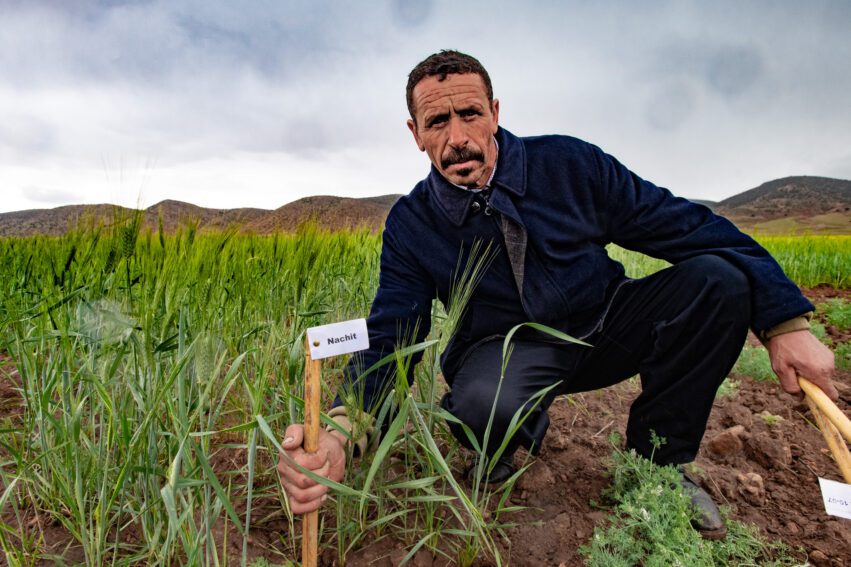
Farmer Aziz el Kaissi conducts a durum wheat trial in Ait Bouhou, Morocco, as part of an ICARDA project to collect data on improved crop varieties. Photo: Michael Major/Crop Trust.
CGIAR’s climate-smart crops offer a vital buffer against the impact of drought, which last year reduced wheat production by around 70 per cent in Morocco, where conditions were so harsh the episode was named “the drought of the century”.
ICARDA has released about 880 new crop varieties in the last 40 years, generating annual benefits worth over US$850 million – and this goes well beyond the MENA region. In the last five years, more than 120 climate-resilient cereal and legume crops have been grown in more than 20 countries.
CGIAR’s heat-resilient wheat varieties, derived from the MENA region’s crop wild relatives, increased yields by up to 24 per cent when tested on sites in Ethiopia, Lebanon, Morocco and Senegal.
Alongside breeding hardier crops, agricultural researchers in the region have also developed cutting-edge early warning systems to help MENA countries and other water-stressed nations to better forecast and anticipate droughts.
Scientists working on the MENAdrought project in collaboration with governments in Jordan, Lebanon and Morocco, have built country-specific systems which predict the likelihood of drought conditions over the next one to three months. This allows farmers and local authorities to manage water resources more effectively and make better-informed planting decisions.
A drought index has already been adopted to show where stressed conditions exist and trigger actions to help, and the project has expanded to Tunisia, with interest from other MENA countries.
The region also offers a compelling example of how traditional knowledge and practices can be harnessed to bolster food security, accelerated through local and regional collaboration.
Techniques that have improved productivity and reversed desertification include water management innovation, green energy integration, vertical farming, conservation agriculture and deep learning through satellite observation.
A novel technique is the use of an ancient practice known as “Marab”, which involves creating areas of relatively flat land that slows water flow after rainfall, allowing more moisture retention and less degradation.
Reseeding indigenous range species, including grasses and legumes with reduced water needs, and controlling the grazing of livestock have also been shown to contribute to rangeland rehabilitation. Using this technology in Jordan meant barley production increased from 0.34 to 8.37 tonnes per hectare and the yields became more reliable due to a lesser dependence on unpredictable rainfall.
While the world races to limit global temperature rises, climate change is already under way with now inevitable consequences both in MENA and beyond.
As many more countries face hotter and drier conditions, the MENA region is a valuable test case for the adaptive capacity of agriculture. Many of the innovations developed in the Middle East and North Africa will become instrumental to farming in a climate emergency.
Governments, policymakers and climate negotiators at COP28 must heed the lessons of the MENA region to enshrine food security in a hotter, drier world.
ICARDA researches and develops climate-smart agri-innovations to generate resilient livelihoods for dryland farmers suffering a climate crisis.
This piece was produced by SciDev.Net’s Global desk.
We use cookies on our website to give you the most relevant experience by remembering your preferences and repeat visits. By clicking “Accept”, you consent to the use of ALL the cookies.
This website uses cookies to improve your experience while you navigate through the website. Out of these cookies, the cookies that are categorized as necessary are stored on your browser as they are essential for the working of basic functionalities of the website. We also use third-party cookies that help us analyze and understand how you use this website. These cookies will be stored in your browser only with your consent. You also have the option to opt-out of these cookies. But opting out of some of these cookies may have an effect on your browsing experience.
Necessary cookies are absolutely essential for the website to function properly. This category only includes cookies that ensures basic functionalities and security features of the website. These cookies do not store any personal information.
Any cookies that may not be particularly necessary for the website to function and is used specifically to collect user personal data via analytics, ads, other embedded contents are termed as non-necessary cookies. It is mandatory to procure user consent prior to running these cookies on your website.

 Here is an enlightening article by KAUST (


.png)


You must be logged in to post a comment.