New York City is built with millions of metric tons of concrete and other cement-based materials, which gradually absorb and store carbon dioxide from the air over the lifetimes of buildings and infrastructure.
Credits: Photo: AdobeStock
The world’s most common construction material has a secret. Cement, the “glue” that holds concrete together, gradually “breathes in” and stores millions of tons of carbon dioxide (CO2) from the air over the lifetimes of buildings and infrastructure.
A new study from the MIT Concrete Sustainability Hub quantifies this process, carbon uptake, at a national scale for the first time. Using a novel approach, the research team found that the cement in U.S. buildings and infrastructure sequesters over 6.5 million metric tons of CO2 annually. This corresponds to roughly 13 percent of the process emissions — the CO2 released by the underlying chemical reaction — in U.S. cement manufacturing. In Mexico, the same building stock sequesters about 5 million tons a year.
But how did the team come up with those numbers?
Scientists have known how carbon uptake works for decades. CO2 enters concrete or mortar — the mixture that glues together blocks, brick, and stones — through tiny pores, reacts with the calcium-rich products in cement, and becomes locked into a stable mineral called calcium carbonate, or limestone.
The chemistry is well-known, but calculating the magnitude of this at scale is not. A concrete highway in Dallas sequesters CO2 differently than Mexico City apartments made from concrete masonry units (CMUs), also called concrete blocks or, colloquially, cinder blocks. And a foundation slab buried under the snow in Fairbanks, Alaska, “breathes in” CO2 at a different pace entirely.
As Hessam AzariJafari, lead author and research scientist in the MIT Department of Civil and Environmental Engineering, explains, “Carbon uptake is very sensitive to context. Four major factors drive it: the type of cement used, the product we make with it — concrete, CMUs, or mortar — the geometry of the structure, and the climate and conditions it’s exposed to. Even within the same structure, uptake can vary five-fold between different elements.”
As no two structures sequester CO2 in the same way, estimating uptake nationwide would normally require simulating an array of cement-based elements: slabs, walls, beams, columns, pavements, and more. On top of that, each of those has its own age, geometry, mixture, and exposure condition to account for.
Seeing that this approach would be like trying to count every grain of sand on a beach, the team took a different route. They developed hundreds of archetypes, typical designs that could stand in for different buildings and pieces of infrastructure. It’s a bit like measuring the beach instead by mapping out its shape, depth, and shoreline to estimate how much sand usually sits in a given spot.
With these archetypes in hand, the team modeled how each one sequesters CO2 in different environments and how common each is across every state in the United States and Mexico. In this way, they could estimate not just how much CO2 structures sequester, but why those numbers differ.
Two factors stood out. The first was the “construction trend,” or how the amount of new construction had changed over the previous five years. Because it reflects how quickly cement products are being added to the building stock, it shapes how much cement each state consumes and, therefore, how much of that cement is actively carbonating. The second was the ratio of mortar to concrete, since porous mortars sequester CO2 an order of magnitude faster than denser concrete.
In states where mortar use was higher, the fraction of CO2 uptake relative to process emissions was noticeably greater. “We observed something unique about Mexico: Despite using half the cement that the U.S. does, the country has three-quarters of the uptake,” notes AzariJafari. “This is because Mexico makes more use of mortars and lower-strength concrete, and bagged cement mixed on-site. These practices are why their uptake sequesters about a quarter of their cement manufacturing emissions.”
While care must be taken for structural elements that use steel reinforcement, as uptake can accelerate corrosion, it’s possible to enhance the uptake of many elements without negative impacts.
Randolph Kirchain, director of the MIT Concrete Sustainability Hub, principal research scientist in the MIT Materials Research Laboratory, and the senior author of this study, explains: “For instance, increasing the amount of surface area exposed to air accelerates uptake and can be achieved by foregoing painting or tiling, or choosing designs like waffle slabs with a higher surface area-to-volume ratio. Additionally, avoiding unnecessarily stronger, less-porous concrete mixtures than required would speed up uptake while using less cement.”
“There is a real opportunity to refine how carbon uptake from cement is represented in national inventories,” AzariJafari comments. “The buildings around us and the concrete beneath our feet are constantly ‘breathing in’ millions of tons of CO2. Nevertheless, some of the simplified values in widely used reporting frameworks can lead to higher estimates than what we observe empirically. Integrating updated science into international inventories and guidelines such as the Intergovernmental Panel on Climate Change (IPCC) would help ensure that reported numbers reflect the material and temporal realities of the sector.”
By offering the first rigorous, bottom-up estimation of carbon uptake at a national scale, the team’s work provides a more representative picture of cement’s environmental impact. As we work to decarbonize the built environment, understanding what our structures are already doing in the background may be just as important as the innovations we pursue moving forward. The approach developed by MIT researchers could be extended to other countries by combining global building-stock databases with national cement-production statistics. It could also inform the design of structures that safely maximize uptake.
The findings were published Dec. 15 in the Proceedings of the National Academy of Sciences. Joining AzariJafari and Kirchain on the paper are MIT researchers Elizabeth Moore of the Department of Materials Science and Engineering and the MIT Climate Project and former postdocs Ipek Bensu Manav SM ’21, PhD ’24 and Motahareh Rahimi, along with Bruno Huet and Christophe Levy from the Holcim Innovation Center in France.
Behind the rush in the MENA region to develop renewable-energy capacity is the continued exploitation of fossil fuels to achieve economic growth amid worsening climate pressures on agriculture and water. Economic security, not reduction of emissions, is at the core of this expansion of states’ energy supplies.
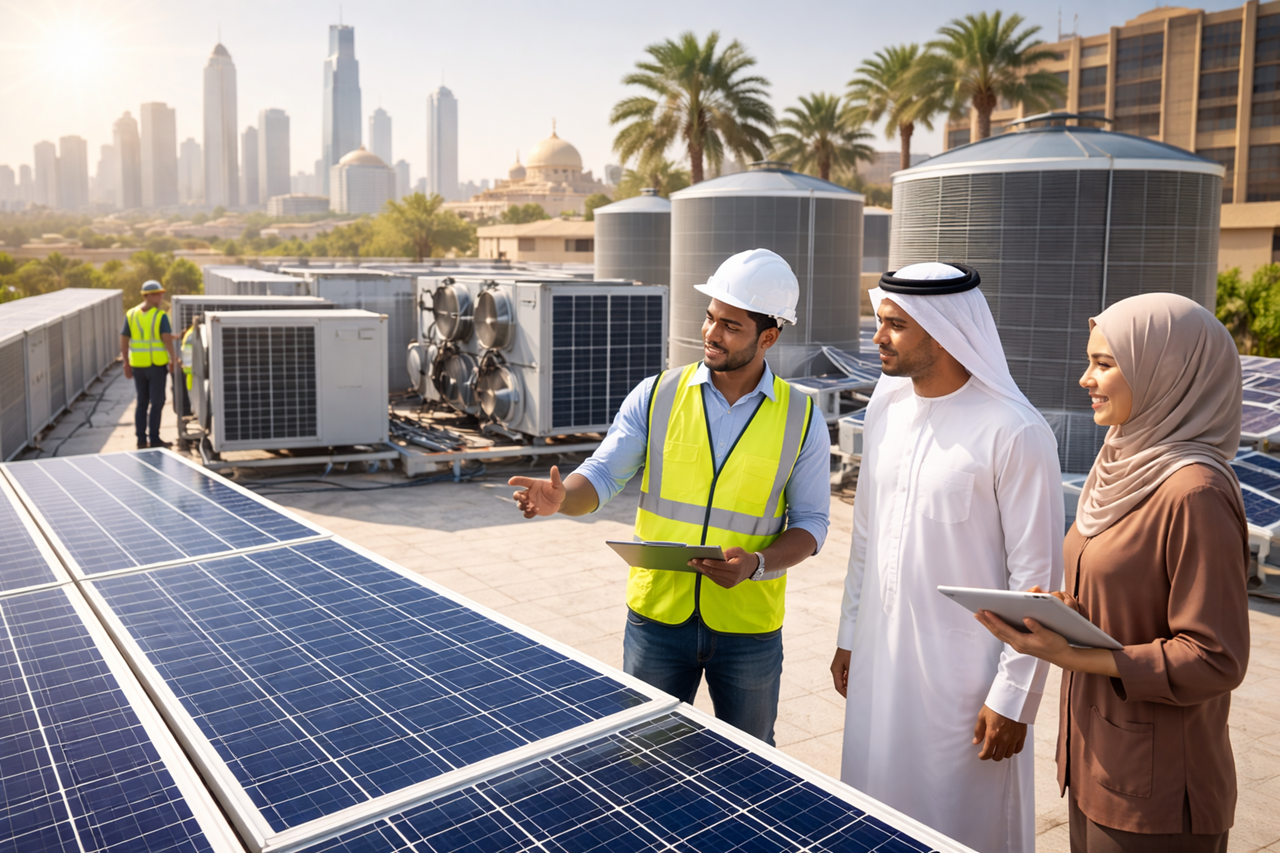
The Middle East and North Africa (MENA) is finally waking up to the imperative of renewable energy. Although the region has lagged behind the rest of the world in developing its infrastructure, surging investments in renewables will see over four times the existing capacity installed in the MENA by 2030. Nevertheless, not all countries are equally equipped to diversify and secure their energy supply to meet the soaring demand driven by rising temperatures. While Saudi Arabia has set itself the target of adding 20 gigawatts (GW) of renewable-energy capacity annually and of reaching 130 GW by 2030, other countries beset by conflict, political instability, or corruption are struggling to keep pace and adapt to climate pressures.
The economic incentives behind renewable-energy strategies
The International Energy Agency (IEA) has increased its forecast for renewable-capacity growth in the MENA by 25% over the next five years, the largest regional upgrade globally. But the year-to-year uptick in projects reflects incentives for diversification that go beyond carbon-emission concerns. The effects of climate change on MENA soil and water systems pose an acute threat to the region’s agriculture, food security, and, therefore, economies. In this context, renewables are better seen as an adaptation tool to provide the additional energy security needed to maintain agricultural production and water supplies, rather than as a system-wide energy transition away from polluting fuels.
Saudi Arabia’s ambition to finance gigawatt-scale scale renewable projects to achieve 50% renewable-energy generation by 2030 exemplifies the wider petrostate strategy of using revenues from fossil-fuel exports to secure domestic energy supply for future growth. The success of its broader technology-driven modernisation strategy, including the ambitious development of energy- and water-intensive data centres, is underpinned by energy expansion. Renewable investments are necessary to prevent potential resource constraints on other critical sectors as a consequence of this modernisation, such as Saudi Arabia’s efforts to create a self-sufficient agri-food industry. Current rates of worsening water scarcity anticipate the kingdom will face a 65% reduction in agricultural production from today’s levels by 2050, the most significant projected losses in the region, followed by Yemen (35%) and Syria (13%). As of 2023, public energy was used for irrigation in 44.7% of Saudi Arabia’s agricultural land, 98% of which was powered by water-intensive diesel. In addition to other technological industrial advancements, a shift towards renewable-powered groundwater pumping, desalination, or wastewater treatment, as well as still-necessary large-scale food imports, will all require extensive funding. Maximising hydrocarbon export revenue by reducing domestic energy usage is a key component of Saudi Arabia’s strategic growth.
As a non-hydrocarbon economy and net energy importer, Morocco’s Green Generation 2020-2030 initiative is rooted in an understanding of the urgent economic vulnerabilities of the food–water–energy nexus. Given that the agricultural sector employs roughly 40% of the country’s workforce, Morocco’s nearly 24 GW renewable-energy development pipeline sits alongside a US$45 billion National Water Plan 2020–-2050 to ensure food-system resilience through renewable-powered desalination plants. Moreover, the National Office of Electricity and Drinking Water has sought to integrate its fertiliser-manufacturing value chain with green hydrogen production and expand renewable-pumped hydropower storage, decreasing its vulnerability to supply-chain volatility.
Political obstacles to renewables in the region
For others in the region, conflict, political instability, and financial mismanagement have prevented foreign investment and the development of utility-scale renewable energy projects. In Iraq, the severe summer temperatures directly resulting from global warming, and the accompanying need for air-conditioning, regularly cause complete grid failure. Yet corruption, protracted negotiations and lack of political will have prevented financial investment into renewable-energy projects and grid storage. In Lebanon, finding investors for the Akkar wind farms has also been obstructed for years due to debt defaults and a lack of economic reform. To cope with daily power shortages, household installations of off-grid, rooftop solar panels have proliferated.
Egypt has made material steps to overcome such barriers, as it also deals with temperature-induced blackouts. Subsidy reforms and foreign-debt repayments have strengthened its exchange rate and begun to rehabilitate Egypt’s investor climate, prompting a series of announcements over the last year regarding renewable-energy expansion and grid rehabilitation. But for other countries, ongoing violence derails the development of renewables despite available international funding. Palestinian renewable-energy projects have long been undermined by Israel’s systematic denial of infrastructure permits in the West Bank in favour of illegal settlements. As Israel is geographically limited in developing sufficient landmass of its own for energy diversification at scale, it has gone as far as destroying and confiscating solar panels (part of projects funded by the European Union) in Area C. This is the only land available for Palestinian utility infrastructure, and thereby sustains Palestinian dependency on Israeli gas.
Supply-chain threats to renewable-energy security
The race to develop renewables infrastructure, including necessary power-grid rehabilitation and battery technologies, is now under pressure from rapidly depleting resources of required critical minerals within the supply chain, such as copper and lithium. The vulnerability of the MENA’s slow start to diversification contrasts with China’s first-mover advantage, with Chinese-dominated value chains now factored into national renewable-energy-development strategies in the region. China is the largest manufacturer and market for renewables, and will account for up to 60% of global deployment over the next ten years. Critically, China is the dominant refiner for 19 out of 20 energy-related strategic minerals, with an average market share of around 70%. Given the IEA estimates that, even in the highest production scenarios, the world will face a 30% supply shortfall for copper by 2035 if all national climate commitments are met, states with structural barriers to diversification risk being left behind.
Tightening Chinese export controls, including on the use of renewable technology, is leading states with sufficient capital to invest in localising segments of their value chains. Essential technologies for baseload electricity supply, such as the mega-capacity battery energy-storage systems (BESS) at Egypt’s Red Sea wind farm and Abydos II solar plants, are predominantly electrochemical, using lithium. In December 2024, Saudi Arabia announced its first successful extraction from oilfield brine, with plans to begin producing lithium by 2027. Similarly, multiple countries in the region are in severe need of electrical-grid rehabilitation. Jordan had implemented a ban on new utility-scale renewable-energy developments between 2019 and 2024 due to grid limitations. Since lifting the ban, the government has faced heightened pressure to restart mining limited copper reserves within a protected nature reserve, despite the country’s severe water scarcity and issues of wastewater pollution.
The vicious cycle of continued fossil-fuel dependency
The underlying approach to developing renewable-energy capacity in the region is ultimately geopolitical and economic, not environmental. With over 30% of the world’s oil supplied by the region, energy has always determined the geopolitical leverage, regional influence, and political economy of MENA states. They are set to protect this global posture, as reflected by the energy-security strategies set out in the 2025 United Nations Climate Change Conference (COP30), held in November. Although supply chain security was high on the conference’s agenda, MENA states resisted the phasing out of fossil fuels. Natural gas and oil still comprised 90% of electricity generation in the MENA in 2024. Alongside 50% growth in forecasted electricity demand by 2035, the rapid expansion of renewable-energy capacity in the region and proportional electricity-generation targets do not necessarily equal a reduction in fossil-fuel production.
The race to diversify energy is generating unsustainable pressure on the supply chains of critical minerals. These rates of resource consumption risk leaving behind states in the region with insufficient political and financial capital to invest in future-proof energy infrastructure. Depleted water and food systems, resulting from continued dependency on fossil fuels, will exacerbate energy demand and limit the capacity of MENA economies to adapt to an increasingly uninhabitable region. Although scaling renewable-energy capacity is necessary, it will be insufficient without a shift in focus towards mitigation and a full energy transition to exit this vicious cycle.
GENEVA: The Middle East and North Africa recorded their hottest year on record in 2024, with temperatures rising at twice the global average of recent decades, the UN weather agency said in a report.
Heatwaves in the region are becoming longer and more intense, according to the World Meteorological Organization’s first report focused on the area.
“Temperatures are rising at twice the global average, with intense heatwaves that are pushing society to the limits,” said WMO Secretary-General Celeste Saulo.
The average temperature in 2024 was 1.08 degrees Celsius above the 1991-2020 average, the report found, with the highest in Algeria at 1.64 C above the average of the last 30 years.
Saulo warned that extended periods of more than 50 C in a number of Arab countries were “too hot to handle” for human health, ecosystems and economies.
Droughts in the region, home to 15 of the world’s most water-scarce countries, have become more frequent and severe, with a trend of more and longer heatwaves recorded in North Africa since 1981, the report said.
Consecutive failed rainy seasons caused drought in Morocco, Algeria and Tunisia, while intense rainfall sparked flash floods in Saudi Arabia, Bahrain and the United Arab Emirates, the report found.
More than 300 people in the region died last year from extreme weather events, mainly heatwaves and floods, while nearly 3.8 million were affected in total, the WMO said.
The report said investment was urgently needed in water security, such as desalination and reusing wastewater, as well as warning systems to reduce risks from extreme weather events. Currently, about 60% of the region has such systems in place.
Average temperatures are expected to rise up to 5 C in the region by the end of the century under current emission levels, the report said, citing regional projections from the Intergovernmental Panel on Climate Change.
Meanwhile, a weak La Nina may affect global weather patterns during the next three months, according to a WMO prediction published on Thursday.
Though the La Nina pattern involves the temporary cooling of temperatures in the central and eastern Pacific Ocean, many regions are still expected to be warmer than normal – increasing the chance of floods and droughts, which can impact crops, the WMO said.
There is a 55% probability that there could be a weak La Nina from this month until February next year, the WMO predicted. In mid-November 2025, oceanic and atmospheric indicators show borderline La Nina conditions, it added.
There is a 65% to 75% chance that neutral conditions are likely for January to March and February to April 2026, respectively, the WMO said.
The UN weather agency said it is not likely there will be an El Nino, a natural climate phenomenon that fuels tropical cyclones in the Pacific and boosts rainfall and flood risk in parts of the Americas and elsewhere.
Seasonal forecasts and their impact on weather can translate into millions of dollars of economic savings for agriculture, energy, health and transport, said the WMO, adding thousands of lives can also be saved by preparing response actions. — Agencies
Three-dimensional maps, such as this one of a district in Singapore, could help researchers to keep track of urban planning, disaster risk assessment and climate change.Credit: Zhu et al./ESSD
Scientists have produced the most detailed 3D map of almost all buildings in the world. The map, called GlobalBuildingAtlas, combines satellite imagery and machine learning to generate 3D models for 97% of buildings on Earth.
The data set, published in the open-access journal Earth System Science Data on 1 December1, covers 2.75 billion buildings, each mapped with footprints and heights at a spatial resolution of 3 metres by 3 metres.
The 3D map opens new possibilities for disaster risk assessment, climate modelling and urban planning, according to study co-author Xiaoxiang Zhu, an Earth observation data scientist at the Technical University of Munich in Germany. It could also help to improve how researchers monitor United Nations (UN) Sustainable Development Goals for cities and communities, Zhu adds.
Billions of buildings
Conventionally, creating detailed 3D maps at a global scale has been difficult, say Zhu, because it usually requires either laser scanning or high‑resolution stereo imagery. The team’s solution was to combine deep learning with laser-scanning techniques to predict building heights. The tool was trained on reference data obtained using light detection and ranging (LiDAR) from 168 cities, mostly in Europe, North America and Oceania.
The researchers created the 3D maps from approximately 800,000 satellite scenes captured in 2019, using the deep-learning tool to predict building heights, volumes and areas.
The study found that Asia accounts for nearly half of all mapped buildings in the world — approximately 1.22 billion structures. Asia also dominates the total building volume at 1.27 trillion cubic metres, reflecting rapid urbanization and dense metropolitan clusters in China, India and southeast Asia.
Africa has the second largest number of buildings, at 540 million, but their combined volume is only 117 billion cubic metres, underscoring the prevalence of small, low-rise structures.
City-scale analyses illustrate how building volume correlates with population density and economic development. In Europe, Finland has six times more building volume per capita than does Greece. The study also highlighted that Niger’s per-capita building volume is 27 times below the world average.
These patterns suggest that conventional 2D measures of urban growth, such as built-up areas, might obscure crucial differences between infrastructure and living conditions.
Dorina Pojani, an urban planning researcher at the University of Queensland in Brisbane, Australia, says that the data set would be extremely valuable for her research, because she has previously relied on static, 2D data.
“Since this can be regularly updated it will be very valuable over the next five to ten years, as the data set will reveal how urban areas develop over time,” Pojani says.
She says that the data set presents fresh opportunities to study corruption, allowing researchers to “link buildings or projects to specific developers, firms or politically connected actors, and ask whether certain networks of people are disproportionately represented in high-value or strategically located projects”.
Pojani says her previous research has linked informal settlements with election outcomes2. Political parties often ignore “such settlements when there is an election coming up”, she adds. With a more dynamic data set, Pojani says her work could involve more high-quality evidence.
Liton Kamruzzaman, a transport and urban planner at Monash University in Melbourne, Australia, says that the data set has a lot of potential to help track urbanization around the world.
“There are many parts in the world that do not have any information about how their cities and buildings are growing. This data set is great for everyone irrespective of where they are living,” he adds.
In the past year alone, four major environmental negotiations have collapsed.
Global talks on a treaty to cut plastic pollution fell apart. Governments did not agree on the timeline and scope for the seventh assessment report of the Intergovernmental Panel on Climate Change (IPCC). Talks on the International Maritime Organization’s net-zero framework failed to reach consensus. And the summary for policymakers for the UN Environment Programme’s flagship report on the state of the environment was not approved.
These failures signal a deeper breakdown in how the world tackles environmental crises such as climate change, biodiversity loss, pollution and waste and land degradation.
There are cracks in the system. International negotiations are built on principles of representation and consensus, meant to ensure fairness and inclusivity. In theory, every country has a voice, and decisions reflect collective agreement. In practice, however, these principles often paralyse or delay progress.
Consensus can allow a few countries to block collective action, even when most members are in favour, while calls for representation are sometimes used to delay decisions in the name of democracy – ironically, sometimes by states where democratic principles are in question.
Take the global plastics treaty negotiations. Talks have hit a deadlock between countries seeking limits on plastic production and oil-producing countries pushing to focus only on waste and recycling. Similarly, the IPCC process is grappling with unprecedented disputes over timelines and plans for removing carbon from oceans and rivers.
Then there’s the politicisation of science. Every paragraph of a policy summary – distilling key scientific findings for governments – is negotiated line by line. This process often dilutes or deletes science to fit national agendas, with the recent UN climate summit (Cop30) declaration removing any mention of fossil fuels. The result: assessments that take years to produce and summaries mired in political wrangling, eroding trust in science, and delaying the urgent action they are meant to drive.
Who really decides? Formally, it is the member states – that’s nations and entities like the EU. On paper, every country has an equal voice. In reality, power dynamics tell a different story.
Some nations dominate the floor with large, well-prepared teams, armed with technical experts and seasoned negotiators. They arrive with detailed positions, ready to shape the agenda. Others, often from smaller or less-well-resourced states, struggle to be heard. Their delegations are thin, sometimes just one or two people juggling multiple sessions.
Gender gaps persist, too. Despite decades of commitments to equality, men still speak far more often than women in many negotiations – up to four times more in some sessions of the recently collapsed Global Environment Outlook, the UN’s flagship report on the state of the global environment that connects climate change, nature loss and pollution to unsustainable consumption.
Negotiations to agree on possible ways to tackle the issues fell apart when some governments failed to agree with scientific conclusions outlined in the report. This is not just about optics, and it affects whose perspectives shape global environmental policy. When voices are missing, so are ideas and priorities.
Scientists, meanwhile, sit at the back of the room. Their role is largely reactive – allowed to clarify technical points only when specifically asked by member states. Their expertise, which should anchor decisions in evidence, is often sidelined by political bargaining. The result? Policies that sometimes drift away from what science says is necessary to protect ecosystems and communities.
The new fault lines
Rising nationalism and geopolitical tensions make cooperation harder. Environmental action is increasingly framed as a sovereignty issue, with domestic interests trumping global solutions. Climate pledges are weighed against economic competitiveness, biodiversity targets through trade-offs and resource control. Trust erodes, negotiations drag on, and the planet pays the price.
This reality shows in the slow progress of major agreements. Multilateralism, once the only path forward, now splinters into shifting blocs. Some countries stall decisions to protect short-term gains; others walk away entirely, creating a void – and an opportunity for others to step in.
Improving this means rethinking the system from the ground up. That involves challenging the consensus stranglehold. The requirement for consensus often paralyses negotiations. Allowing coalitions of ambitious countries to move ahead when consensus fails could break deadlocks and create momentum. So-called “coalitions of the willing” (such as the fossil fuel phase-out coalition announced at Cop30) can set higher standards and inspire others to follow.
Giving science a stronger voice, while allowing political input, ensures that decisions remain grounded in facts without ignoring legitimate national concerns.
Current models treat scientific input as secondary to political negotiation. Hybrid approval systems can protect evidence without ignoring legitimate national concerns.
Modernising the process can speed up negotiations. Moving away from paper-heavy, language-dependent systems towards digital tools and AI-assisted drafting could accelerate text negotiations, reduce translation or language delays and make participation easier for smaller delegations.
Beyond funding and technical aid, small delegations can be empowered through real-time intelligence, dedicated staff, mentorship and early access to information. Gender and regional balance can be ensured through measures like speaking-time quotas and consistent, process-long leadership roles.
The collapse of these talks is a warning. Our governance systems were built for another era, yet environmental crises today are more complex and more interconnected than ever. The machinery meant to solve them is buckling under outdated rules and rising pressure.
Without bold reform, multilateral environmentalism risks irrelevance. Failure to reach global agreements will invite fragmented, unilateral fixes – patchwork solutions far too weak to prevent ecological breakdown. The question is not whether reform is needed, but whether we act before it’s too late.
The stakes are high. Every delay means more emissions, more extinctions and more communities exposed to environmental impacts. The world cannot afford negotiations that stall while ecosystems collapse. We need systems that are agile, inclusive, evidence-based and fit for the 21st century.
Don’t have time to read about climate change as much as you’d like?
We use cookies on our website to give you the most relevant experience by remembering your preferences and repeat visits. By clicking “Accept”, you consent to the use of ALL the cookies.
This website uses cookies to improve your experience while you navigate through the website. Out of these cookies, the cookies that are categorized as necessary are stored on your browser as they are essential for the working of basic functionalities of the website. We also use third-party cookies that help us analyze and understand how you use this website. These cookies will be stored in your browser only with your consent. You also have the option to opt-out of these cookies. But opting out of some of these cookies may have an effect on your browsing experience.
Necessary cookies are absolutely essential for the website to function properly. This category only includes cookies that ensures basic functionalities and security features of the website. These cookies do not store any personal information.
Any cookies that may not be particularly necessary for the website to function and is used specifically to collect user personal data via analytics, ads, other embedded contents are termed as non-necessary cookies. It is mandatory to procure user consent prior to running these cookies on your website.