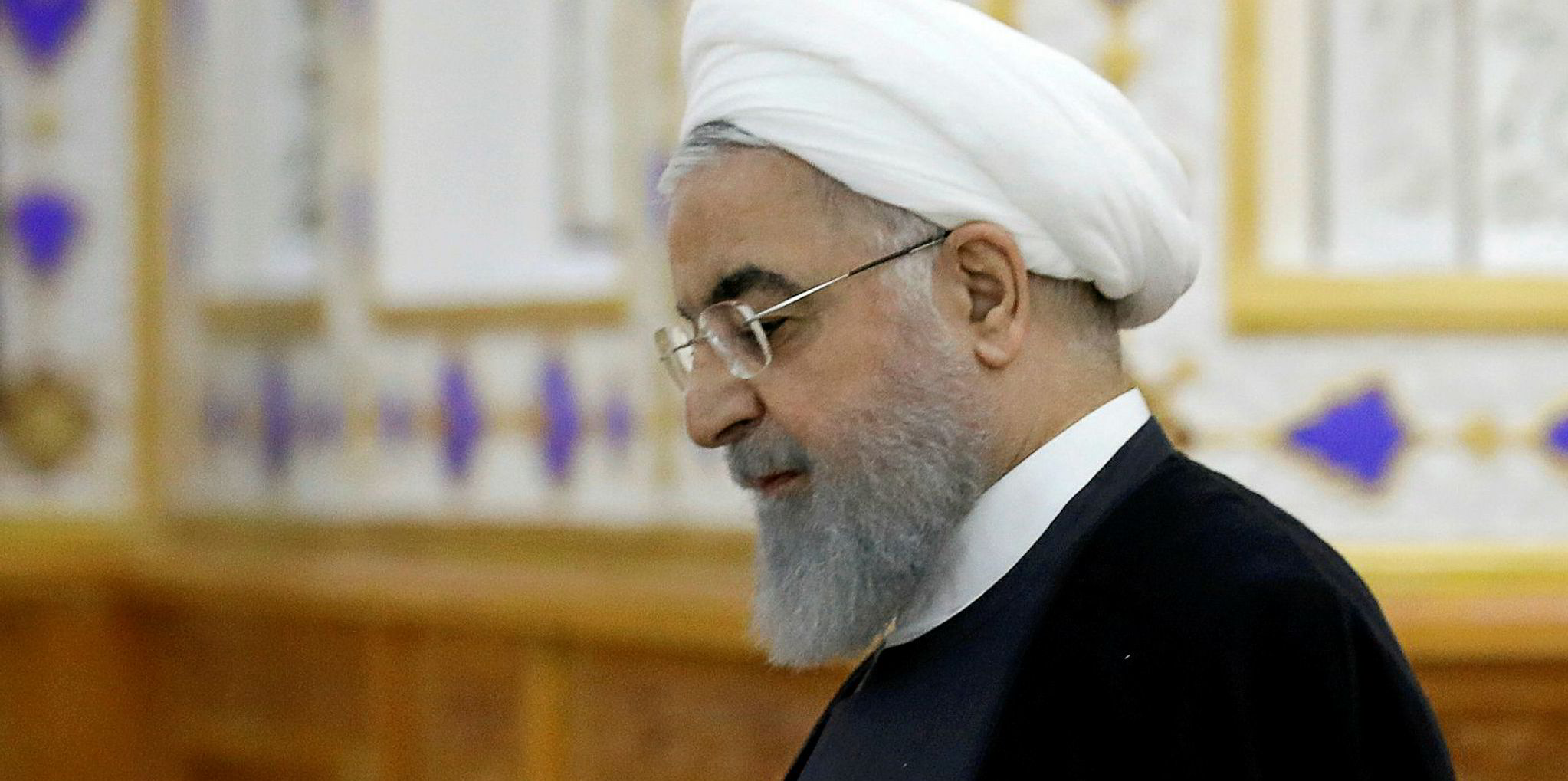
Oil price pressure: Iranian President Hassan Rouhani Photo: REUTERS/SCANPIX
OPINION: The epic oil price slump, if prolonged, is bound to prove calamitous for the upstream sector of the financially strapped Middle Eastern and North African producers and those with high production costs.
The consequences will go beyond the energy sector for the more populous nations, where autocratic governments have long used oil windfalls to shield themselves from social unrest through generous handouts and subsidies.
World Bank warning
“As the world struggles with the fear of recession, the Middle East and North Africa could be the hardest hit by what is arguably a perfect storm: the coronavirus spreads to the region and oil prices collapse,” the World Bank says.
“If the decline in oil prices persists, it will erode the fragile macroeconomic and social stability of countries, especially in the Middle East and North Africa, that have been hit by the novel coronavirus.”
Only the wealthy Persian Gulf producers with small populations — such as Qatar, Kuwait and the United Arab Emirates — can be expected to weather a prolonged storm thanks to their enviable financial position.
Iran position precarious
The major losers will primarily be Iran as well as Iraq, Libya Algeria, Oman, and Saudi Arabia.
Iran, whose economy is being seriously squeezed by unprecedented US sanctions against its vital oil sector, will find itself struggling to pay for basic imports as the price collapse will further reduce income from the crude sales achieved through circumventing the stifling sanctions.
Iran’s exports have fallen to a fraction of the 2.5 million barrels per day that the Islamic Republic used to export before May 2018, when US President Donald Trump tore up the landmark 2015 nuclear agreement and imposed draconian punitive measures against the country.
The Iranian Central Bank has just put out an international distress call amid rising cases of the coronavirus outbreak by asking the International Monetary Fund (IMF) for $5 billion in emergency funds to cope with containment.
Iran is fast becoming the global epicentre of the endemic, with more than 500 dead and 11,000 afflicted.
Severe economic problems have led to widespread unrest in the past two years, with the clerical leadership employing heavy-handed tactics to quell dissent.
Iraq set to suffer
Neighbouring Iraq is in the grip of growing political unrest with protesters demanding jobs and end to endemic corruption.
Iraq, Opec’s second-biggest producer, has been without a functioning government for months, disrupting planning and delaying major upstream projects.
Rising tensions between the US and Iran — both of which are fighting for influence in Iraq — have added to the security and political woes.
Algeria, often seen as a hostile destination for international oil companies, will find it difficult to attract fresh investment in the face of the price collapse and social unrest.
Algeria’s Prime Minister Abdelaziz Djerad said the North African country is faced with an unprecedented “multi-dimensional crisis”, while also urging the public to make fewer demands of the government and reduce their presence on the streets.
Libya’s civil war, which has crippled the oil industry, is showing no signs of ending.
Oman has so far been spared social unrest but the future remains bleak since the Persian Gulf sultanate has the highest production costs among regional producers because the bulk of its oil production is ultra-heavy heavy, which needs robust commodity prices in order to compete with other blends.
The oil price rout, arising from the collapse earlier this month of Opec+ talks to persuade Russia to agree to new production curbs, is also a real threat to Saudi maverick ruler Crown Prince Mohammed bin Salman, who has pinned his success as the future king on delivering on an ambitious economic diversification scheme funded by oil money.
An international research group has analyzed the visual impact of PV facades on buildings which include crop cultivation. Architects, PV specialists and farmers were surveyed and the results showed broad acceptance of such projects. The ‘vertical farming’ survey generated suggestions for the design of productive facades. So here is Raising crops in PV facades of buildings by Emiliano Bellini.
The researchers conducted anonymous 10-minute, multiple-choice web surveys in English with 15 questions. The group also provided images of four variants of productive facade, with respondents asked to rate their architectural quality on a scale of one to five.
The questions addressed topics including the visual impact of PV modules and crops, preferences about the arrangement of PV modules and ease of operation for owners and workers. Around 80% of the 97 respondents were architects with the remainder engineers, PV specialists, productive facade experts, horticulturalists, solar facade professionals, consultants and other professionals.
Architectural concerns
The results indicated architects and designers gave low ratings to all four of the designs presented and rated the design of PV installation poor. However, respondents with experience in horticulture, farming and PV facades showed stronger acceptance of building-integrated productive facades. “All groups of experts agree that PFs have the most positive effect on the exterior facade design and have accordingly graded them with higher marks than the designs without PV and VF [vertical farming] systems,” the paper noted.
Concerns were expressed by almost all respondents about the logistics of crop cultivation and irrigation near electronic devices such as the vertical solar modules.
“Several comments recommended exploring more creative designs,” the researchers added.
The lowest rating – 2.84 – was given to a productive facade with only PV modules visible from the inside. The highest mark – 3.9 – was scored by the image in which only plants were visible.
Tips for developers
The study also generated recommendations for the improvement of productive facade prototypes. “It should be noted that the selection of elements for practical application cannot be made based on a single isolated PF element – the entire building should be considered, especially the aesthetic elements of the building envelope, such as composition, proportion, rhythm, transparency, scale, colors and materials,” the researchers stated.
The study’s authors recommended the installation of the PV systems on north and south-facing facades, with ceiling level a preferable location.
Tilt angles of less than 20 degrees were suggested as a better aesthetic solution which would also avoid reflection onto neighboring buildings. “However, a well-designed integration of the PV modules with the planter of the above storey provides additional advantages – it improves the quality of indoor daylight and obstructs the view from inside to a lesser degree,” the study stated.
The researchers added copper indium gallium selenide (CIGS) panels were preferred to crystalline silicon modules, due to their more homogeneous structure.
Emiliano Bellini
Emiliano joined pv magazine in March 2017. He has been reporting on solar and renewable energy since 2009.
We often treat the decisions to find alternative ways of living more sustainably and to pursue political resistance against big polluters and inactive governments as separate. But our recent research found that the relationship between alternatives and resistance is really far more complex. One can often lead to the other.
Previous studies have shown that taking individual responsibility for the environment or developing green alternatives often go hand in hand with political action. Our research suggests that this relationship can form over time, and that when people change their lifestyles for environmental reasons this can galvanise their political action more generally. But we also found that this doesn’t always happen and that bringing the two together can be difficult.
Our first study, carried out with Soetkin Verhaegen of UCLouvain in Belgium, looked at the environmental actions of a group of over 1,500 politically interested Belgians between 2017 and 2018. We found that citizens who took individual actions such as buying ethical products, changing how they travelled or producing their own food or energy, became more politically active over time. This included interacting with political institutions (for example, contacting elected politicians) and other actions such as taking part in protests.
Our research suggests that taking individual responsibility for the environment increases your concern for it, which in turn motivates you to participate in other forms of action. While the effect was quite small, this seems to be good news for environmental movements. It shows that when people (at least the politically interested ones) can be motivated to adopt modest lifestyle changes, they can, in turn, become politically active in more a general sense.
Yet on a practical level, trying to encourage both individual alternatives and political resistance isn’t easy, as we found in our study of two organisations promoting local food and energy systems in Manchester in the UK. As well as having limited time, the organisations found political activism sometimes conflicted with their aim of promoting alternative lifestyle projects to the broadest possible audience. As one interviewee put it: “If we’re trying to influence the uptake of solutions, then being seen as the opposition … isn’t particularly productive.”
However, we’ve also seen how bringing alternatives and resistance together can be done, and that its success can depend on location. In a series of in-depth interviews with environmental organisers in Bristol, we found the activists strongly benefited from their city’s compact size and layout (when compared to Manchester). Being more likely to bump into people from other activist groups means that, according to one interviewee, “your socialising is political”.
The result was that activists in Bristol were better at maintaining relationships between different groups and at keeping the social side of activism going than in Manchester. This enabled a crossover of participants between the alternatives and resistance sides of the movement.
Some started growing their own food and ended up defending their allotments against urban developments. Others who were initially protesting against supermarkets ended up in a food-growing scheme.
Pursuing alternatives also helped sustain the resistance activities. This was both because the alternatives often involved a more positive experience and because they made it easier to point to viable solutions during environmental protests.
Increasing involvement
So from a campaigner’s point of view, there’s little evidence that promoting alternative lifestyle choices and political resistance are mutually exclusive. In fact, in many cases the two feed into each other in positive ways, especially in the form of spillover from participation in one form of action to another.
The effect we found was quite small and spillover will certainly not happen automatically. But that suggests there’s an important role for organisers to stimulate it further. Different organisations are needed to provide both personal and political activities and encourage more (and more diverse) people to get involved.
For most ordinary people concerned, the debate over the effectiveness of taking individual responsibility for the environment is likely to continue. Our research at least suggests that people motivating each other to take personal action doesn’t undermine a broader environmental project. But it’s still important for people to discuss what other action is needed, and to look for or even organise ways to put pressure on powerful actors to take their responsibility.
At its December 2019 12th edition in Dubai, the Arab Strategy Forum affirmed that a Second Great Recession highly unlikely: Report. This gathering run under the theme of ‘Forecasting the Next Decade 2020-2030’ concluded that after all, it’s business as usual with no ad-hoc surprises at all.
DUBAI — The global economy is not likely to witness another Great Recession-style collapse, despite several indicators to the contrary in recent months, according to a newly-published report by the Arab Strategy Forum in partnership with Good Judgement Inc., the world’s leading geopolitical and economic forecasting institution.
Global Growth
Titled ‘11 Questions for the Next Decade’, the wide-ranging and far-reaching findings and themes of the report, will be discussed in depth by former ministers, decision-makers and politico-economic thought leaders, including former US Vice President Dick Cheney, at the 12th edition of the annual Arab Strategy Forum in Dubai on Dec. 9 at the Ritz Carlton, Dubai International Financial Centre.
The ‘state of the world’ style report– tackles 11 vital mega-trends and questions that will define the global social, political and economic landscape in the 10 years ahead. Unlike previous editions, this year’s report looks to predict the future leading up to 2030 – a crucial time for many Middle Eastern economies whose visions are set to come to fruition by that year.
‘11 Questions for the Next Decade’ analyses 11 major political and macro-economic situations – or ‘mega-trends’ as the report terms them – and their likely consequences to determine where the world is headed, come 2030. Topics covered range from the global recession to the fragmentation of superpowers and Brexit to the Iranian regime and America’s anticipated fall from dominance, to the emerging US-China tech war and the prospective ‘splinternet’, water scarcity in the region and the growing crop of gas fields in the East Mediterranean region.
Qualitative and quantitative feedback and data was garnered for the report’s 11 sections following rounds of discussions on Good Judgement’s online platform, with a series of ‘ignition questions’ posed to ‘Superforecasters’ – 150 experts from diverse backgrounds, such as political scientists, economics researchers, scholars, and subject-matter experts in professions ranging from finance to intelligence, to management and medicine. The ignition questions for each topic seek answers to the issues at the heart of major economic change in the years ahead. The Superforecasters’ answers serve as indicators and monitors of predicted change based on the outlined global mega-trends.
Mohammad Abdullah Al Gergawi, President of the Arab Strategy Forum, said: “The report provides answers to the most pressing questions today, these outcomes will have a significant impact on regional and global policies. It explores a range of scenarios that will support the decision-makers of today and tomorrow to guide progress and prosperity for generations to come.
“Unlike previous years, this year’s reports predict the future of the region and the world over the next decade in the context of the current events that will have a major impact. They provide an up-to-date analysis of the increasing need for decision-makers to understand future scenarios on which to base their plans.”
As the world’s first platform for forecasting geopolitical and economic events, both regionally and globally, and targeting the most influential leaders and decision-makers in the Arab world and beyond, the Arab Strategy Forum will provide invaluable insights from the world’s foremost thought leaders on the crucial topics addressed in the report and elsewhere. Below is a list of the mega-trends, their related ignition questions, and a brief summary of the findings from the ‘11 Questions for the Next Decade’ report.
• Will the world avoid another Great Recession through 2030?
Based on current global economic performance records and data from the last 100 years of economic cycles, the report sought to find out whether the next recession will be a repeat of the Global Financial Crisis / Great Recession (2007-2009) or whether we are likely to see a return to an earlier pattern of a brief economic downturn followed by resurgent and steady growth.
The report’s Superforecasters said there is a 76 per cent chance that the world will not undergo another global financial crisis similar to the one in 2007 in the next decade, citing central banks’ improved technological ability to adapt and steer skidding economies out of difficulty. In their analysis of the last 100 years’ of business cycles, the Superforecasters concluded that the Great Recession was an outlier rather than the expected norm.
• Will China, Russia, or a G7 country leave the World Trade Organization by 2030?
Considering the emerging tendency of two, or a group of countries, setting out to establish new regional trading systems, such as the US-backed Trans-Pacific Partnership or the Russian-backed European-Asian Economic Union, the report noted that such new trading entities pose a populist threat to long-established global trading systems.
It goes on to rule out the possibility of China, Russia or one of the G7 countries withdrawing from the World Trade Organization by 2030, as doing so would cost more than the gains are likely to be worth in the long run. However, considering the relentless pressure on the WTO in the face of populism, the post-World War II trading body faces a big challenge in maintaining its status and platform in the next 10 years.
• Will China, Russia, the US, or the EU lose 0.5% or more of its territory or population before 2030?
After the fall of empires in the 20th century, the question lingers over whether countries and blocs will fragment in the 21st century. The Superforecasters anticipate a 5% likelihood that the EU will lose 0.5% or more of its territory or population before 2030, a 2% likelihood that Russia or China will, and 1% likelihood that the United States will. Though the uncertainties and problems hanging over the United Kingdom are mainly considered ‘peaceful’, market volatility and decreased consumer confidence could have an impact on the EU’s territory and population in the next decade. The Superforecasters also said that a split or fragmentation in China or Russia, will only occur through a violent disruption.
• Will the US economy be ranked 1st, 2nd or 3rd in 2030?
Despite being the largest economy in the world since the beginning of the 20th century, the US’s position as the world’s number one is under threat from the formation of a multipolar system and the emergence of several countries and regions that contribute today to the international community.
The report claims that there is a 65 per cent chance that the US will still be the world’s largest economy a decade from now, and a 33 per cent likelihood it will be second, after China.
The most prominent countries competing with the United States, in terms of nominal GDP, the report adds, are China, the European Union bloc, and India. And, as the US economy shrinks to the size of other countries, it will be less able to influence other nations of the world.
• Will OPEC’s share of global crude oil production remain above 33% in 2030?
The Organization of Petroleum Exporting Countries (OPEC) currently holds a share of about 40 per cent of the world’s crude oil production. But the future of the organization and its domination is likely to be called into question, with the emergence of hydraulic fracturing and new oil discoveries outside the Middle East and North Africa.
There is a 90 per cent chance that OPEC will supply more than a third of the world’s crude oil supply in 2030. However, its fiscal revenue is likely to result in a decline in its production. Given its resilience and adaptation to multiple challenges in past decades, including wars, revolutions and global recessions, the organization is viable in a carbon-free world, but new and innovative adaptation measures are needed later, the report pointed out.
Cyberattacks
• Will a cyberattack shut down a major infrastructure system in a G7 country for 1+ days before 2030?
The Superforecasters see a 66 per cent likelihood of a cyberattack shutting down a major infrastructure system in a G7 country for at least one day before 2030. Outside of the G7, there are countries perhaps more vulnerable. “It will be worth monitoring these situations as harbingers of larger-scale attacks elsewhere. For instance, in the Philippines, government hearings recently raised concerns that China could remotely ‘turn off power’ in the country,” the report noted.
• Will Lebanon be involved in a major military conflict by 2030?
After the discovery of the East Mediterranean gas fields off the coast of Cyprus, Lebanon and Egypt, questions have arisen over whether the East Mediterranean gas fields will enhance the stability of the region or pose a security risk. The report said there’s a risk that offshore gas fields could escalate tensions between nations over disputed drilling rights, but potential energy revenues are worthwhile, and will lead to a strengthening of the region’s economic stability, as well as the internal stability of the concerned countries and reduce risks of war.
• Will water scarcity cause a deadly conflict between Jordan & Israel, Egypt & Ethiopia, or Turkey & Iraq before 2030?
Water scarcity is unlikely to drive any regional conflict in the MENA region over the next decade, the report stated. There is a small, 1 per cent chance of a conflict on the flow of water between Jordan and Israel, according to the Superforecasters. Meanwhile, the chance of a conflict between Egypt and Ethiopia or Turkey and Iraq during the next decade will reach 3per cent.
• China-US tech war and peace
Will a ‘splinternet’ – with one Internet led by the US and one led by China – be avoided as of 2030?
The Superforecasters offer an 80 per cent chance that a ‘splinternet’ – one Internet led by the United States and one led by China — will not be in place by 2030. “Information will continue to flow across global networks, even as other types of political or ideological information will be blocked,” the report pointed out.
John Scales Avery – TRANSCEND Media Service in explaining Why Climate Is an Emergency recommends that Fossil fuels must be left in the ground. Forests must be saved from destruction by beef or palm oil production.
The central problem which the world faces in its attempts to avoid catastrophic climate change is a contrast of time scales. In order to save human civilization and the biosphere from the most catastrophic effects of climate change we need to act immediately. Fossil fuels must be left in the ground. Forests must be saved from destruction by beef or palm oil production.
These vitally necessary actions are opposed by powerful economic interests, by powerful fossil fuel corporations desperate to monetize their underground “assets”, and by corrupt politicians receiving money from the beef or palm oil industries.
However, although some disastrous effects of climate change are already visible, the worst of these calamities lie in the distant future. Therefore it is difficult to mobilize the political will for quick action. We need to act immediately, because of the danger of passing tipping points beyond which climate change will become irreversible despite human efforts to control it.
Tipping points are associated with feedback loops, such as the albedo effect and the methane hydrate feedback loop. The albedo effect is important in connection with whether the sunlight falling on polar seas is reflected or absorbed. While ice remains, most of the sunlight is reflected, but as areas of sea surface become ice-free, more sunlight is absorbed, leading to rising temperatures and further melting of sea ice, and so on, in a loop.
The methane hydrate feedback loop involves vast quantities of the powerful greenhouse gas methane, frozen in a crystalline form surrounded by water molecules. 10,000 gigatons of methane hydrates are at present locked in Arctic tundra or the continental shelves of the world’s oceans. Although oceans warm very slowly because of thermal inertia, the long-term dangers from the initiation of a methane-hydrate feedback loop are very great. There is a danger that a very large-scale anthropogenic extinction event could be initiated unless immediate steps are taken to drastically reduce the release of greenhouse cases.
The World Is on Fire!
“The world is on fire!” says Swedish climate activist Greta Thunberg. She is right. California is burning. The Amazon is burning. Indonesia is burning. Alaska is burning. Siberia is burning. These fires have been produced partly by the degree of climate warming that has already occurred, and partly by human greed for profits, for example from beef production or palm oil.
Speaking at the opening ceremony of the UN climate conference COP24, the universally loved and respected naturalist, Sir David Attenborough, said:
“If we don’t take action, the collapse of our civilizations and the extinction of much of the natural world are on the horizon.”
Sir David’s two-part program, “Climate Change: The Facts” is currently being broadcast by BBC Earth. Hopefully, this important documentary film, like Leonardo DiCaprio’s excellent film “Before the Flood”, can do much to mobilize public opinion behind the immediate action that is needed to save the long-term future of human civilization and the biosphere.
Recently more than 7 million young people in 150 countries took part in strikes aimed at focusing public opinion on the need for rapid climate action. The Extinction Rebellion movement, which started in the UK, has now spread to many countries, and is also doing important work. In the United States, popular political figures such as Bernie Sanders and Alexandria Ocasio-Cortez are doing much to mobilize public opinion behind the Green New Deal and much to counteract Donald Trump’s climate change denial.
The Remarkable Properties of Exponential Growth
Positive feedback loops occur when the presence of something leads to the generation of more of the same thing. For example in the presence of an unlimited food supply, the growth of a population will lead to more individuals reaching reproductive age, and hence an accelerated growth of the population. This type of relationship leads to the mathematical relationship known as exponential growth.
Exponential growth of any quantity with time has some remarkable characteristics, which we ought to try to understand better, since this understanding will help us to predict the future. The knowledge will also show us the tasks which history has given to our generation. We must perform these tasks with urgency in order to create a future in which our descendants will be able to survive.
If any quantity, for example population, industrial production or indebtedness, is growing at the rate of 3% per year, it will double in 23.1 years; if it is growing at the rate of 4$\%$ per year, the doubling time is 17.3 years. For a 5% growth rate, the doubling time is 13.9 years, if the growth rate is 7% (the rate of economic growth that China’s leaders hope to maintain), the doubling time is only 9.9 years. If you want to find out the doubling time for any exponentially growing quantity, just divide 69.3 years by the growth rate in percent.
Looking at the long-term future, we can calculate that any quantity increasing at the modest rate of 3% per year will grow by a factor of 20.1 in a century. This implies that in four centuries, whatever is growing at 3% will have increased by a factor of 163,000. These facts make it completely clear that long-continued economic growth on a finite planet is a logical absurdity. Yet economists and governments have an almost religious belief in perpetual economic growth. They can only maintain this belief by refusing to look more than a short distance into the future.
Exponential decay of any quantity follows similar but inverse rules. For example, if the chance of a thermonuclear war will be initiated by accident or miscalculation or malice is 3% in any given year, the chance that the human race will survive for more than four centuries under these conditions is only1 in 163,000, i.e. 0.000625 percent. Clearly, in the long run, if we do not completely rid ourselves of nuclear weapons, our species will have no hope of survival.
Besides nuclear war, the other great threat to the survival of the human species and the biosphere is catastrophic climate change. The transition to 100% renewable energy must take place within about a century because fossil fuels will become too rare and expensive to burn. But scientists warn that if the transition does not happen much faster than that, there is a danger that we may reach a tipping point beyond which feedback loops, such as the albedo effect and the methane hydrate feedback loop, could take over and produce an out-of-control and fatal increase in global temperature.
In 2012, the World Bank issued a report warning that without quick action to curb CO2 emissions, global warming is likely to reach 4 degrees C during the 21st century. This is dangerously close to the temperature which initiated the Permian-Triassic extinction event: 6 degrees C above normal. During the Permian-Triassic extinction event, this occurred 252 million years ago. In this event, 96 percent of all marine species were wiped out, as well as 70 percent of all terrestrial vertebrates.
Is a quick transition to 100% renewable energy technically possible? The technology is available, remarkable characteristics of exponential growth can give us hope that it can indeed be done, provided that we make the necessary effort. Governments currently give enormous subsidies to fossil fuel industries. These must be stopped, or better yet, shifted to subsidize renewable energy. If this is done, economic forces alone will drive the shift to renewable energy. The remarkable properties of exponential growth can give us hope that the transition will take place rapidly enough to save the future of our planet from the worst effects of climate change.
Feedback Loops and Ethics
All of the major religions of the world contain some version of the Golden Rule,
“Do unto others as you would have them do unto you”.
In Christianity, there is a striking passage from the Sermon on the Mount:
“Ye have heard that it hath been said, Thou shalt love thy neighbour, and hate thine enemy. But I say unto you, Love your enemies, bless them that curse you, do good to them that hate you, and pray for them which despitefully use you, and persecute you.”
This seemingly impractical advice, that we should love our enemies and do good to them, is in fact extremely practical. It prevents the feedback loops of revenge and counter-revenge that we see so often in today’s conflicts. In fact, if nations that claim to be Christian really followed this commandment, their participation in war would be impossible. Conflicts can be prevented by unilateral acts of kindness.
Feedback Loops and the Information Explosion
In 1965, the computer scientist Gordon E. Moore predicted that the number of components per integrated circuit would increase exponentially for the next ten years. In 1975, he revised his growth rate to correspond to a doubling time of every two years. Astonishingly, Moore’s Law, as this relationship has come to be called, has proved to be valid for much longer than he or anyone else believed would be possible.
Moore’s Law is an example of the fact that the growth of knowledge feeds on itself. The number of scientific papers published each year is also increasing exponentially. This would be all to the good, if our social and political institutions matched our technology, but because of institutional and cultural inertia, the exponentially accelerating rate of technical innovation is threatening to shake human society to pieces. We need new global institutions of governance and new global ethics to match our new technology.
John Scales Avery, Ph.D., who was part of a group that shared the 1995Nobel Peace Prize for their work in organizing the Pugwash Conferences on Science and World Affairs, is a member of the TRANSCEND Network and Associate Professor Emeritus at the H.C. Ørsted Institute, University of Copenhagen, Denmark. He is chairman of both the Danish National Pugwash Group and the Danish Peace Academy andreceived his training in theoretical physics and theoretical chemistry at M.I.T., the University of Chicago and the University of London. He is the author of numerous books and articles both on scientific topics and on broader social questions. His most recent books are Information Theory and Evolution and Civilization’s Crisis in the 21st Century (pdf).
We use cookies on our website to give you the most relevant experience by remembering your preferences and repeat visits. By clicking “Accept”, you consent to the use of ALL the cookies.
This website uses cookies to improve your experience while you navigate through the website. Out of these cookies, the cookies that are categorized as necessary are stored on your browser as they are essential for the working of basic functionalities of the website. We also use third-party cookies that help us analyze and understand how you use this website. These cookies will be stored in your browser only with your consent. You also have the option to opt-out of these cookies. But opting out of some of these cookies may have an effect on your browsing experience.
Necessary cookies are absolutely essential for the website to function properly. This category only includes cookies that ensures basic functionalities and security features of the website. These cookies do not store any personal information.
Any cookies that may not be particularly necessary for the website to function and is used specifically to collect user personal data via analytics, ads, other embedded contents are termed as non-necessary cookies. It is mandatory to procure user consent prior to running these cookies on your website.



You must be logged in to post a comment.