Generative AI-Powered Forecasting for Urban Growth

Generative AI-Powered Forecasting for Urban Growth

Aerial view of wind turbines in a vast desert landscape under a clear blue sky. by Kelly via pexels

.

Generative AI-powered forecasting for sustainable urban development


construction site

Researchers introduce a novel generative AI-driven framework, MMCN (Memory-aware Multi-Conditional generation Network), for forecasting future urban layouts by jointly considering building density, building height, transportation networks, and historical development patterns.

Leveraging a generative architecture-enhanced diffusion model with multi-conditional control, semantic prompt fusion, and spatial memory embedding, MMCN offers a novel approach to modeling complex urban evolution. This framework provides a powerful tool to explore sustainable urban development, demonstrating AI’s transformative potential in urban design.

Environmental sustainability in urbanization has become a critical global concern as cities expand at unprecedented rates. Urban design faces the challenge of making long-term decisions about infrastructure, building development, transportation networks, and land use, all of which shape the future structure and sustainability of cities.

These decisions are inherently complex, as urban growth emerges from the interaction of multiple factors, including building density, building height, road networks, and historical development patterns, which evolve together over time. Traditional urban design methods often struggle to capture these interconnected dynamics, making accurate forecasting of urban development impossible.

In response to this challenge, artificial intelligence (AI) has emerged as a promising tool for modeling complex spatial patterns and supporting data-driven urban planning. Yet, many existing generative AI-based models produce fragmented predictions because they may have difficulty effectively integrating multiple urban development factors or maintaining spatial continuity across large areas.

To address these limitations, researchers at the Japan Advanced Institute of Science and Technology (JAIST) and Waseda University, Japan, developed a novel AI-driven framework called the Memory-aware Multi-Conditional generation Network (MMCN).

The research team was led by Associate Professor Haoran Xie (JAIST and Waseda University) and included Doctoral Student Xusheng Du from JAIST and Professor Zhen Xu from Tianjin University, China, among others.

Their study was published in Sustainable Cities and Society.

Explaining the motivation behind the study, Dr. Xie said, “We aimed to bridge the gap between current AI capabilities and the practical needs of urban planners by developing a predictive model capable of forecasting future urban layouts while simultaneously considering multiple urban development factors and historical evolution patterns, as inspired by the actual decision-making workflow from professional planners.”

The MMCN model relies on multi-temporal spatial data, including building layouts, building density, building height, and transportation networks, which were standardized into 512 × 512-pixel patches for model training. In particular, this model adopted the urban layout data of Shenzhen due to it being the most rapidly developing city in China.

The network architecture combines a diffusion model with a multi-conditional control mechanism, allowing diverse urban factors to guide the generation process. A semantic prompt fusion module encodes information from each input type, while a spatial memory embedding component preserves contextual information from neighboring regions, ensuring continuity across patches.

Multiple conditional generation branches integrated with the diffusion model form the core generative model, enabling the production of realistic, coherent urban layouts that remain consistent with historical patterns.

Data training uses denoising and edge-stitching loss functions to enhance reconstruction accuracy and smooth transitions across patch boundaries. This approach allows MMCN to model complex interactions among urban variables and generate spatially consistent forecasts of urban development.

Experimental results demonstrated the framework’s effectiveness. MMCN outperformed baseline methods such as Pix2Pix, CycleGAN, and Instruct-Pix2Pix, achieving a Structural Similarity Index (SSIM) of 0.885 and a Boundary Intersection over Union (IoU) of 0.642, indicating strong structural fidelity and spatial continuity.

Qualitative analysis further confirmed that MMCN generates realistic, coherent urban layouts with continuous road networks and well-organized building clusters, whereas baseline models often produce fragmented roads, duplicated structures, or disconnected patterns.

These findings highlight the importance of combining multi-factor conditioning, spatial memory mechanisms, and learning from historical patterns within a unified generative framework. Additional cross-city experiments using data from Shanghai and Tianjin in China further demonstrated the model’s ability to produce stable and consistent urban layout predictions under diverse spatial conditions.

Beyond technical performance, MMCN offers practical benefits for urban design. By simulating potential growth scenarios, the framework allows planners to evaluate the long-term consequences of development strategies, supporting more informed and sustainable decisions. This aligns with the Sustainable Development Goals, particularly those focused on creating resilient and inclusive cities.

Looking ahead, the researchers envision several enhancements. Integrating climate models could enable assessment of environmental impacts, while including socio-economic data, could support more comprehensive forecasts.

“Interactive planning tools built on MMCN could facilitate community and stakeholder engagement in urban design, promoting collaborative planning,” said Dr. Xie. He added, “Expanding the dataset to include cities with diverse morphologies would improve the model’s generalizability, making it applicable across different urban contexts worldwide.”

In conclusion, MMCN represents a significant advancement in AI-assisted urban design, offering a novel approach to forecasting urban layout evolution by integrating multiple spatial factors and historical patterns.

By producing accurate, spatially coherent predictions, it provides a powerful tool for guiding cities toward more resilient, livable, and sustainable futures in an increasingly urbanized world.

.
More information

Xusheng Du et al, AI-driven urban evolution forecasting: A unified memory-aware multi-conditional generation framework for sustainable development planning, Sustainable Cities and Society (2026). DOI: 10.1016/j.scs.2026.107272

Key concepts

Machine learning methodologies  AI in built environment

.

.


.


World Engineering Day for Sustainable Development 2026

World Engineering Day for Sustainable Development 2026

Scientist in lab coat handling samples in a research facility, focusing on sustainable practices. by ThisIsEngineering via pexels

.

World Engineering Day for Sustainable Development 2026 features Omantel as an official partner

.

Contributed by: Presswire

24 March, 2026

Presswire associated0

[PRESSWIRE] London, UK – 24 March, 2026 — Omantel has been named as an official partner for World Engineering Day for Sustainable Development (WED) 2026, the annual initiative highlighting the essential role that engineers and engineering plays around the world.

As a pioneer in telecommunications, Omantel plays a key role in developing inclusive and more environmentally friendly communications technology not just in Oman, but further afield.

“Technology must create real value for people and the communities it serves,” says Lujaina Al Kharusi, VP of Governance, Regulatory and Compliance at Omantel. “Engineering is fundamental to that progress, enabling stronger connectivity, smarter services and resilient digital infrastructure. Sustainable development, however, depends on how responsibly and collaboratively these capabilities are applied. As Oman advances its digital transformation in line with Vision 2040, our responsibility is to build intelligent networks that support inclusive growth and long-term economic resilience. We are proud to partner with World Engineering Day 2026 to recognise the engineers who turn innovation into meaningful impact for society.”

World Engineering Day launched in Jakarta, Indonesia, on 4 March 2026, marking the start of a year-long campaign of events, films, features and news. The focus of this year’s theme is “Smart engineering for a sustainable future through innovation and digitalisation”.

An official International Day, as proclaimed by UNESCO, WED is operated by the World Federation of Engineering Organisations (WFEO), the global body that spans members from more than 100 countries and represents over 30 million engineers worldwide.

WED 2026 provides governments, UN-associated organisations, policymakers, educators and leaders in the public and private sectors with the opportunity to raise awareness of the importance of engineering. All campaign content will be produced by SJH Studios – the official media partner and broadcaster for WED – and hosted on the official WED website at http://www.worldengineeringday.net.

Seng-Chuan Tan, President of the WFEO, says: “World Engineering Day brings together engineers, governments, academia, industries and individuals to exchange ideas, drive innovation and take meaningful action. Collaboration is essential – we must work together to transform innovative ideas into real-world impact. When we bring together different voices, perspectives and expertise, we create stronger, more sustainable solutions.”

Ludovica Bellomaria, SJH Group Director, Operations, says: “World Engineering Day is a unique opportunity for organisations to share the best of what the industry has to offer, so we’re excited to have Omantel providing their expertise in telecommunications as an official partner.”

To view Omantel’s WED content, visit: https://worldengineeringday.net/partner/omantel/

.


.

Why the damage to Qatar’s gas infrastructure matters

Why the damage to Qatar’s gas infrastructure matters

High angle view of offshore oil platforms in Ras Laffan, Qatar under clear blue sky. by Anoop VS via pexels

Here is why the damage to Qatar’s gas infrastructure matters as elaborated on Adi Imsirovic, University of Oxford. Put simply, any damage to Qatar’s gas infrastructure would push costs higher for years to come despite .

.

Why the damage to Qatar’s gas infrastructure could push costs higher for years to come


By  Adi Imsirovic, University of Oxford

.

Qatar’s Ras Laffan “energy city” was hit by Iranian strikes. PaPicasso/Shutterstock


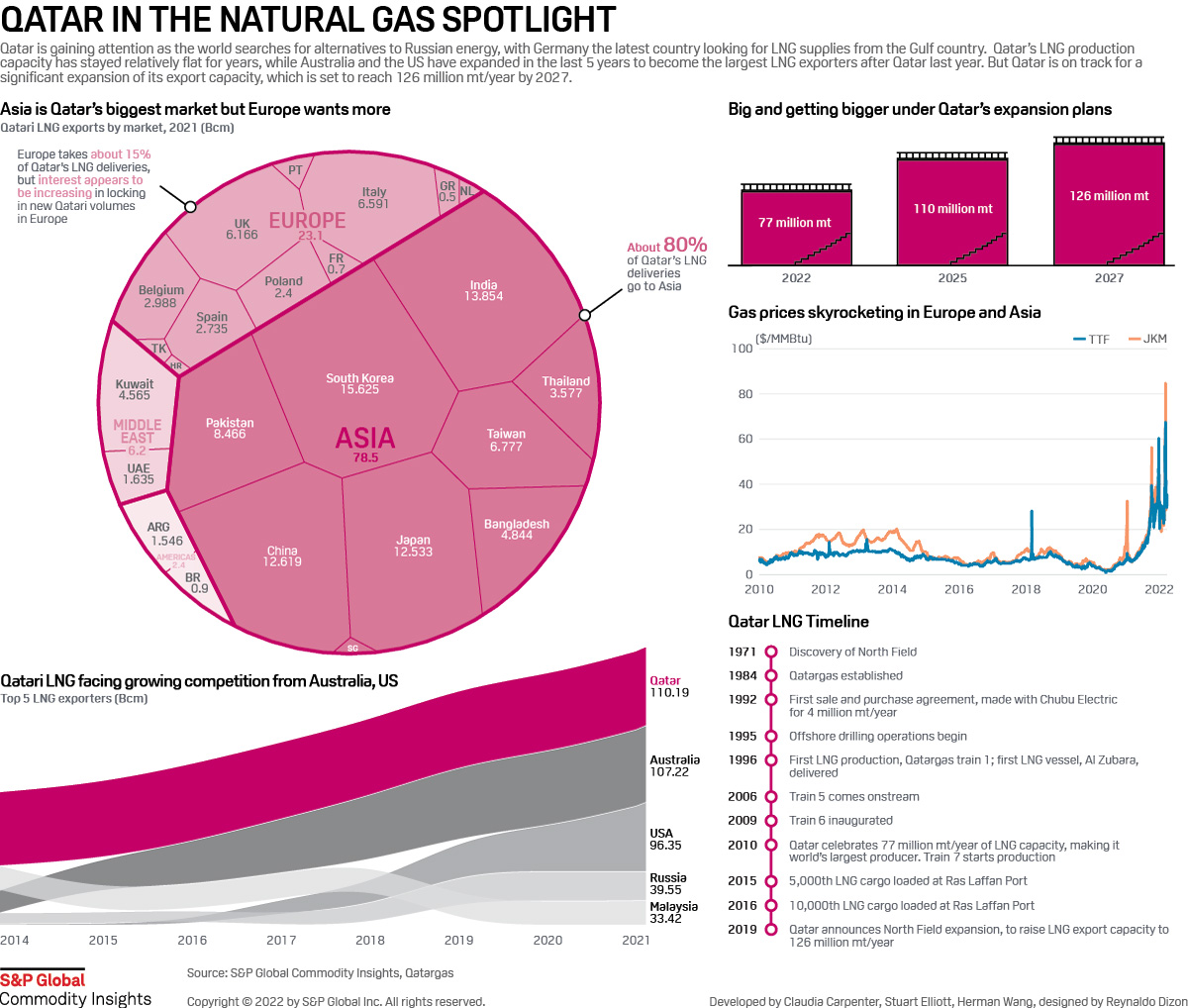
On March 19, Ras Laffan, the largest liquified natural gas (LNG) terminal in the world, supplying one-fifth of the world’s super-chilled fuel, was hit by Iranian missiles and drones. The Qatari terminal suffered substantial damage in the strikes – fires were raging across the gas-to-liquids facility within the complex, which covers 295 square kilometres – the size of a large city.

Investments worth tens if not hundreds of millions of dollars disappeared into thin air. Damage was estimated to be so extensive that QatarEnergy’s CEO, Saad Sherida al-Kaabi, said the company may have to declare a “force majeure” (non-fulfilment of orders due to circumstances outside their control) on long-term contracts. He said this could affect LNG supplies to Italy, Belgium, Korea and China “for up to five years”.

Similar to oil, gas exports from the Persian Gulf supplied about 20% of world demand. But gas (mostly methane) is a very different fuel from crude oil. To move it in liquified form, methane must be chilled to below -162°C.

But at these temperatures steel becomes brittle and shatters. So storing and transporting LNG in ships is expensive and very energy-intensive. Liquefaction and transportation of methane can easily consume 15% of the initial natural gas extracted.

It also means that the infrastructure that enables a highly flammable and explosive fuel to be handled at these extreme conditions has to be complex and consequently very expensive. Ras Laffan, for example, was built over decades and in several phases, costing tens of billions of dollars.

No quick fix

Interestingly, Qatar’s North Field and Iran’s South Pars gas field are part of the same massive geological structure, separated only by a maritime border in the Persian Gulf. Together, they form the world’s largest natural gas field.

So, Iran and Qatar are essentially exploiting the same gas reservoir the same way two people would use straws to drink from the same bottle. The US president, Donald Trump, now appears to have retreated from his threats to blow up “the entirety” of the Iranian gas field – but this geological fact had always made his comments quite ridiculous.

While Qatar exports most of its production, Iran uses the bulk of its gas domestically (although some exports go via pipeline to Turkey and Iraq).

But the damage to the complex has been done, and it affects some 17% of the country’s LNG infrastructure. Repairing it will take a long time, precisely because of the complexity of LNG projects.

The plant must be warmed up slowly before repairs and cooled down slowly after. Rapid temperature changes can cause pipes to bend or even snap. And parts of the plant are bulky and hard to transport. The main heat exchangers can be more than 50 metres long, and compressors, turbines and liquefaction trains can easily weigh 5,000 metric tonnes. Storage tanks must be built of special alloys with double walls and customised insulation.

In other words, gas is very different to oil. Recent events have shown just how vulnerable the LNG supplies from the Gulf region are. They are going to affect Asia most, as about three-quarters of Qatar’s LNG ends up there – particularly China, India, Taiwan, South Korea and Pakistan, as well as others.

Most of the rest ends up in Europe – Italy, Belgium, Poland and a small amount to the UK (the UK imported only about 1% of its supply from Qatar last year). The majority of the UK’s imports come from its own UK production in the North Sea and imports from Norway and the US.

However, LNG is a part of the global energy market and the shortfall in production will result in higher prices globally. Gas will end up with the highest bidder, while some nations will probably go back to using coal. This may especially be the case with India, Pakistan, Bangladesh and a few other Asian countries that are very sensitive to high fuel prices.

Some European countries may even see coal as a cheaper option. Following the events in the Gulf, this “spark spread” (the profit margin from gas-fired electricity generation) has fallen, narrowing the gap in Europe with the “dark spread” (profit from generating power using coal).

The benchmark for European gas prices, the Dutch Title Transfer Facility, has more than doubled since mid-January. Coal prices have picked up due to higher demand, but not as much. Unlike oil, the LNG shortage has turned from a logistical problem – the closure of the strait of Hormuz – into a structural one. The damage to the Qatari production facility may take several years to repair. This means that gas prices – already high – are likely to remain elevated for some time.The Conversation

Adi Imsirovic, Lecturer in Energy Systems, University of Oxford

This article is republished from The Conversation under a Creative Commons license. Read the original article.

The Conversation

.


.

Sustainable Breakthrough in Low-Cost Materials Innovations

Sustainable Breakthrough in Low-Cost Materials Innovations

A small plant sprouts in soil inside a light bulb, symbolizing eco-friendly and sustainable growth. by Singkham via pexels

.

Sustainable breakthrough in low-cost materials for next-generation energy harvesting

.

Peer-Reviewed Publication

University of Surrey

A new sustainable approach to energy harvesting could transform how wasted heat is turned into electricity, thanks to a breakthrough in low-cost, flexible materials developed by researchers at the University of Surrey’s Advanced Technology Institute (ATI).

Thermoelectric devices generate electricity from temperature differences, offering a way to capture large amounts of wasted energy from industrial processes, electronics and even the human body. This kind of energy harvesting is already used in some instances to power small sensors, wearable devices and Internet of Things (IoT) devices without batteries, but the most efficient materials used today are typically expensive, brittle and difficult to recycle.

In a new study, published in Advanced Energy and Sustainability Research, the research team outline a new way of designing thermoelectric materials using metal–polymer superlattices – ultra-thin layered structures that boost performance while avoiding the cost and environmental impact of conventional materials.

Researchers combined thin metal layers with a widely used organic polymer, called PEDOT:PSS – improving performance by up to 100 times compared to the base material. They also showed that by selecting different metals, they could control whether the material behaves as a p-type or n-type semiconductor – a key requirement for building practical thermoelectric devices.

James G. Neil, PhD Researcher and lead author of the study from the ATI at the University of Surrey, said:

“By understanding and controlling how charge moves through these layered materials, we’ve created a framework that significantly improves performance while keeping the system simple and scalable. This provides a new route for designing the next generation of organic thermoelectric materials.”

Professor Ravi Silva, Director of the ATI at the University of Surrey, said:

“This work opens a pathway toward low-cost, environmentally responsible thermoelectric devices that can be integrated into real-world systems – from wearable technologies to industrial low-grade heat energy recovery. It’s a step towards energy harvesting solutions that combine high performance with sustainability, perfectly aligned with the sustainable development goals.”

The research offers a scalable and more sustainable alternative to traditional thermoelectric materials, opening new possibilities for powering everyday devices and even future space missions. The findings also highlight the potential of combining advanced nanostructures with sustainable materials to help tackle global energy challenges – especially the urgent need to recover waste heat, given that roughly 80 per cent of global energy input is lost as low-grade waste heat.


Notes to editors 

Dahiyeh: The Beirut Suburb Under Military Fire

Dahiyeh: The Beirut Suburb Under Military Fire

Panoramic view of dense residential buildings along Jounieh’s waterfront in Lebanon, highlighting urban architecture. by Jo Kassis via pexels

.

Dahiyeh: the Beirut suburb at the heart of an Israeli military doctrine

.

John Nagle, Queen’s University Belfast and Edouardo Wassim Aboultaif, Université Saint-Esprit de Kaslik (USEK)

.

Dahiyeh: The Beirut Suburb Under Military Fire

Israeli airstrikes on the south Beirut suburb of Dahiye, March 9 2026.  EPA/Wael Hamzeh

.

Over the ten days of the renewed conflict in the Middle East, Beirut’s southern district of Dahiyeh has been targeted by Israel, which is looking to deal a knockout blow to Hezbollah.  It’s not the first time the area has been bombarded.  Dahiyeh was bombed by Israel during its 2006 war with Hezbollah, again in 2014 and yet again in 2024 and 2025.  Now the Israel Defense Forces is bombing the area again.

The attacks mark the return of a strategy first developed by the Israeli armed forces in Dahiyeh before becoming a military doctrine, bearing the name of the suburb.  The Dahiyeh doctrine is a military strategy that calls for using overwhelming and disproportionate force against civilian infrastructure in areas controlled by hostile armed groups in order to deter attacks on Israel. It has repeatedly put into practice in Gaza. Now the Dahiyeh doctrine is once again being enacted in the place where it was first conceived.

Dahiyeh is a Hezbollah stronghold. It became the main urban centre for Lebanon’s Shia population in the middle of the last century, as poor Shia families from Baalbek and southern Lebanon migrated to Beirut’s suburbs.

During the civil war between 1975 and 1990, Hezbollah established its urban base in the southern suburbs of Beirut.  Dahiyeh – the word means “suburb” – is the heart of Hezbollah’s political, social and service networks.  Which is why it has become a target for Israel’s military.

Byword for mass urban destruction

The doctrine was developed in the aftermath of the 2006 Lebanon war between Israel and Hezbollah.  Israel’s military leadership realised that Hezbollah had stalled their advance in urban combat.

To respond to this, the director of Israel’s Institute for National Security Studies (INSS), Gabi Siboni, a former senior IDF officer, wrote a paper in the INSS journal in October 2008, arguing for the use of overwhelming force against both fighters and the urban environment in which they operated and lived.

This was developed by the IDF into a working strategy. As Gadi Eisenkot, head of the army’s northern division, explained at the time: “What happened in the Dahiya quarter of Beirut in 2006 will happen in every village from which Israel is fired on. We will apply disproportionate force on it (the village) and cause great damage and destruction there.  From our standpoint, these are not civilian villages, they are military bases.  This is not a recommendation. This is a plan. And it has been approved.”


The primary goal of the doctrine was punishment and deterrence. The idea was to disrupt civilian life and make reconstruction almost impossible to afford. The doctrine’s architects hoped that its outcome would force the civilian population to rebel against the armed groups sheltering among them.

Siboni had made clear in his paper that this strategy was also applicable to Israel’s conflict in Gaza. In 2014, Operation Protective Edge targeted civilian infrastructure, including private houses as well as water, sanitation, electricity and healthcare facilities.  Again, after the October 7 Hamas attack on Israel, the IDF has applied the Dahiyeh doctrine in the Gaza Strip, this time destroying between 80% and 90% of its civilian infrastructure.

Critics argue this violates international humanitarian law (IHL). IHL demands that states and groups make a clear distinction between civilians and combatants. It is necessary for armed groups to take all precautions to avoid acts of extreme destruction in heavy civilian residential locations.

Ravina Shamdasani, spokesperson for the UN High Commissioner for Human Rights, has warned that the blanket evacuation orders directed at Dahiyeh’s population risk violating international humanitarian law, saying they risk amounting to “prohibited forced displacement”.  While Israeli strategists defend the doctrine as a means to defeat groups like Hezbollah, critics describe it as a template for handing out indiscriminate punishment to combatants and civilians alike.

What this means for Lebanon

The attacks on Dahieyh come at yet another fragile moment for Lebanon. The power-sharing government, led by the prime minister, Nawaf Salam, with the president, Joseph Aoun, as head of state, is still trying to implement economic reforms after the catastrophic 2019 financial collapse (estimated by the World Bank to be among the top three most severe economic crises globally since the mid-19th century). The latest round of conflict will severely set back the Lebanese government’s attempts to rebuild the economy.

Dahiyeh: The Beirut Suburb Under Military Fire Wrecked buildings in Dahiyeh, Beirut.

Repeat performance: Dahiyeh has regularly been a target for Israeli bombardment.  Before the past ten days, the most recent previous attack was in 2025. EPA/Wael Hamzeh

The brunt of Israel’s assault on Lebanon is being felt in Dahiyeh. UN officials had estimated that the latest Israeli evacuation orders have forced at least 100,000 people to leave the area for shelters across Lebanon.

So far, the Lebanese government’s response is to try to pull Hezbollah back from yet another drawn-out war with Israel. On March 2, Aoun formally banned Hezbollah from engaging in military activities and ordered the group to surrender its weapons to the Lebanese army. The government has also postponed the legislative election scheduled for May 2026 by two years.

The Lebanese government has put forward a four-point plan and called for an Israeli ceasefire to allow negotiations to proceed. The plan calls for “establishing a full truce” with Israel, the disarmament of Hezbollah and direct negotiations with Israel “under international auspices”.

But the international community seems incapable of applying any pressure to change the situation in Lebanon. As of March 9, by UN estimates, nearly 700,000 people had been forced from their homes, including 200,000 children.  Meanwhile, the IDF continues to carry out strikes in Dahiyeh.

The Dahiyeh doctrine is so effective for the IDF because it is designed to move faster than the often glacial workings of international diplomacy. It can accomplish a military objective before the international community can craft an agreed and workable plan. This is not the only time residential districts have been bombed or civilian infrastructure targeted. Far from it.  Modern warfare is full of examples of bombing civilian districts, and Hezbollah has also launched attacks against residential areas in Israel.

But in the years since the doctrine was first articulated, it has been observed at work in both Lebanon and in Gaza, where Israel’s approach to operating in civilian areas was was criticised by the UN after Operation Cast Lead in 2008-09 as an official military strategy “designed to punish, humiliate and terrorise a civilian population”. As such, it’s a chilling illustration of the horror of modern warfare as waged in the Middle East today. And once again it appears to have come home to Dahiyeh.The Conversation

John Nagle, Professor in Sociology, Queen’s University Belfast and Edouardo Wassim Aboultaif, Assistant Professor, School of Law and Political Sciences, Université Saint-Esprit de Kaslik (USEK)

This article is republished from The Conversation under a Creative Commons license. Read the original article.

The Conversation

.


.