Cities Have Stood as Symbols of Economic Growth

Cities Have Stood as Symbols of Economic Growth

Stunning aerial view of Doha’s modern skyline and waterfront, Qatar. by Ramaz Bluashvili via Pexels

.

Developing smarter communities for urban growth

.

.

Cities Have Stood as Symbols of Economic Growth
Evening_tao | Magnific

.

Cities have stood as symbols of opportunity. They drew people seeking jobs, education, healthcare, and a chance at a better life. The United Nations Development Programme (UNDP) noted that urban areas generate roughly 80% of global gross domestic product, making them major contributors to economic growth and employment.


The UNDP also reported that nearly 70% of the world’s population will live in cities and towns by 2050. Much of that growth is expected to take place in Asia and Africa. Without effective planning, experts argued that urban expansion can lead to congestion, environmental degradation, inequality, and limited access to basic services.

These realities have prompted policymakers to view smart community development as a strategy for addressing long-standing urban issues through better planning and stronger governance.

The phrase “smart city” might bring to mind images of digital control centers, intelligent traffic systems, connected devices, and automated public services. Yet, the true measure of a smart city is not the sophistication of its technology but the quality of life it delivers to residents.

According to UNDP, urban innovation should begin with people rather than technology. A smart city should serve as an instrument to help communities address real-world challenges and create more livable, resilient, and equitable communities.

Smart communities, on the other hand, should be seen as an ecosystem. The World Bank describes smart cities as “interconnected,” which brings people, businesses, government institutions, policies, technologies, and public services to create better development outcomes. As a result, successful smart communities require coordination across multiple sectors.

Digital technologies remain an important component of smart community development, particularly when used to improve decision-making and public service delivery. Urban planners continue to rely on remote sensing, geographic information systems, cloud computing, and data analytics to understand population trends and infrastructure needs. The UNDP reported that these tools can help both the national and local governments allocate resources more efficiently and identify areas requiring immediate attention.

The use of the Internet of Things also allows cities to gather real-time information on transportation systems and utilities. Data generated through these systems can further support traffic management, optimize energy distribution, improve waste collection schedules, and strengthen emergency response efforts.


Artificial intelligence, on the other hand, remains relevant as a tool for urban management, as data analysis can help identify patterns and improve operational efficiency across sectors.

However, experts caution against viewing advanced technologies as universal solutions. In fact, low-cost innovations, open-source platforms, makerspaces, and community-driven solutions produce meaningful results. In some cases, nature-based approaches may offer more effective responses than digital interventions.

Building integrated ecosystems

The Smart City Hexagon Tool, developed by the DAP, measures the progress of LGUs towards becoming a Smart and Sustainable Community. — Photo from dap-csf.oneradical.com

Government initiatives led by the Department of Science and Technology (DoST), the Department of Information and Communications Technology (DICT), and the Department of the Interior and Local Government (DILG) have introduced frameworks, programs, and partnerships to support local governments in adopting innovation-driven approaches to urban development.


The country’s Smart and Sustainable Cities and Communities Program has also attracted participation from local government units (LGUs). In fact, more than 90 LGUs have enrolled in the program, surpassing the government’s initial targets.

A separate survey conducted by the DILG and the World Bank found that 70% of surveyed urban local government units reported plans for smart city development, while 61% indicated that they already have existing or planned smart city projects.

Meanwhile, the Development Academy of the Philippines Center for Strategic Futures (DAP-CSF) links smart community development to goals of economic competitiveness, environmental sustainability, and quality of life. Its Smart City Assessment and Roadmap Development initiative encourages local governments to evaluate current conditions, identify opportunities, and establish long-term priorities.

DAP-CSF also has its Smart City Hexagon Tool, which, measures progress across six dimensions: smart economy, smart environment, smart governance, smart living, smart mobility, and smart people.


Across the Philippines, several LGUs have already demonstrated that smart community principles can translate into practical and efficient improvements for their residents.

In Santiago City, Isabela, local officials have used geographic information systems and data management tools to support planning and decision-making. The city has also established the Research and Innovation for Sustainable Empowerment Center, which seeks to connect research and innovation with practical solutions in agriculture, public health, education, climate action, and disaster resilience.

In Prieto Diaz, Sorsogon, the local government has focused on disaster preparedness because of the municipality’s exposure to tsunami risks. Community-based initiatives supported nutritional programs that improved health outcomes among undernourished children through locally developed food technologies.

On the other hand, Cauayan City, Isabela, recognized as the country’s first smart city, has introduced digital solutions, including public Wi-Fi access, citizen identification systems, mobile applications, and programs supporting farmers.


Despite progress, the Philippines faces limited funding, gaps in digital infrastructure, data privacy concerns, and a need for stronger citizen participation, all of which continue to affect implementation efforts. The World Bank noted the need for stronger coordination among national programs and better integration of smart city initiatives into broader development plans to address these challenges.

Community participation as a defining factor

One of the strongest principles across smart communities is the importance of citizen engagement. In fact, the country’s Smart and Creative Communities framework promotes community participation in identifying challenges and generating solutions.

The DAP-CSF reported that community involvement improves the relevance of projects and increases public trust in technology-driven initiatives. Residents also possess local knowledge that can help identify needs and improve implementation outcomes.


Such engagement, the group said, encourages local governments to involve stakeholders in planning processes and to align initiatives with sustainable development objectives.

Drawing on experiences from more than 150 urban-digital initiatives across more than 90 countries, the UNDP has identified several factors that contribute to the successful implementation of smart community systems. These include policy reforms, digital literacy, community participation, cybersecurity measures, and partnerships among governments, businesses, universities, and civil society organizations.

The organization recommends extensive consultation, iterative testing, and adaptation to local circumstances for the Philippines to fully enjoy the benefits of cities.

However, the UNDP argues that urban challenges differ significantly from one community to another. A solution that succeeds in one city may not produce the same results elsewhere. Therefore, local realities, cultural contexts, and development priorities must shape national decision-making in order to develop smart communities.

— Mhicole A. Moral

.


.

Desert Cities’ Future Takes Centre Stage at Forum

Desert Cities’ Future Takes Centre Stage at Forum

A stunning view of the Dubai skyline featuring Burj Khalifa with a desert foreground and clear skies. by Florian Kriechbaumer via pexels

.

Desert cities’ future takes centre stage at Dubai forum

.

DUBAI 
Desert cities' future takes centre stage at Dubai forum

.

Leading architects, urban planners, government officials and sustainability specialists gathered in Dubai on the opening day of the Desert Architecture MENA Forum 2026 to discuss how desert cities can balance development with cultural preservation and environmental sustainability.

Held under the theme “Integrating Heritage with Innovation: The Future of Desert Living,” the two-day forum kicked off today (June 18) and focused on strategies to build climate-resilient communities while maintaining regional identity and heritage.

The panel discussions on the opening day examined topics including the adaptive reuse of heritage buildings, regenerative urban development, climate-responsive architecture, sustainable hospitality design, high-performance building façades and the role of natural landscapes in supporting biodiversity and urban liveability.

Speaking at the launch, Ala Hason, Principal & Director of the Mena Region at HKS, said: “Desert architecture is entering a new era where sustainability, cultural identity and human wellbeing must be considered together. The region has an opportunity to lead globally by combining traditional environmental wisdom with advanced design technologies to create communities that are resilient, efficient and deeply connected to their surroundings.”

“The future of desert living is not simply about adapting to climate challenges, but about designing places where people and nature can thrive together,” he added.

The participants at the Desert Architecture MENA Forum also explored how traditional desert knowledge can help shape the cities of the future, alongside emerging technologies, innovative construction materials and smart design strategies that enhance thermal comfort, improve energy efficiency and support long-term sustainability.

It featured high-level panel discussions, expert presentations and industry innovation sessions dedicated to shaping the future of desert architecture across the Middle East and beyond.

Abdullatif Al Jasmi, Director of Cultural Heritage Protection, Qatar Museums said: “Our architectural heritage offers valuable lessons for addressing many of today’s environmental and urban challenges. Traditional desert settlements were designed with a deep understanding of climate, materials and community needs. Preserving and learning from this heritage is not only essential for safeguarding cultural identity, but also for inspiring innovative approaches to sustainable development.”

“By integrating heritage into contemporary planning, we can ensure that future generations remain connected to the stories, knowledge and values that shaped our region,” he stated.

Arthi Balasubramanian, Senior Architect, Department of Culture and Tourism – Abu Dhabi (DCT Abu Dhabi), said: “Adaptive reuse is one of the most effective ways to preserve cultural heritage while responding to the environmental and social needs of contemporary communities. By thoughtfully revitalising existing buildings, we can extend their lifespan, reduce the environmental impact of new construction, and create spaces that remain relevant for future generations.”

“The challenge is not simply to conserve the past, but to ensure that heritage continues to evolve as a living part of our cities, contributing to community identity, economic vitality and long-term sustainability,” she added.-

.


.


Gulf-to-Europe Railway to Ease Hormuz Disruption

Gulf-to-Europe Railway to Ease Hormuz Disruption

Gulf-to-Europe Railway to Ease Hormuz Disruption and land here. A Scenic sunset view of a metro train crossing Haliç Bridge in Istanbul with cityscape and water.  by Zeynep Sude Emek via Pexels

.

Gulf-to-Europe railway to ease Hormuz disruption

.

15 June 2026

Gulf-to-Europe railway to ease Hormuz disruption Gulf Times

.

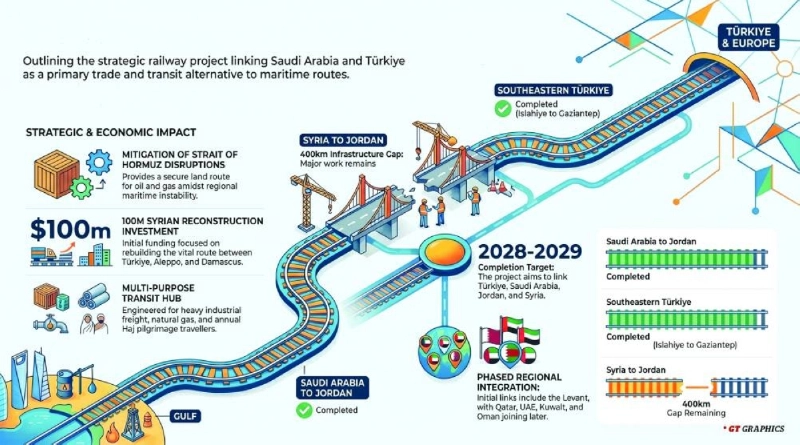
Turkiye and Saudi Arabia aim to build a railway to link the two countries with Jordan and Syria in the next three ‌or four years, Turkish Transport Minister Abdulkadir Uraloglu ​said Sunday, adding ‌other Gulf countries would also join the project.

Speaking ‌to Al ⁠Jazeera, ‌Uraloglu said the railway would ‌help alleviate in future the problems that have arisen from ⁠the disruption of the Strait of Hormuz caused by the war in Iran. The project is described in a memorandum of understanding signed between Ankara and Riyadh last week on logistics cooperation and the railway sector.

In the initial phase, a rail link would allow ​for the transport of goods, oil, natural gas and people between Saudi Arabia, Turkiye, Jordan, Syria and Europe, Uraloglu said, adding that the ‌Qatar, UAE, Kuwait, ⁠Oman, ​and possibly Yemen would be included later too.

“A ​train leaving from Saudi Arabia, from Riyadh already reaches several regions of Saudi Arabia. So this is a project for it to reach Turkiye via Jordan and Syria. We are talking about a route that will carry every type of freight via this route to Europe,” Uraloglu was cited as saying. He said the route from Saudi Arabia to Jordan’s ‌border had been finished and ‌on the Turkish side, ⁠the link was completed from Islahiye to Kilis and ⁠Gaziantep in southeastern ⁠Turkiye, near the border with Syria.

That leaves a gap of some 400km between Syria and Jordan, he said.

In addition to commercial trade, Uraloglu said the railway could also be used by people on the annual Haj pilgrimage.

Turkiye, ​which neighbours Syria, has built close ties with the government in Damascus after the fall of President Bashar al-Assad at the end of 2024 and has said it will help the country rebuild.

Uraloglu told Al Jazeera a financial plan would be drawn up for the rail project. The investment would include some $100mn to rebuild the route ‌between Turkiye ​and Syria’s Aleppo, creating a direct link to Damascus.

.


.


MENA Project Momentum Holds Despite Conflict Disruption

MENA Project Momentum Holds Despite Conflict Disruption

A modern dome structure with geometric patterns surrounded by visitors outdoors, by This And No Internet 25 via Pexels

.

Mena project momentum holds despite conflict disruption

.

MEED – 10 June 2026

.

.

GlobalData’s Construction Projects Momentum Index for April 2026 shows the region in third place globally, with execution-stage activity recovering even as the Israel-Iran conflict weighs on the pipeline

The Middle East and North Africa’s construction project pipeline has demonstrated considerable resilience in the months since the military conflict between the US, Israel and Iran began in late February, although the regional performance has softened from its early-year highs and the full effects of the geopolitical shock continue to ripple through the project market.

GlobalData’s Construction Projects Momentum Index (CPMI) for the Mena region recorded 0.86 in April 2026, placing the region third globally behind North-east Asia and South Asia. The Mena score represents a 12% decline from 0.98 in March, which itself was unchanged from February. The regional three-month moving average eased modestly to 0.96 in April from 0.97 in March, suggesting that while momentum has nudged lower, the pipeline has not experienced the kind of sustained deterioration that might have been expected given the severity of the geopolitical disruption.

The resilience partly reflects the composition of the regional project market. The Mena region’s largest markets, the UAE and Saudi Arabia, have both continued to record solid momentum in the months following the start of hostilities in February. The UAE led the region in April with a CPMI of 1.20, easing only slightly from 1.30 in March, while Saudi Arabia recorded 0.94.

Mixed performance

The impact of the conflict is most visible at the country level, where a sharp divergence has opened up between markets directly exposed to the fighting and those insulated from it. Israel recorded the lowest CPMI score in the region in April at -3.26, reflecting substantial delays to major projects. The East Mediterranean Gas Pipeline was among the most significant casualties, with its Final Investment Decision pushed well beyond its original timeline. Iran, another direct participant in the conflict, registered a markedly weaker score of 0.53 in April, a stark reversal from its position as one of the region’s strongest performers in January, when it posted 1.31.

The conflict’s first major imprint on the index appeared in March, when the CPMI data reflected the initial shock of the escalation. Execution-stage momentum in the region dipped from 1.06 in February to 0.89 in March, while pre-execution activity slipped from 1.02 to 0.95. Infrastructure, which had been a strong performer earlier in the year, fell sharply to 0.53 in March from 1.06 in February, with the institutional sector also pulling back from 1.27 to 0.78. These moves are consistent with the channels through which conflict typically disrupts construction activity — cost inflation driven by energy price volatility, supply chain disruption and elevated risk premiums that delay investment decisions.

Stability signs

By April, some of these pressures had begun to ease, at least at the index level. Execution momentum recovered to 1.01, reversing the March dip, and infrastructure returned as the top-performing sector with a CPMI of 1.13. Commercial and leisure activity also remained solid at 0.94, building on gains that have been sustained throughout the conflict period.

Pre-execution momentum, however, continued to soften, falling to 0.86 in April from 0.95 in March. This is significant because the pre-execution stage — which captures project planning, design development and procurement preparation — is where investor caution and risk reassessment typically show up first. A sustained decline in this segment would signal a thinning of the future project pipeline, even if near-term execution activity holds up.

Kuwait offers a specific illustration of how supply chain and procurement disruptions linked to the conflict can affect individual markets. In January, Kuwait had recorded a CPMI of 0.27, depressed by delays to tender packages on Kuwait Oil Company developments including the SGC1, SGC II, SGC III and JLO Export Facility projects. The country recovered strongly to 1.43 in February and 0.90 in March, before falling back to 0.55 in April, with delays reported on Dorra Field developments. The oscillation reflects the vulnerability of projects with complex procurement requirements to the kind of supply chain uncertainty the conflict has generated.

Future pipeline

The Mena region entered 2026 from a position of strength, having ranked first globally in January with a CPMI of 1.05 — a 16% jump from December 2025’s 0.90. That momentum reflected broad-based gains across infrastructure, residential and institutional sectors, with Qatar, the UAE and Iran all posting scores above 1.20.

The conflict began when the region’s project pipeline was strong, and the data suggest that the buffer of accumulated momentum has helped absorb the initial shock. Whether that buffer holds through the remainder of 2026 will depend on how the conflict develops and, in particular, whether the more cautious behaviour visible in pre-execution activity translates into a deferral of new project launches. GlobalData’s data through April suggest the region is maintaining momentum, but the direction of the pre-execution trend is a forward-looking indicator to be watched in the coming months.

.


.

South–South Learning to Strengthen Environmental Systems

South–South Learning to Strengthen Environmental Systems

Capture of a breathtaking sunset over the cityscape of Hargeisa, Somalia. by Abdulkadir Hiraabe via Pexels

.

South–South Learning to Strengthen Environmental and Social Risk Management Across Somalia

WORLD BANK GROUP

.

South–South Learning to Strengthen Environmental Systems

Workers at a construction site in Somalia.  Photo: World Bank

.

STORY HIGHLIGHTS

  • South–South learning strengthened institutional capacity for managing environmental and social risks that are critical to enabling sustainable investment and job creation.
  • Practical lessons from Ghana highlighted the importance of legal clarity, coordination, and land governance in accelerating project delivery and investor confidence.
  • Strong environmental and social systems are essential enablers of infrastructure, private sector growth, and job creation, resilient development across Somalia.

.

When Somali officials arrived in Accra recently, they were not looking for new policies or templates. They wanted to understand how environmental and social (E&S) risk management works in practice, how institutions coordinate, and how E&S risks and impacts are managed as development projects move from planning to implementation.That practical curiosity sat at the heart of a South–South Knowledge Exchange and Learning Visit convened by the World Bank Group, bringing together regulatory institutions from Somalia and Ghana to share experience on strengthening environmental and social risk management in development.Delivered under the Somalia Programmatic Advisory Services and Analytics (ESSRM PASA), the exchange supports the World Bank Group’s efforts to strengthen institutions that are essential for sustainable investment, infrastructure delivery, and job creation.

Learning grounded in institutional practice 

Rather than focusing on theory, the visit facilitated technical exchanges between institutions responsible for E&S protection, land administration, and key sectors such as extractives, transport, and energy. Participants engaged directly with their counterparts through institutional briefings, site visits, and facilitated peer-to-peer exchanges.

For fragile and transitioning countries, direct exposure to mature regulatory systems is critical, particularly for environmental and social risk management. Seeing how established institutions coordinate across government, sequence decisions, and manage risks in practice helps emerging systems scale faster.
Haroub Ahmed
World Bank Senior Environmental Specialist
With long-established regulatory institutions and extensive experience managing E&S risks across infrastructure, land, energy, and extractive sectors, Ghana provided a strong peer learning environment for the exchange. Its well-defined legal frameworks established environmental and sectoral regulators, and experience coordinating across institutions responsible for land, minerals, energy, and environmental protection offered participants concrete examples of how regulatory systems function in practice.

What stood out: clarity, coordination, and sequencing 

Across discussions, participants highlighted the importance of clear legal mandates that can enable effective institutional oversight. Ghana’s regulatory framework is anchored in well‑defined laws that clarify roles, responsibilities, and decision‑making authority, reducing ambiguity and strengthening compliance.

Coordination emerged as another recurring theme. Inter‑agency collaboration in Ghana is formalized through legislation, board representation, and structured review processes, enabling environmental, land, and sector regulators to work together while maintaining distinct mandates.

Land administration was also a strong area of interest. Discussions highlighted how consolidated land management systems help reduce disputes, improve oversight, and build confidence among communities and investors, particularly infrastructure and extractives development.

Effective E&S systems as enablers of jobs and sustainable development

Throughout the exchange, a shared understanding became clear: environmental and social risk management is not simply a compliance requirement. Strong E&S systems are essential to advancing development priorities, including jobs, infrastructure, and private investment, while safeguarding people and the environment.

By improving regulatory clarity and coordination, effective E&S systems reduce uncertainty and delays that can discourage investment and slow project delivery. This is especially important as Somalia scales up investments in energy, transport, logistics, water, and productive sectors, central to the World Bank’s Jobs Agenda, Mission 300, and broader efforts to foster economic integration and growth.

Land and environmental governance also underpin the building of climate- resilience, smart development, and agri‑food value chains that support livelihoods. In fragile settings, clear and predictable institutions further contribute to state legitimacy and public trust, reinforcing stability over the long term.

Strengthening institutions for sustainable investment and jobs

The visit concluded with a debrief focused on translating learning into sequenced, capacity‑aligned actions. Participants identified priority areas to inform ongoing reforms, including establishment of the National Environmental Management Agency, strengthening environmental and social impact assessment systems, clarifying institutional mandates, and formalizing inter‑agency coordination, key building blocks for enabling sustainable investment and job creation.

Through the exchange, participants will take on follow‑up actions such as continued technical engagement, adaptation of legislative and regulatory materials, and development of a sequenced institutional roadmap aligned with capacity and available resources.

South–South exchange reaffirmed the value of peertopeer learning

“The Ghana exchange reinforced the value of South–South learning: countries engage as peers, lessons are practical and credible, and partnerships feel achievable,” said Grace Muhimpundu, World Bank Senior Social Development Specialist.

By grounding learning in lived institutional experience, the exchange reaffirmed the value of peer‑to‑peer learning in translating global good practice into context‑specific solutions. It also established a basis for follow-on work across legislation, ESIA systems, and institutional coordination, while opening channels for continued technical exchange, strengthening the systems needed for investment to drive private sector growth and create more and better jobs.

.


.