Many cities around the world are sinking because too much water is extracted from the groundwater reservoirs beneath them.
This sinking makes these coastal cities more exposed to rising seas as the climate warms.
But as our new research shows, this process can work in reverse; when groundwater is replenished, cities can rise.
Our findings also reveal an unexpected clue: faultlines play a key role in shaping where the fastest groundwater recovery and land uplift occur.
The global problem of sinking cities
Land subsidence, the gradual sinking of the ground surface, affects many of the world’s major cities.
Parts of Jakarta, the capital of Indonesia, are sinking more than ten centimetres each year, prompting the government to plan a relocation of the city.
The coastal city of Tianjin, China, is home to 15 million people. It, too, is a subsidence hotspot. If sinking there continues unabated, 15% of the city’s population will be underwater by 2120.
Similar stories are playing out from San Diego to Iran’s major cities, wherever groundwater has been pumped faster than it can refill.
In Aotearoa New Zealand, recent studies show around 80% of the urban coastline is sinking, and that groundwater may be a contributing factor in some areas, including Christchurch and Wellington.
How urban groundwater leads to sinking
Many cities are built above natural groundwater reservoirs (aquifers), and are literally held up, in part, by the water beneath them.
Think of a gigantic water balloon beneath a city. The balloon represents an aquifer full of water. When groundwater is pumped out, the “balloon” deflates, and the ground above sinks.
This matters most at the coast. If the land is sinking while the sea is rising, the two effects combine, meaning coastal cities experience relatively higher sea levels, and the impacts of climate change arrive sooner.
This effect of groundwater pumping on land subsidence is well understood, and improved groundwater management is often put forward as the key strategy for slowing or halting the sinking.
What is not clear is how the ground beneath a city responds when long-term water aquifer recovery happens. Does the ground simply rise back up, uniformly, like a balloon reinflating? Or is the response more complicated?
To answer this, we need two key things: long-term records of where the water is accumulating in the underground aquifers, and precise millimetre-scale measurements of elevation of the ground surface above.
Osaka, a natural laboratory
Osaka provided the perfect setting to explore this. Between the 1920s and 1960s, heavy groundwater pumping lowered water levels beneath the city by up to 30 metres, and the land sank by more than two metres in places.
This led the Japanese government to introduce strict groundwater regulations in the early 1960s. In the decades since, groundwater levels have been recovering steadily.
To track the groundwater levels, we looked at data from 44 monitoring wells, some reaching as deep as 500 metres below the surface, and stretching back in time to 1985.
To measure the tiny changes in ground elevation, we used a technique known as interferometric synthetic aperture radar (InSAR). This involves the repeat acquisition of satellite radar images of the Earth’s surface, tied to very accurate global navigation satellite system measurements of ground stations.
The results are striking. Across greater Osaka, home to about 15 million people, the ground is rising, and fast.
The speed of uplift averaged about four millimetres a year, and was as high as 12 millimetres a year in some places. Groundwater levels have also been steadily rising, at rates of up to a metre a year. Where water levels climbed fastest, so did the land.
But the map of uplift was also very patchy.
One city block could be uplifting fast, while less than 100 metres down the road it could be much slower. These abrupt changes aren’t random. They form narrow but continuous corridors that ran across the city.
We soon realised something unexpected: these corridors mapped almost perfectly onto known tectonic fault lines.
Faults act like dams
Faults are fractures in the Earth’s crust, and are usually thought of in terms of earthquakes. But we found they play another role here.
Picture a fault as a curtain hanging vertically underground, cutting through the aquifer. Instead of holding back light, it holds back water, blocking its sideways flow and acting like an underground dam.
On one side of Osaka’s Uemachi Fault, groundwater levels have been rising three times faster than on the other side.
We found the same pattern repeats at other faults across the city. Water dams on the “upstream” side of a fault, where it can’t easily flow through, driving faster groundwater recovery and faster uplift there, while the “downstream” side lags behind.
Our research highlights a potentially important opportunity for coastal cities adapting to sea-level rise.
Where groundwater depletion has contributed to land subsidence, reducing extraction and allowing aquifers to recover could reduce – and in some places potentially reverse – the downward movement of the land.
As seas continue to rise, keeping the ground beneath coastal cities from sinking could be an increasingly important part of adapting to a warming world.
“The Gulf should not merely adapt to the desert. It should learn from it.” says Marcus
.
.
The defining environmental challenges of the Gulf are not abstract. They are measured every day in degrees Celsius and liters of water.
As the UAE continues investing in climate resilience, sustainable development and advanced technologies, architects face an increasingly urgent question: are we fully leveraging the materials and environmental knowledge unique to this region?
For decades, Gulf architecture has drawn on a mix of local and imported materials, technologies and construction systems, producing extraordinary results. The UAE is now a global reference point for architectural innovation and rapid urban growth. Yet one of the region’s most abundant resources remains largely untapped as a driver of that innovation: sand.
At American University of Sharjah (AUS), our research has been investigating this. Using computational modelling, we have studied how dune sand naturally accumulates, erodes and self-organises under wind and gravity, and how those same patterns can be translated, through digital fabrication and 3D printing, into new architectural systems. Other AUS projects have explored locally sourced materials and “material ecologies” designed to cut waste and strengthen the relationship between buildings and the environments that surround them.
This is not an argument for trading concrete towers for mud-brick ones, nor for romanticising the architecture of the past. Traditional Gulf building, with its thick walls, shaded courtyards, thermal mass and carefully oriented openings, emerged from a deep understanding of climate and material constraints long before mechanical cooling existed. That knowledge still matters. But simply reviving historical earthen techniques is not a realistic answer for a region where sand is abundant but suitable clay is comparatively scarce. The opportunity instead lies in asking a different question: what new forms of architecture can emerge when we start with the materials that are actually abundant here?
Discussions about the future of cities tend to focus on artificial intelligence, smart infrastructure and digital systems. These matter. But resilience is also a material question. A genuinely intelligent city has to consider not only how buildings operate, but what they are made from and how those materials relate to local conditions. Dune formations, erosion patterns and sedimentary processes are not random; they are physical records of an ongoing negotiation between wind, gravity, climate and time. Reading and applying that intelligence, rather than treating sand as merely a problem to stabilise, is the real design challenge.
This thinking is gaining ground. The recent TURAB Prize, a regional award recognising innovation in earth-based construction, highlighted projects examining sustainability and material stewardship. Two first-place entries came from AUS, both reinterpreting regional material knowledge through digital fabrication rather than looking backward. This reflects a broader shift in the profession: the most promising solutions are emerging not from choosing between tradition and technology, but from combining them.
Critics sometimes dismiss earth-based materials as nostalgic or impractical for contemporary cities. They are right that sand and earth alone will not build the future of Dubai, Abu Dhabi or Sharjah. But that misses the point. The question is not whether alternative materials can fully replace concrete and steel. They can’t, not yet and perhaps not ever at scale. It is whether building material systems that are better adapted to local conditions, and sourced locally, can reduce dependence on carbon-intensive construction. Even incremental shifts in sourcing, fabrication and deployment add up across a rapidly urbanising region.
Realizing that will take more than research papers and prize shortlists. It will take developers willing to pilot sand-based components at building scale, and regulators and funders willing to back that experimentation alongside the smart-infrastructure investment the UAE already prioritises. The technical groundwork, computational modelling, robotic fabrication and additive manufacturing, already exists. What is needed next is to treat material innovation with the same urgency as digital innovation.
The UAE is well placed to lead this. Few places combine such demanding environmental conditions with such ambitious investment in technological innovation, or such a rich legacy of climate-responsive design. Architecture’s role here extends beyond energy efficiency or certification. It is an opportunity to rethink the relationship between the built and the natural, so that buildings emerge from an understanding of the desert’s materials and processes rather than being imposed upon them.
The Gulf should not merely adapt to the desert. It should learn from it,not as heritage, but as foundation.
The future of Gulf architecture could be written in sand, not concrete.
.
Marcus Farr, Fulbright Scholar and Associate Professor of Architecture at the American University of Sharjah, whose research focuses on desert materials, computational design and climate-responsive architecture.
Stunning modern architecture in Riyadh with curved buildings and a central stairway. by Sena Tohum via Pexels
.
2nd Desert Architecture – Saudi Arabia forum to bring architecture, innovation and urban transformation to the forefront
.
Forum brings architects, developers, planners and government stakeholders together to explore how Saudi heritage, climate intelligence and innovation can shape the next generation of sustainable cities
Press Release
Published 28 September 2026
.
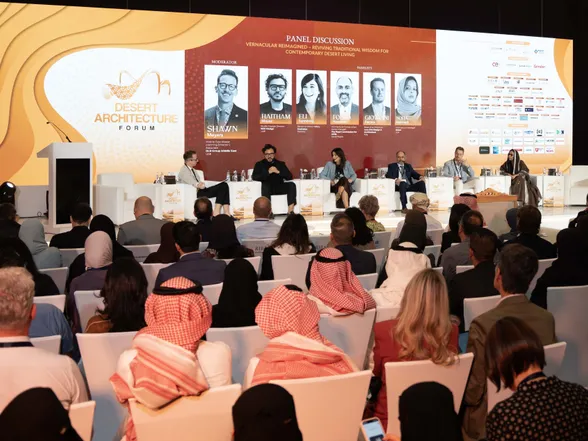
As Saudi Arabia continues one of the most ambitious periods of urban development in its history, architects, planners, developers and industry leaders will gather in Riyadh for the 2nd Desert Architecture KSA Forum, taking place from 12–13 October 2026 at the Radisson Blu Hotel & Convention Center, Riyadh Minhal. Image courtesy: 2nd Desert Architecture KSA Forum
Riyadh, Saudi Arabia: As Saudi Arabia continues one of the most ambitious periods of urban development in its history, architects, planners, developers and industry leaders will gather in Riyadh for the 2nd Desert Architecture KSA Forum, taking place from 12–13 October 2026 at the Radisson Blu Hotel & Convention Center, Riyadh Minhal.
The two-day forum will focus on the convergence of heritage, sustainability, technology and contemporary design as the Kingdom looks to create cities and destinations that respond intelligently to the desert environment while retaining a distinctive Saudi architectural identity.
Aligned with Saudi Vision 2030, the forum will place particular emphasis on climate-responsive and culturally grounded architecture and the role of the Saudi Architectural Map, which encompasses 19 regional architectural styles reflecting the Kingdom’s different climates, landscapes, materials and cultural traditions.
The discussion comes against the backdrop of an extraordinary development pipeline. According to figures highlighted by the Desert Architecture Forum, Saudi Arabia has more than US$1.3 trillion in active projects spanning real estate, hospitality, cultural districts, government facilities and infrastructure, with 5,200-plus developments in the pipeline. The event website also points to more than 470 urban masterplans being revised in alignment with the Architectural Map’s directives, while 13 regional municipalities and 28 government entities are integrating the architectural identity framework into planning, approvals and design briefs.
Against this rapidly evolving landscape, the forum will examine how lessons embedded in traditional desert architecture can work alongside advanced engineering, materials and technology to deliver environments that are both resilient and comfortable.
Husain Buhwaid, Senior Development Director, Misk City, said: “Desert Architecture Forum 2026 edition will be a key platform for essential dialogue among architects, planners, and leaders in the Kingdom not only about iconic architecture but also creating even more sustainable and livable urban environments with traditional solutions and engineered systems.”
Husain Buhwaid will participate in the opening panel discussion, “Building the Architectural Identity of Saudi Arabia Through the Saudi Architectural Map,” which will examine how the Kingdom’s 19 regional architectural styles can inform its future built environment. Discussions will explore the integration of regional culture, climate-responsive design and heritage into modern architectural practice, as well as the alignment of national design frameworks with giga-projects, urban transformation and Vision 2030.
The wider programme reflects the growing recognition that designing successfully for desert environments involves considerably more than creating visually striking landmarks.
The Forum’s second day will broaden the conversation from individual buildings to the evolution of entire desert cities. Sessions will examine how climate intelligence, policy, infrastructure and long-term urban planning can help establish desert cities as models for sustainable development. The programme will also address regenerative tourism, exploring how architecture can work with landscapes, heritage and local communities to create destinations that strengthen rather than diminish their surrounding environments.
The speaker line-up brings together expertise from government, development, academia, architecture and urban planning, with representatives from organisations including Misk City, ROSHN Group, Red Sea Global, AlUla Development Company, Diriyah Company, King Salman Park Foundation, Aseer Development Authority, Madinah Region Development Authority, Saudi Building Code Centre, Prince Sultan University and the the Royal Commission for AlUla, alongside leading international architectural and design practices like Foster + Partners, ZHA Architects, Gmp, Herzog & de Meuron, RMJM, Snohetta.
Press release issued on behalf of GM Events by Coral Coast Public Relations. For press inquiries, please connect with Verna on +971581544378 or verna@coralcoastpr.com . For event inquiries, contact Aashutosh on aashutosh@gmevents.ae . For a detailed agenda, speaker lineup, and registration information, visit https://desertarchitectureforumksa.com/
Research integrity (RI) guidelines around the world increasingly recognise fairness, diversity, equity and inclusion.
But a new analysis suggests that fairness is still understood predominantly in procedural terms – for example, through fair authorship, peer review and misconduct procedures – while the structural inequalities that shape who conducts research, whose knowledge is recognised and who sets the rules are usually neglected.
This neglect risks reproducing colonial hierarchies and reinforcing the marginalisation of Indigenous and Global South actors and epistemic and ethical frameworks, the study argues.
Therefore, there is a need for the integration of non-Eurocentric, Indigenous knowledge and ethical frameworks in RI guiding documents for researchers.
These were the conclusions of the study, “Fairness in Research Integrity Guidelines Across the World: A Critical Discourse Analysis”, which was published in the Journal of Academic Ethics on 2 September.
The conclusions were drawn after analysing 66 national and international guidelines and codes of conduct for RI originated from 39 countries in Europe, Africa, South America, North America, Asia and Oceania.
“The topic of ‘research fairness’ is receiving growing attention in Research Integrity (RI) initiatives, with increasing acknowledgement of the relationship between RI and fairness concerns such as diversity equity and inclusion (DEI) and responsible collaborations,” the study says.
“However, initiatives usually neglect addressing structural injustices and their relationship to RI. Furthermore, RI standards are mostly set in economically powerful countries but are applied globally, posing a risk of ethical imperialism and reinforcing existing colonial hierarchies.”
The study analysed three aspects of ‘fairness’: Addressing injustices, attention to colonial hierarchies and DEI.
The authors – Clàudia Pallisé Perelló, María de los Ángeles Crespo López, Natalie Evans, Johannes Ket, Mariëtte van den Hoven and Krishma Labib at Vrije Universiteit Amsterdam in the Netherlands – say their study provides the “first systematic scoping review” of RI documents critically assessing the treatment of fairness.
“Moreover, it is also the first one that takes an explicit anticolonial and systemic justice perspective, putting structural inequalities in the centre of the analysis.”
Maura Hiney, an adjunct professor of Research Integrity at University College Dublin’s Institute for Discovery in Ireland, told University World News that the study is “very timely and will be an important consideration for the revision of the All European Academies (ALLEA) European Code of Conduct for Research Integrity and the ongoing development of an African Code of Conduct for Research Integrity and AI”.
“While the necessarily high level of such frameworks precludes detailed elaboration of the concepts explored in the paper, they can nonetheless seek to clarify their importance for research integrity in more meaningful ways,” added Hiney, who served as chair and co-authored the ALLEA European Code of Conduct for Research Integrity (2017 and 2023).
Zeenath Reza Khan, founding president for the Centre for Academic Integrity at the University of Wollongong in Dubai, United Arab Emirates and Audit Group member for the European Network for Academic Integrity, told University World News that it was a “valuable and timely study” that offered an important opportunity for the research integrity community to “reflect on whether our existing frameworks adequately represent the diverse environments in which research is conducted”.
However, the research findings also raise questions about how research systems maintain common expectations for reliability, transparency and accountability while allowing legitimate contextual, Indigenous and epistemic diversity.
Lokman Meho, Professor and University Librarian at American University of Beirut in Lebanon and the developer of the Research Integrity Risk Index (RI²), told University World News that greater fairness in funding, collaboration, authorship, and participation should help create better research but not become a separate goal that competes with research quality and integrity.
Scant mention of injstices
The study found that RI documents originated mostly from European countries, with limited representation from elsewhere – of the 39 national documents, 24 came from European countries, with the rest originating from Africa (2), South America (1), North America (1), Asia (9) and Oceania (2).
The majority of the included documents referred to fairness only as “procedural”, covering issues such as fair authorship, peer review, and misconduct investigations.
A large number of guidance documents addressed diversity equity and inclusion (DEI) principles with at least one of these words being mentioned in just under half of the documents, but their uses vary significantly in terms of depth and meaning, the study found.
More than half of the documents either do not mention DEI or approach these in a more symbolic or superficial way, reflecting a more tokenistic or performative vision, the study said.
In these cases, the word “diversity” often appears without further elaboration, concrete actions, or clear links to research practices.
In general, the study found few documents explicitly mentioned issues of injustice, such as knowledge and material extractivism, epistemic injustice, and socioeconomic inequities.
It noted that Global North documents often fail to acknowledge in a meaningful way three forms of systemic injustice – injustices related to colonial history, socioeconomic injustices and injustices affecting the environment.
None of the documents explicitly mention ‘colonialism’. A small number discuss inequities in knowledge production in different countries, although they do not refer to these as colonial legacies or realities.
Only a minority of the documents acknowledge the validity of diverse epistemic values and systems, with most instead promoting Global North knowledge systems.
In general, many of the documents frame ‘objectivity’ as the approach of scientific research, but the study authors argue that this implicitly excludes diverse epistemic values.
The few codes of conduct that explicitly confronted colonial hierarchies came from colonised nations.
The study found some documents acknowledged diverse knowledge systems and ethical frameworks, but even these documents often reflected assumptions of colonial hierarchies in their language. For instance, they portrayed Indigenous and marginalised groups as “passive” agents and receivers of research rather than as “active” groups capable of conducting research.
Overall, the study unveiled that most European RI frameworks tended to frame fairness without taking into account structural injustices, colonial hierarchies and DEI systematically, reinforcing watered-down, “procedural” rather than “structural” visions of fairness.
“While most dominant RI initiatives can be considered Eurocentric, they have global influence, for instance via funding frameworks, publishing ethics, and data management requirements.
“Therefore, they might be considered a form of ‘ethical imperialism’, in which Eurocentric understandings of RI and responsible conduct of research are imposed across the world,” the study argues.
Speaking to University World News, lead author Perelló said the study found that the predominant standards that define “ethical” and “good” research, or define which issues are considered Responsible Conduct of Research (RCR) or RI concerns, are mostly coming from Western contexts that “frequently fail to consider or include local frameworks, epistemic traditions, or histories of injustice and their associated concerns”.
She added that “deeper questions of structural injustice and equity in science are rarely addressed”.
Key messages for policy makers
Perelló said RI guidelines should acknowledge both the structural conditions in which research is conducted and ethical and epistemic plurality.
“This involves, on the one hand, recognising that universal and culturally neutral ethical frameworks do not exist, and, on the other hand, legitimising the existence of diverse epistemic traditions.”
She said there are good existing examples, such as the “Te Ara Tika Guidelines for Mori research ethics: A framework for researchers and ethics committee members or the San Code on Research Ethics”, which show that it is possible to “explicitly integrate non-Eurocentric, Indigenous knowledge and ethical frameworks in RI guiding documents for researchers in a situated way”.
Impact of funding inequality
Khan said the study “reminds us that fairness in research integrity cannot be understood only through procedures such as authorship, peer review or misconduct processes.
“As research becomes increasingly global and collaborative, our integrity frameworks also need to remain attentive to context, inclusion and different knowledge traditions,” she said.
Meho said the study shows that research integrity is not only about whether individual researchers follow rules and procedures.
“It is also shaped by the conditions in which researchers work, such as unequal access to funding and research resources, unequal power in international collaborations, and differences in who sets research standards and whose knowledge is recognised,” he said.
Call to widen perspectives
He argues that standards intended to apply internationally should not be developed mainly from the perspective of a small number of countries.
“Researchers from different countries and research systems, especially those currently under-represented, should have a meaningful role in deciding what constitutes responsible research,” Meho suggested.
Independent Research Ethics and Integrity Consultant, Dr Lyn Horn, former director of the Office of Research Integrity at the University of Cape Town, South Africa, told University World News she is grateful that scholars are taking this conversation forward.
“One of the biggest challenges for researchers in low- and middle-income countries (LMICs), especially in Africa, is that a huge amount of research funding comes from the Global North, and they dictate leadership requirements and project management aspects, not without reason, as they need to ensure that the high-income country (HIC) taxpayer money produces the intended outcomes,” said Horn, who is the lead author for “The Cape Town Statement on fairness, equity and diversity in research” made in 2023.
“One structural change that I believe would shift the balance would be for LMIC governments to provide a lot more funding for good-quality research directly and for HIC funders to provide a percentage of co-funding but enable projects to be LMIC-led and managed, providing support rather than dictating all administrative aspects, which is currently usually the case,” she added.
“This would advance LMIC research management systems, including ethics and integrity monitoring, at both institutional and national levels,” Horn said.
Across the MENA region, Arabic remains strongly present in the daily lives of youth and an integral part of their identity. However, according to research from Strategy& and Ipsos many young people see English as essential to building their future, highlighting a gap between Arabic’s cultural importance and its practical role in work.
.
Unveiled at the 2026 Congress of Arabic & Creative Industries this week, the report finds that Arabic dominates at home for MENA youth, but the balance shifts where they study and work: 91% use Arabic at home, falling to 64% at work, university or school and 60% in online learning, as English rises from 7% to 33% and 36% respectively.
At the same time, 77% say English is essential to achieving their goals. The report draws on the views of more than 4,000 people aged 18–25 across 10 MENA countries.
The authors highlight that the current generation is not turning away from Arabic. Almost three-quarters, 74%, want Arabic to evolve to better reflect how they learn, create and work, while 76% say the language connects them to their roots. Instead, they point to a challenge of utility: ensuring Arabic remains relevant not only to young people’s identity, but to their ambitions and opportunities.
“Young people are not turning away from Arabic; rather, they aspire for its tools and its presence to keep pace with the rhythm of their lives, and for Arabic to be present in every field in which they learn, work, create and shape their future,” said Ali Bin Tamim, Chairman of the Abu Dhabi Arabic Language Centre.
“It is our responsibility to ensure that this deep connection with the Arabic language is matched by opportunity, by strengthening its presence in education, technology, knowledge production and the creative industries. Arabic has always been a language of knowledge and creativity, and by listening to this generation and responding to its aspirations, we can ensure that Arabic continues to have a meaningful place in their future, while empowering them to contribute to shaping it with confidence.”
AI a priority area for Arabic
Half of young people surveyed identify technology and AI as the leading priority for greater investment in Arabic, ahead of schools and universities at 42%, government and public services at 39%, and media and entertainment at 32%.
The report also points to gaps in Arabic-language AI, noting that many large language models underperform in non-English and low-resource language contexts and are often insufficiently attuned to cultural context. It calls for shared Arabic language technology infrastructure, including high-quality datasets, language models, speech-recognition tools, and translation resources that can be used across sectors and dialects.
An ambitious generation
Youths in the MENA region are ambitious about their future while remaining strongly connected to their heritage. Some 81% believe they have the power to shape their own future, while 77% say balancing tradition and modernity is important in their career choices.
That ambition sits alongside a strong attachment to Arabic and concern about its future. More than three-quarters, 76%, say Arabic connects them to their roots, while 70% are concerned about losing traditions and values and 66% about the declining use of Arabic.
Young people also want the language they value culturally to feel contemporary. While 77% feel proud when they see Arabic used in modern contexts, 67% say the Arabic content they find feels dated compared with English.
“Young people across the region are ambitious about their future without wanting to leave their heritage behind. Arabic remains an important part of who they are,” said Nay Abi Ramia, Partner at Strategy&. “The opportunity now is to ensure the language has a meaningful place in the technologies they use, the content they consume and create, and the education and career pathways they pursue.”
Ali Bin Tamim and Nay Abi Ramia
.
Five recommendations
To make Arabic more usable in the environments shaping young people’s futures, the report sets out five actions: connecting Arabic education to real-world applications and professional use; building shared Arabic language technology; turning Arabic digital standards into measurable user outcomes; helping build modern Arabic content ecosystems and sustainable creative career pathways; and assigning clear ownership, measuring outcomes, and scaling what works.
In education, the report recommends giving learners more opportunities to use Arabic in areas such as AI, STEM, entrepreneurship, media production, and the workplace. In technology, it calls for shared infrastructure, including high-quality datasets, language models, speech-recognition tools and translation resources that can improve the quality and accessibility of Arabic-language digital tools across sectors and dialects.
Importantly, greater investment alone will not close the gap. Initiatives should be measured against whether they lead to greater use of Arabic and better experiences for Arabic users, allowing successful approaches to be identified and scaled. “This means setting clear measures from the outset, identifying what works, and scaling the initiatives that demonstrate meaningful impact,” said Abi Ramia.
We use cookies on our website to give you the most relevant experience by remembering your preferences and repeat visits. By clicking “Accept”, you consent to the use of ALL the cookies.
This website uses cookies to improve your experience while you navigate through the website. Out of these cookies, the cookies that are categorized as necessary are stored on your browser as they are essential for the working of basic functionalities of the website. We also use third-party cookies that help us analyze and understand how you use this website. These cookies will be stored in your browser only with your consent. You also have the option to opt-out of these cookies. But opting out of some of these cookies may have an effect on your browsing experience.
Necessary cookies are absolutely essential for the website to function properly. This category only includes cookies that ensures basic functionalities and security features of the website. These cookies do not store any personal information.
Any cookies that may not be particularly necessary for the website to function and is used specifically to collect user personal data via analytics, ads, other embedded contents are termed as non-necessary cookies. It is mandatory to procure user consent prior to running these cookies on your website.




You must be logged in to post a comment.