Statetron Unveils 10-Hectare Andromean Class in Qatar

Statetron Unveils 10-Hectare Andromean Class in Qatar

A Qatar Airways Boeing 777 jet featuring Oneworld livery flying through a clear sky. by Go Journal via Pexels

.

Statetron Unveils 10-Hectare Andromean Class Industrial Facility Concept in Qatar

.

.

Statetron Unveils 10-Hectare Andromean Class in Qatar

.

Statetron has unveiled its Andromean Class™, a new industrial architecture designed to integrate artificial intelligence (AI), robotics, autonomous logistics, energy storage and digital intelligence within a single advanced manufacturing ecosystem.

The company is proposing its first Andromean Class facility in Qatar, with an initial development concept spanning approximately 10 hectares and an architecture designed to support expansion toward multi-gigawatt-scale energy storage manufacturing capacity.

Unlike a conventional battery assembly facility, the proposed development is conceived as an intelligent, energy-integrated industrial platform in which manufacturing, logistics, energy, data and maintenance systems operate as a coordinated ecosystem.

Project Scope

The proposed Qatar facility will integrate AI-driven production, robotic assembly, autonomous material movement, digital-twin technology, automated quality control and intelligent energy management.

At the core of the manufacturing platform will be Statetron’s modular 5 MW Power Block architecture, designed for large-scale energy-storage applications serving utility, industrial, renewable-energy and grid-infrastructure markets.

The manufacturing platform is intended to support configurable energy-storage durations and progressively increase production capacity in line with market demand.

The facility’s architecture will also allow production, automation, logistics and energy infrastructure to be expanded progressively, with the long-term objective of reaching multi-gigawatt-scale manufacturing.

Factory Designed as an Energy System

The Andromean Class concept extends beyond battery manufacturing by integrating renewable energy generation, energy storage and intelligent power management into the facility itself.

Under the concept, energy systems will power the manufacturing operation while the factory produces energy-storage infrastructure, with digital intelligence connecting and optimizing the overall system.

Statetron said Qatar provides a compelling environment for the development, citing the country’s focus on advanced manufacturing, AI, robotics, Internet of Things (IoT), data analytics and clean technologies.

The proposed facility is also intended to benefit from Qatar’s strategic industrial and logistics infrastructure, including the Umm Alhoul Free Zone, which is positioned for heavy manufacturing, logistics and emerging technologies and is located adjacent to Hamad Port.

Statetron’s Andromean Class Vision

Statetron said the Andromean Class represents a new approach to industrialisation in which the factory itself becomes an intelligent and energy-integrated system.

The company aims to replace fragmented manufacturing processes with a continuously connected industrial environment where production, logistics, energy, data and maintenance are optimized together.

Lars Carlstrom, CEO of Statetron, said: “The first industrial revolution mechanised production. The digital revolution connected it. The next era will make industry intelligent, autonomous and energy-native.”

He added: “We don’t want to build another battery factory. We want to build the blueprint for how industry itself will operate in the next decade.”

The proposed Qatar development represents Statetron’s first application of the Andromean Class architecture and is intended to establish a scalable platform for the future manufacturing of large-scale energy-storage systems.

.


.

US-Iran War Spurs Energy Transition Across Continents

US-Iran War Spurs Energy Transition Across Continents

.

US-Iran War Spurs Energy Transition Across Continents


BRUSSELS/LONDON/SINGAPORE, Aug 26 (Reuters) – Six months into the U.S.-Israeli war with Iran, governments across Europe and Asia are scrambling to accelerate a renewables build-out in a bid to cut dependence on fossil fuel imports, providing a fresh impetus to the global energy transition.

As the effective closure of the Strait of Hormuz has choked off a fifth of the world’s oil and liquefied natural gas (LNG) shipments, governments from South Korea and Thailand to the European Union have pledged to increase funding for renewables.

Has the conflict delivered a boon to the clean energy transition? Here are some ways to measure the impact.

.

US-Iran War Spurs Energy Transition Across Continents

RENEWABLES ARE SURGING, BUT COAL IS ALSO UP

Renewable power output is soaring across the world, and the International Energy Agency (IEA) expects it to become the top electricity source for the first time this year.

Since the war began, rooftop solar has proved attractive because it is quick and cheap to install. In the Philippines, high power prices driven by costlier imported fuel are pushing households and businesses onto solar, while a battery subsidy scheme is fuelling a rooftop resurgence in Australia.

European demand for rooftop systems has also jumped since the war began.

But coal is rising too. With the Strait of Hormuz closed and renewables still unable to guarantee round-the-clock power, coal-fired generation is set to grow — though the IEA’s forecast 8.5% jump in renewable output this year dwarfs the 1.4% rise in coal.

In the United States, where President Donald Trump has opposed green energy, renewable generation rose 10% in the first half of the year from the same period in 2025.

EMISSIONS ARE STILL CLIMBING

Even as renewable generation surges, the IEA expects emissions of the greenhouse gases that cause climate change to rise 1.1% this year to an all-time high of 14.2 billion tonnes.

In 2027, the IEA expects coal output to dip by 0.7%, but gas-fired power generation to rise 1.5% from this year’s levels. Curbing climate change will require even more renewable energy and investments in power grids and energy storage.

ASIA BEARS THE BRUNT

Asian economies most dependent on oil and gas through the Strait of Hormuz have absorbed the sharpest shock.

China leaned hard into solar, with output rising more than three times as fast as coal between March and July. India, Vietnam and South Korea went the other way, burning more coal. Some European countries also saw extra coal burn, but the IEA expects EU coal generation to resume its decade-long decline in 2026.

Last month, the Vietnamese government said it was considering building more coal plants to secure supply — despite pledging at the 2021 U.N. climate summit to build no new coal after 2030.

TRANSPORT

Most of the world’s oil is burned as transport fuel — in cars, trucks, ships and planes. The war has not collapsed that demand, but it has reversed the growth forecasters had pencilled in.

Higher prices, reduced air travel, softer Chinese consumption and faster EV adoption mean the world is now likely using less oil for transport than projected before the war. Goldman Sachs estimates gasoline-related demand fell about 20% at the April peak of the disruption; GL Consulting puts the drop nearer 15%.

Costlier fuel has pushed drivers toward EVs, and China — the world’s biggest maker — has seen its EV export value top $10 billion for the first time this year.

Electric models made up 63% of the country’s passenger-car retail sales in June, up from 53% a year earlier, according to BofA analysts, who estimate electrification explains roughly a third of China’s year-to-date decline in crude imports.

EV sales have also soared across Europe since the war began as high oil prices have caused pain at the pump.

HOW LONG WILL IT LAST?

As long as Hormuz stays shut, high oil and gas prices are likely to persist, strengthening the case for countries to invest in cheaper, home-grown renewables and reduce their exposure to volatile fuel costs. But whether a shift away from oil and gas gathers even more momentum is difficult to predict.

“Changing a nation’s energy mix requires investments, and higher interest rates will make the considerable upfront capital required for renewables and power grids more expensive. Thus, while the present conflict is likely to ultimately favour decarbonization, it is not a one-way street,” said Sverre Alvik, vice president and energy transition outlook director at DNV.

Many large Asian markets have substantial gas and coal resources to provide a buffer against Middle East supply disruptions and a lot more U.S. LNG supply is expected to come online between 2026 and 2030.

“As this supply materialises, LNG should become more affordable for import-dependent Asian markets, reducing the incentive for a permanent shift away from gas driven solely by the current conflict,” said Victor del Carpio Neyra, senior research associate at Aurora Energy Research.


(Reporting by Kate Abnett in Brussels, Nina Chestney in London and Sudarshan Varadhan in Singapore; Editing by Conor Humphries)


.


.


Oman Water Services Launches Camelina Project for Sustainability

Oman Water Services Launches Camelina Project for Sustainability

Aerial shot of lush date palm plantations surrounding a farmhouse in Oman. by Eslam Mohammed Abdelmaksoud via Pexels

.

Nama Water Services launches camelina biofuel project in Oman

.

BioFuels International – 24 August 2026

.

Nama Water Services has launched a new project to cultivate one of the leading sustainable crops used in biofuel production – camelina.

The initiative, in partnership with Hema Energy, forms part of the company’s commitment to environmental sustainability, supporting green economy goals and expanding the use of reclaimed water supplied under the Manhal Nama programme.

The project reflects Nama Water Services’ strategy to transform reclaimed water into a strategic resource that supports sustainable development through innovative agricultural applications.

It aims to strengthen water and food security, reduce carbon emissions and accelerate the transition to clean energy sources.

Nama Water Services will provide the project site and reclaimed water supplies, while Hema Energy will be responsible for implementing the project, overseeing its technical management and operations, carrying out monitoring and data analysis  in line with the highest technical and environmental standards.

The project is supported by several national institutions. Sultan Qaboos University will provide research, scientific and technical support, the Environment Authority will oversee environmental compliance, and the Oman Net Zero Centre (ONZC) will ensure alignment with Oman’s net zero targets and carbon sink initiatives.

The pilot project will assess Camelina’s agricultural performance under local climatic conditions, improve irrigation efficiency using treated water, monitor soil and water quality, measure environmental benefits and evaluate its potential for biofuel production and carbon credit generation.

The findings are expected to support decisions on expanding the commercial use of treated water for agriculture and contribute to the development of sustainable value chains for biomass and renewable energy production in the Sultanate of Oman.

.


.

What If Our Cities Were Designed for Both People and Nature?

What If Our Cities Were Designed for Both People and Nature?

Aerial shot of Fortaleza’s urban landscape blending with sprawling forested areas. by Nino Souza via Pexels

.

What if our cities were designed for wildlife as well as people?

.

By Saman Sobhani, Aberystwyth University

.

Common swift flying at sunset
shutterstock.
Paul Sawer/Shutterstock

.

On a warm evening in May, swifts scream over rooftops, chasing insects above the traffic. A fox slips along a garden wall while gulls squabble on a supermarket roof. We tend to treat these animals as visitors. But they’re residents too, living alongside us in places designed for people.

My recent research argues this needs to change.  Instead of asking how nature can make cities better for humans, urban planners should consider what cities owe the many species that already live in them.

More than half the world’s population now lives in urban areas, while cities continue to expand into wildlife habitats.

In the UK, swifts provide a distinct example. They nest in gaps under eaves and roof tiles, which can disappear when older buildings are demolished, re-roofed or insulated. UK swift numbers have fallen by around 60% since 1995. In 2021, the species was added to a list of birds at greatest risk of extinction.

The issue isn’t simply how we can make cities greener. It’s who we think cities are for.

For my new study, I compared approaches to incorporating nature into urban planning, including environmental offsetting, sustainable development and nature-based solutions such as green roofs, street trees and wetlands. I also examined cases where governments and courts have given species and ecosystems a different status in decision-making.

The pattern I found was striking. These approaches have become increasingly good at showing how nature benefits people, but much less willing to ask whether other species have interests of their own.

Trees are planted because they cool streets. Wetlands are protected because they can hold floodwater. Parks are funded because they improve our health.

All of those benefits are important. But they can also leave nature looking like a service provider for people. If a tree no longer provides enough shade, or a wetland becomes more valuable as development land, what happens to the argument for protecting it?

This is where the idea of “multispecies justice” comes in. It starts from a different premise, where animals, plants and ecosystems are not simply amenities that provide benefits to people. They are co-inhabitants of places we share.

That changes the question urban planning asks. Instead of only considering what nature can do for us, it asks what responsibilities we have towards the species with which we live.

What would change?

This doesn’t mean turning cities into wildlife reserves. It can involve small changes to decisions that shape urban life.

For example, before restoring a river, planners could consider whether the proposed changes are likely to create conditions in which fish and frogs can thrive. They could then assess the project not only on its effects on flooding or visitor numbers.

A development could be designed around established wildlife routes rather than treating them as obstacles to mitigate later. Environmental assessments could consider what a new road does to the routes used by badgers, bats or other animals, alongside its effects on drainage and emissions. Some places might be left undisturbed during breeding seasons.

There are already examples of governments experimenting with this type of approach. In New Zealand, the Whanganui River was recognised as a legal person in 2017, with guardians appointed to represent its interests. Colombia’s Atrato River was recognised as a subject of rights in 2016, with a similar system of guardianship.

.

A view of the Whanganui River looking lush and green.
The Whanganui River in New Zealand.
Robert Harding Video/Shutterstock

.

These cases aren’t straightforward solutions. The rights granted to rivers still have to operate within existing political and legal systems. Research suggests implementation in Colombia has been uneven.

But they illustrate a different way of thinking. Nature doesn’t have to justify its existence solely through the benefits it provides to people.

The idea is also beginning to appear in more conventional urban planning. Barcelona has built green corridors linking parks to the hills beyond the city so that wildlife can move through it.

In the UK, Scotland has become the first nation by law to require swift bricks in new buildings. These hollow bricks contain a nesting cavity and cost roughly £30 each. But its significance is larger than the brick itself. It treats the presence of another species as something that should be considered when we design buildings, rather than as an unexpected problem to deal with afterwards.

In England, efforts to require swift bricks by law were rejected by the House of Lords. The UK government has instead pursued their inclusion through planning policy and development requirements.

A different way of designing cities

None of this makes urban planning simple. Species can have competing needs, and protecting wildlife can sometimes conflict with other environmental or social goals.

A protected predator might threaten a vulnerable population. Preserving a habitat might complicate a development intended to reduce overheating. There won’t always be a simple answer.

But those conflicts already exist. The difference is that they’re often resolved using systems that give human interests the greatest weight. Multi-species justice asks us to make those choices more explicit.

Cities are already shared habitats. The birds nesting in our roofs, the insects in our gardens, the bats above our streets and the organisms in our soils are not simply passing through. They are part of urban life.

The challenge for planners is to decide whether they’ll continue to design cities primarily around human needs, adding nature where it provides a benefit, or begin to treat the flourishing of other species as a legitimate consideration in its own right.The Conversation

Saman Sobhani, PhD Candidate in Environmental Economics, Aberystwyth University

.

This article is republished from The Conversation under a Creative Commons license. Read the original article.

.


.

Bedouin Craft in Contemporary Infrastructure Influence

Bedouin Craft in Contemporary Infrastructure Influence

Across the Gulf, Bedouin heritage often enters architecture first as an image. Airport terminals recall tent silhouettes, visitor centres incorporate woven screens, and pavilions reinterpret traditional textiles as decorative façades. These references have become a familiar visual language for expressing regional identity. They also risk reducing one of the world’s most sophisticated vernacular building traditions to an architectural motif. Long before the Bedouin tent became a cultural symbol, it was an environmental technology: a lightweight, adaptable structure capable of creating comfort in one of the planet’s most demanding climates. What contemporary infrastructure may inherit is not the tent’s silhouette, but the construction intelligence woven into it.

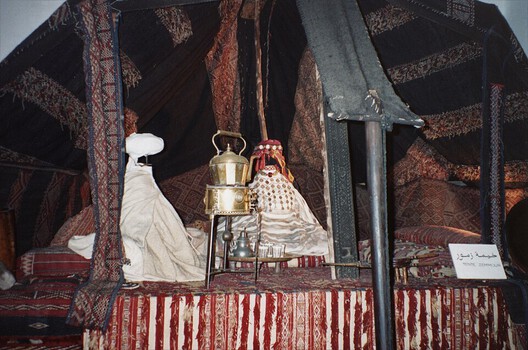
The Bedouin black tent, traditionally woven from goat hair by women practising Al Sadu weaving, demonstrates a remarkably precise understanding of climate and material. The material works with desert conditions instead of resisting them. Goat-hair fibres swell when exposed to moisture, tightening the weave to resist rain, and loosen as they dry, allowing air to circulate during intense heat. Individual textile strips are woven separately before being stitched into larger membranes, enabling damaged sections to be repaired or replaced without dismantling the entire structure.

Save this picture!

Bedouin Craft in Contemporary Infrastructure Influence From Tent to Terminal: Bedouin Craft in Contemporary Infrastructure - Image 6 of 11

Museum of Moroccan art in Rabat – Zemmour tent 1989. Image © JopkeB under the Creative Commons Attribution-Share Alike 4.0 International license

Supported by poles and tensioned ropes instead of rigid walls, the tent remains lightweight, portable, and adaptable to changing patterns of movement. Filtered shade, moving air, and permeability create comfort without complete enclosure. Recognised by UNESCO as an important element of intangible cultural heritage, Al Sadu represents far more than a craft tradition; it contains a sophisticated understanding of environmental performance achieved through material knowledge rather than mechanical technology.

From Tent to Terminal: Bedouin Craft in Contemporary Infrastructure - Image 11 of 11

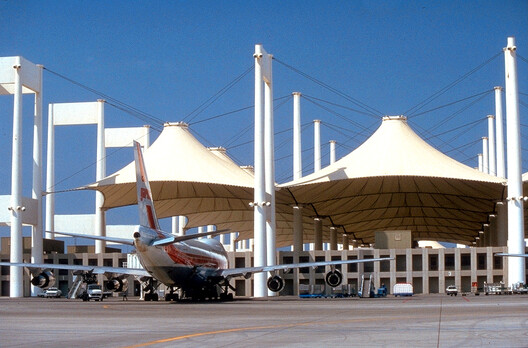
The Western Hajj Terminal of King Abdulaziz International Airport. Image © Diriyah Biennale Foundation

For decades, these ideas were discussed mainly as vernacular architecture. The Hajj Terminal changed that. Completed in 1981, the Hajj Terminal at King Abdulaziz International Airport in Jeddah transformed the environmental logic of the Bedouin tent into one of the twentieth century’s most ambitious pieces of transport infrastructure. Beyond borrowing the tent merely as a cultural image, architects at SOM explicitly described the project as a reinterpretation of the Bedouin tent, translating its lightweight construction into a vast cable-supported tensile membrane system. The result was not simply a dramatic roof, but an entirely different approach to accommodating people in an extreme climate.

Bedouin Craft in Contemporary Infrastructure Influence From Tent to Terminal: Bedouin Craft in Contemporary Infrastructure - Image 7 of 11

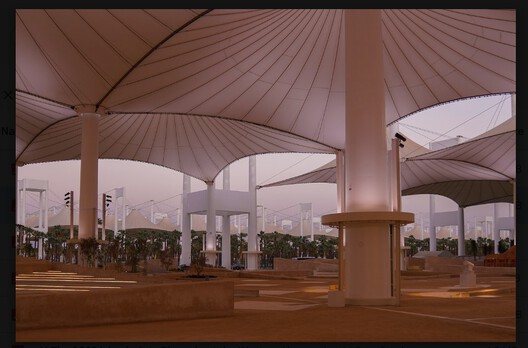
Hajj Terminal at King Abdulaziz International Airport. Image © Jay Langlois | Owens-Corning

The terminal’s celebrated PTFE-coated fabric canopy stretches across hundreds of modular roof bays, creating expansive shaded spaces that remain naturally ventilated while accommodating the extraordinary seasonal demands of the annual Hajj pilgrimage. Unlike conventional airport terminals designed around permanently enclosed, mechanically conditioned halls, the Hajj Terminal accepts that comfort in the desert can emerge through shade, airflow, and openness. Millions of pilgrims occupy these spaces during peak periods before the infrastructure returns to a quieter operational rhythm for the rest of the year. In many ways, its spatial intelligence mirrors that of the Bedouin encampment itself: modular rather than monolithic, flexible rather than fixed, and organised around temporary but highly efficient occupation. The project proved that environmental knowledge developed at the scale of a family dwelling could also organise national infrastructure.

From Tent to Terminal: Bedouin Craft in Contemporary Infrastructure - Image 3 of 11

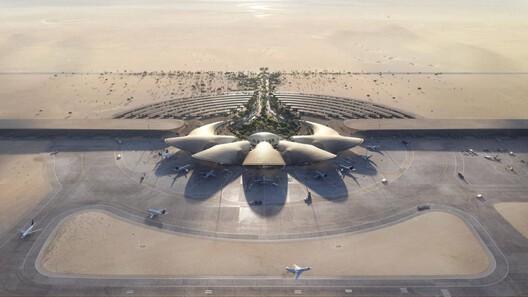
Red Sea International Airport by Foster + Partners, Saudi Arabia. Image © Foster + Partners

Subsequent generations of Gulf infrastructure reveal an interesting shift. Explicit references to Bedouin architecture have become less common. The environmental strategies, however, continue to reappear. Foster + Partners’ Red Sea International Airport, for example, draws inspiration primarily from the surrounding desert landscape rather than Bedouin settlements. Its modular terminal clusters, lightweight roof structures, and carefully shaded circulation spaces are presented as responses to climate, energy efficiency, and future expansion rather than cultural symbolism. The result is unexpectedly familiar: lightweight structures, generous shade, modular growth and buildings that remain adaptable over time. The resemblance is less about influence than about arriving at similar solutions under similar climatic pressures. Faced with the same desert climate, architects repeatedly arrive at principles already embedded within Bedouin construction.

Bedouin Craft in Contemporary Infrastructure Influence From Tent to Terminal: Bedouin Craft in Contemporary Infrastructure - Image 2 of 11

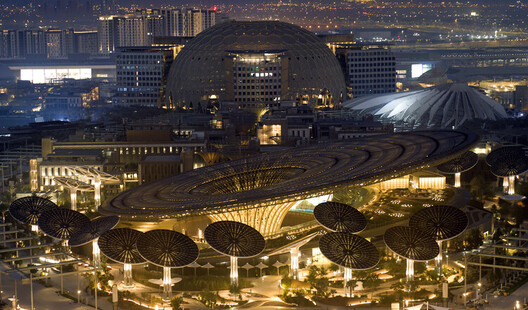
Grimshaw’s Terra Sustainability Pavilion at Expo 2020 Dubai. Image © Expo 2020 Dubai

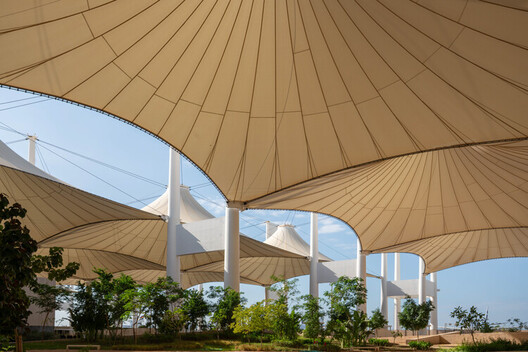
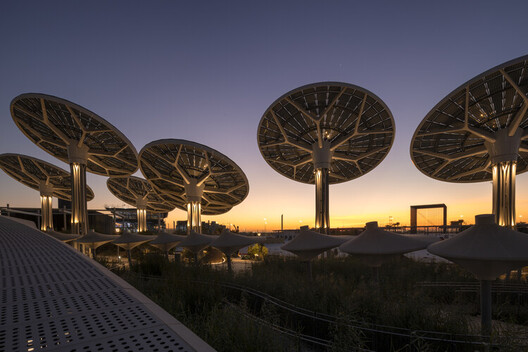
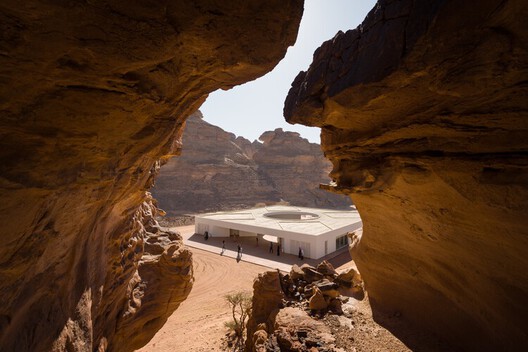
A comparable evolution can be observed in projects beyond transport infrastructure. Grimshaw’s Terra Sustainability Pavilion at Expo 2020 Dubai demonstrates how large roof canopies can function as environmental infrastructure rather than purely formal expression. The pavilion’s expansive shading system filters intense solar radiation while creating usable public space beneath it, reducing dependence on enclosed conditioned environments. Likewise, visitor facilities across AlUla and landscape projects such as the Wadi Hanifah Visitor Centre increasingly prioritise passive cooling, landscape integration, and filtered environmental conditions over iconic architectural form. These projects rarely resemble tents. What they borrow is the way tents work.

Save this picture!

Bedouin Craft in Contemporary Infrastructure Influence From Tent to Terminal: Bedouin Craft in Contemporary Infrastructure - Image 9 of 11

Grimshaw’s Terra Sustainability Pavilion at Expo 2020 Dubai. Image © Expo 2020 Dubai

This distinction may appear subtle, but it fundamentally changes how architectural heritage is understood. Too often, discussions of regional identity focus on preserving appearances while overlooking the knowledge systems that generated them. Bedouin construction was never remarkable because tents looked distinctive. They were remarkable because they solved complex environmental problems using locally available materials, reversible construction, and extraordinary material efficiency. The lesson lies in understanding why weaving produced comfort, flexibility, and repair rather than copying its patterns.

From Tent to Terminal: Bedouin Craft in Contemporary Infrastructure - Image 4 of 11

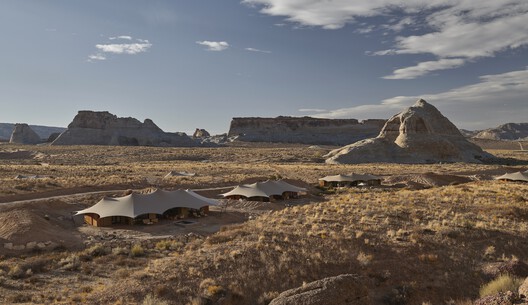
Camp Sarika / Amangiri + Luxury Frontiers. Image © Aman

As architecture confronts increasingly extreme climates, growing resource constraints, and more dynamic patterns of occupation, these lessons become newly relevant. Airports designed for fluctuating passenger volumes, temporary cultural events, disaster relief infrastructure, and rapidly expanding desert settlements all require buildings capable of adapting without excessive material consumption or mechanical dependence. Its principles of lightweight assembly, modular repair, passive environmental control, and climatic responsiveness align closely with many of the ambitions now driving sustainable architecture worldwide.

From Tent to Terminal: Bedouin Craft in Contemporary Infrastructure - Image 10 of 11

Desert X AlUla 2024 Visitor Centre / KWY.studio. Image © Colin Robertson

The Hajj Terminal continues to resonate more than four decades after its completion, for its enduring significance lies in demonstrating that indigenous knowledge can operate confidently within contemporary engineering. It showed that tradition need not survive only through preservation; it can evolve through translation. Desert infrastructure will not become more regionally grounded by repeating the image of the Bedouin tent. It will do so by understanding the environmental intelligence woven into its construction.

This article is part of the ArchDaily Topic: The Architecture of Craft: Handmade Stories in a Digital Age.


.


.