What to Play Next: Rethinking Development Today

What to Play Next: Rethinking Development Today

View of an unfinished high-rise building under construction against a clear blue sky, showcasing urban development. by The Capturist via Pexels

.

By Heiner Janus and Michael Roll – 
What to Play Next: Development after the End of Development

Heiner Janus and Michael Roll argue that the largest aid contraction on record coincides with a reopened decades-old fault line: what “development” means, who it serves — and how the field can reinvent itself for what comes next.

Manchester embodies reinvention like few other places. It built the world’s first industrial economy, watched it rust, and recast itself as the capital of England’s north. When protests turned deadly at the Peterloo massacre, it helped galvanise a tradition of organised labour and democratic reform — one that later produced the suffragettes, founded there by Emmeline Pankhurst. And when Joy Division collapsed, the remaining members re-emerged as New Order. That instinct — not to reassemble what broke but to build something new — was the animating spirit when the University of Manchester’s Global Development Institute convened researchers in mid-April to ask: is the era of Development over? And if so, what replaces it?

The question is sharpened by recent events. According to preliminary OECD data, official development assistance by DAC members fell by 23.1 percent from 2024 to 2025, the largest annual contraction on record, bringing aid back to where it stood when the Sustainable Development Goals (SDGs) were adopted in 2015. The SDGs themselves, once billed as a universal aspiration, have been formally denounced by Washington at the United Nations General Assembly. Yet the upheaval is not just institutional. It has reopened a fault line that has run through the concept of “development” from the start: what the term actually means and who it refers to.

Two distinctions matter. The first is between big-D Development, the organised international project of aid agencies, multilateral institutions, and global goal-setting, and small-d development, the messy, nationally driven process of economic and social transformation that has always owed more to domestic politics than to foreign assistance. The dismantling of the former does not necessarily halt the latter. The second distinction concerns geography. Is development a universal process, occurring in Manchester, Mumbai and Mombasa alike, or does it describe a specific relationship between richer and poorer parts of the world? The conference confronted both questions, and the answers offered little comfort.

The opening plenary dispensed with the notion that this crisis is a temporary disruption. Lee Jones of Queen Mary University argued that we are witnessing a “second Cold War” — not a systemic battle between rival ideologies, as in the first, but a positional struggle within globalised capitalism, where the pillars of the neoliberal order are being pulled apart from the inside. The implications he drew were blunt: the multilateral system is unlikely to survive in its current form, major powers are converging on a miserly approach to development spending, and what remains will be “small-d development” — capitalist integration through reworked value chains, constrained to strategically relevant geographies. National security and economic competition will trump poverty reduction and climate action.

Yuen Yuen Ang of Johns Hopkins University drew a sharper conclusion. The “polycrisis,” she argued, is paralysing only for those attached to the old order. No society has ever escaped poverty through aid or randomised controlled trials. The era of aid dependence is ending, and the spread of universal institutions has ground to a halt. For the global majority, which has never been the producer of the dominant development paradigm, this represents what she calls a “polytunity”: an opening to redefine development itself, away from assimilation and mimicry and toward what she terms an adaptive, inclusive, and moral political economy.

If Jones and Ang diagnosed a paradigm in collapse, Daniela Gabor, SOAS University of London, examined the financial architecture being built in its place. Her concept of the “Wall Street consensus” describes a world where development has been recast as an investible asset class: states de-risk while private capital extracts. The Lake Turkana wind farm in Kenya served as her case in point, a project assembled through a patchwork of dozens of financial agencies that ended up owned by BlackRock, structured in a way she called fundamentally anti-developmental. She pointed to fossil fuel subsidies rolled out in response to rising energy prices, and donor agencies bluntly subsidising domestic companies, as variations on the same theme.

The Wall Street consensus, Gabor argued, is a weak strategy of American hegemony for three reasons: it is not fast enough, not just enough, and not stable enough. Even the World Bank’s renewed interest in industrial policy amounts to little more than subsidising private capital with public money. In closing, she called for a new state-coordinated developmentalism — one that covers all states and combines industrial policy with decarbonisation.

The sharpest challenge to the current development cooperation system came from Ken Opalo of Georgetown University, who opened the second day by accusing the development community of navel-gazing. The sky has not fallen in most low-income countries, he argued, and the pathologies of aid dependency may mean its decline is less catastrophic than the sector assumes. The SDGs, in his telling, represent the lowest common denominator imaginable: any education minister merely parroting SDGs is not thinking about context, and without context, policy outruns the capacity to implement it. His prescription was a pivot from “nano-development,” meaning small, tightly measured interventions, to national development and the proactive use of policy autonomy: context-specific knowledge production, support for local priorities rather than donor-driven faddism, and honest conversations about how European trade and environmental policies actively harm the countries they claim to help.

The closing plenary surfaced the underlying tension. “Development” is becoming a dirty word, observed one participant working in a development agency. Partners find it patronising; within five years it may no longer function as a policy category. Another colleague noted that geopolitics had dominated the conference at the expense of other forms of politics, and that the return to thinking in terms of national development risks ignoring the inequalities within states that development studies had spent decades trying to illuminate. The field is being asked to reopen debates it thought it had closed. Whether development studies can survive without big-D Development remains an open question. The field’s fragmentation and its uncertain institutional footing suggest that muddling through is not an option.

Yet there is a counterweight that has been overlooked: bureaucratic inertia itself. Research on how officials in development agencies behave suggests that career bureaucrats are driven less by ideology than by institutional incentives — blame avoidance, risk aversion, and the desire to keep programmes running. These instincts are usually treated as pathologies. They often are. But in a period of erratic political disruption, they also act as a brake. Bureaucratic routines absorb and dissipate radical policy shifts. Budget lines survive reorganisations; institutions outlast the politicians who threaten to abolish them. None of this defends the status quo. But it does mean that the window for reinvention may be wider than the rhetoric of crisis suggests. The machinery slows the demolition, buying time for those willing to design what comes next.

Manchester knows something about that. Development studies at the university began in the late 1950s as a training centre for “overseas administrators.” Over the following decades it was rebuilt, first into a research institute, then into the Global Development Institute — now one of Europe’s largest centres for the study of development. A key leader in this transformation was David Hulme, the institute’s long-serving executive director, who retires this year. The conference closed with a standing ovation in his honour — a reminder that institutions, like cities, are shaped by people willing to keep innovating. The development community now faces the same test. The raw material for reinvention exists. As any member of New Order could confirm, the hardest part is not letting go. It is deciding what to play next.

.


Heiner Janus is a Project Lead and Senior Researcher at the German Institute of Development and Sustainability (IDOS), where he leads a research project on the effectiveness of development policy.

Michael Roll is a Project Lead and Senior Researcher at IDOS, where he works on the governance of urban sustainability transformations in the Transformative Urban Coalitions (TUC) project.

Photo by Austin Garcia from Pexels

.


.
Building Resilience in Europe and Central Asia Today

Building Resilience in Europe and Central Asia Today

.

Building Resilience in Europe and Central Asia: A Smart Investment for Growth and Jobs

.
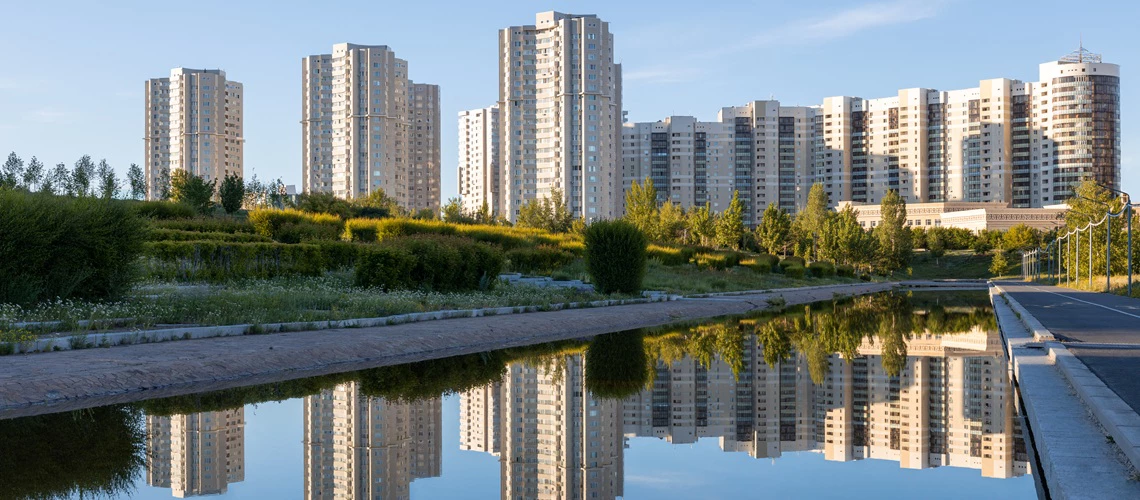
Building Resilience in Europe and Central Asia Today Building Resilience in Europe and Central Asia: A Smart Investment for Growth and Jobs Apartment buildings in Kazakhstan. Photo: IK PhotoStudio

The data is clear: Investments in adaptation and resilience deliver high economic returns but remain insufficient and poorly targeted. Evidence shows that targeted, early investments in resilient infrastructure, climate-smart agriculture, and early warning systems can deliver strong economic and social returns and reduce losses, even under uncertain futures.

However, adaptation finance in Europe and Central Asia is the lowest among all regions as a share of GDP, despite being the world’s fastest-warming continent. In 2025, floods, droughts, and heatwaves cut an estimated US$50 billion from that year’s EU output. By 2029, the longer-term effects are projected to reach US$147 billion, with some countries facing losses approaching 3% of their gross value added.

How countries prepare makes a decisive difference. In Poland, years of investment in flood defenses and early warning systems shielded millions from the worst impacts when, in 2024, Storm Boris killed dozens and caused billions in damages across Central and Eastern Europe. This reflects a broader pattern: countries that invest in resilience before shocks fare better.

A new World Bank report, Building Resilience and Climate Adaptation in Europe and Central Asia, takes stock of where the region stands, what the business case for adaptation is, and what it would take to close the adaptation gap. The findings, compiling evidence from the World Bank Group’s Country Climate and Development Reports, are instructive.

The potential impact of smart investments is considerable. Across the region, World Bank modeling suggests that adaptation and resilience investments equivalent to approximately 1.7% of GDP through 2030 would offset, on average, more than one-third of projected climate-induced economic losses. At the project level, the public investment case for adaptation is also compelling, with most adaptation investments yielding benefits outweighing costs by a factor of 2-10, and some substantially higher. The cost of inaction is also significant. Without adequate adaptation, the short-term losses outlined above propagate into the long-term, leading to annual losses across ECA reaching nearly 6% of GDP by 2050. The transport sector, for example, already sustains damage from hotter temperatures and increasing instances of extreme weather at roughly three times the rate of other regions. For firms, a single-unit rise in temperature variability (that is, larger swings around normal seasonal patterns) is associated with a 9% drop in sales on average.

Across the region, extreme weather events are a direct threat to the jobs and livelihoods that underpin household welfare and economic stability. More than one in three people across ECA live in areas of high exposure to such risks, and substantially more in Bosnia and Herzegovina, Croatia, Moldova, and Romania. Poverty is the single largest driver, accounting for roughly 40% of households’ exposure across the region, rising 70%-90% in some countries. In Moldova, where agriculture supports more than 30% of all jobs, a single drought in 2020 pushed rural poverty up by more than 8 percentage points. In Tajikistan, continued inaction could push an additional 100,000 people into poverty by 2030.

Despite this evidence, Europe and Central Asia significantly under invests in adaptation. The best available data suggests that ECA received just US$3 billion in adaptation finance in 2023. This is the lowest share relative to its economy of any region, and well below the estimated annual needs, which could reach US$20 billion. Private finance, although probably underreported, accounts for barely 2% of that total.

While adaptation is often seen as a government responsibility, resilience is fundamentally built through private decisions by households and firms. But these need to be enabled by the right public information, incentives, and finance.

To close the adaptation gap and accelerate progress, the report identifies five areas where policy can make the biggest difference, including putting private actors in a position to adapt:

  1. Accelerate income growth and close gaps in inclusion: Economic development remains the most powerful tool for building resilience. By focusing on inclusive growth, countries can empower households and firms to invest in their own protection and diversify their economies away from climate-sensitive sectors.
  2. Improve access to information and finance: Governments, firms, and households need reliable climate data and risk information to make informed decisions. Expanding access to finance, especially for the most vulnerable, is crucial for unlocking private investment in adaptation.
  3. Strengthen safety nets and insurance: Adaptive social protection systems and well-functioning insurance markets are essential to protect people and businesses from the financial fallout of increasingly extreme weather shocks, reducing the burden on public finances.
  4. Build resilient infrastructure: Upgrading legacy infrastructure to withstand future climate impacts, mainstreaming adaptation standards in new investments, and promoting sustainable land and water management will reduce exposure and enhance resilience across sectors.
  5. Establish robust macro-fiscal and financial sector policies: Governments must integrate climate risks into fiscal planning, strengthen public investment management, and create enabling environments for private sector participation in adaptation.

Addressing these priorities is not a radical departure from standard development practice – it extends what governments in the region already do. The adjustment required is to adopt a clearer view of how a changing climate alters the risk environment. Countries that make that shift stand to protect not only their populations, but also the jobs, investments, and fiscal positions on which their development depends. The World Bank Group’s work in Europe and Central Asia is increasingly helping countries make exactly that adjustment. The returns are proven and the approach is known; what’s needed now is sequenced execution.

.


.


How Severe Has the Economic Impact of the Iran War Been?

How Severe Has the Economic Impact of the Iran War Been?

Silhouette of Kuwait City’s skyline with a vibrant sunset backdrop, highlighting the urban landscape. by Abdullah Alsaibaie via Pexels

.

How severe has the economic impact of the Iran war been for the Gulf states?

.

By Emilie Rutledge, The Open University


.

The US and Israel’s war on Iran has cast a long shadow over the Gulf. It has placed many of the economies that make up the Gulf Cooperation Council (GCC) regional grouping – Bahrain, Kuwait, Oman, Qatar, the United Arab Emirates (UAE) and Saudi Arabia – under substantial strain.

Since the war began in February, the World Bank has downgraded its 2026 GDP growth forecast for the region from 4.4% to just 1.3%.. Some thinktanks, including Oxford Economics, even predict that some GCC economies will enter recession in the second half of the year.

However, the effects of the war have differed across the region. While the Gulf states are often viewed as a unified economic bloc bound by a shared dependence on hydrocarbons, the conflict has revealed significant differences in their economic vulnerability and resilience.

Countries like Qatar and Kuwait have seen their oil and gas exports seriously disrupted by the effective closure of the Strait of Hormuz. But Saudi Arabia and the UAE, which have access to bypass infrastructure, have been partly able to circumvent this limitation.

Saudi Arabia has diverted 7 million barrels of crude per day through its east-west pipeline, allowing it to export oil from Yanbu on the Red Sea. The UAE, meanwhile, has utilised a pipeline from Habshan to Fujairah to export up to 1.8 million barrels of oil each day from the Gulf of Oman.

This infrastructure has enabled both countries to capitalise on soaring global oil prices. Saudi Aramco, Saudi Arabia’s state oil company, reported a 26% jump in profits in the first quarter of 2026.

Disruption to energy exports is one part of the story. The war has also caused substantial physical damage to energy infrastructure across the region. Around 80 energy facilities, ranging from production plants to refineries and pipelines, have been targeted by Iranian missile and drone attacks so far.

It will take months – and in some cases years – to repair the damage (which stands at an estimated US$58 billion) once the war ends. Qatar’s liquified natural gas industry, in particular, has suffered serious damage. QatarEnergy, the state-owned energy company, says it will take up to five years to repair its Ras Laffan industrial hub alone.

Gulf diversification

The GCC states have adopted strategies to diversify their economies away from a dependency on hydrocarbons. Tourism and aviation are two central pillars of this, with GCC countries investing heavily in these sectors. The Gulf is now home to some of the busiest international airport hubs in the world.

But these industries, too, have been damaged by the war. Financial analysis firm, Moody’s, suggested recently that hotel occupancy in Dubai is set to plummet to 10% in the second quarter of 2026 from 80% before the war. Some Iranian attacks have targeted civilian areas, including hotels and residential buildings, prompting tourists to stay away.

The Iran war has also placed Gulf airlines such as Emirates, Etihad and Qatar Airways under increasing financial pressure. More than 30,000 flights to the Middle East were cancelled in the first month of the war and jet fuel prices – the biggest variable cost to airlines – are up 90% on the annual average.

The logistics sector is another area of Gulf diversification. It has grown rapidly since the early 2000s thanks to the region’s strategic position between east-west trade routes. The UAE’s Jebel Ali Port, for instance, is now one of the world’s largest container ports and the base of Dubai’s multinational logistics firm, DP World.

However, Jebel Ali has seen a 40% drop in vessels due to the war, with container carriers rerouting to alternatives such as Salalah in Oman and Colombo in Sri Lanka. And while DP World has opened emergency land corridors to ports outside the Gulf to keep cargo moving, these routes are costly and have limited capacity.

The UAE and Qatar also both serve as major air freight hubs, acting as bridges for cargo travelling between Asia and Europe. But this has been affected by the war too. Freight rates have increased following attacks on both Dubai and Doha that led to grounded flights and air space closures.

In the long-term, the economic impact of the war on the Gulf economies will hinge on its duration and political outcome. But the risks are firmly tilted to the downside. The fiscal outlook for some GCC states is deteriorating, with several facing scenarios where government spending exceeds revenue. Public sector debt in some GCC states is rising too.

Moody’s has downgraded its outlook on Bahrain, which was already facing longstanding financial issues prior to the war, from “stable” to “negative”. This will make it harder for Bahrain to access much-needed capital and increase future borrowing costs.

GCC economies invest their surplus oil and gas revenues through sovereign wealth funds, which collectively manage between US$4 trillion and US$6 trillion in global assets. Governments are likely to draw on these funds to support domestic spending on reconstruction and bolstering their defences after the war.

This could undermine their future potential to fund large long-term diversification mega-projects such as Saudi Arabia’s Neom City. Plans for Neom, which was initially proposed as a linear city to home 9 million people, have already been scaled down in recent years due to issues including funding pressures.

The Gulf’s loss of “safe-haven” status due to the war, and the resulting reputational damage, cannot easily be reversed. Even after the conflict ends, higher risk premiums will persist for those doing business in the Gulf. Shipping disruptions could take months to unwind, and a prolonged closure of the Strait of Hormuz would be likely to trigger permanent rerouting.

If the conflict drags on, structural shifts in global supply chains may deepen, with lasting costs for the Gulf economies.The Conversation

Emilie Rutledge, Senior Lecturer in Economics, The Open University

This article is republished from The Conversation under a Creative Commons license. Read the original article.

The Conversation.


.

Gulf State Cooperation Has Long Been Shaped by Iran

Gulf State Cooperation Has Long Been Shaped by Iran

Scenic view of Musandam’s rugged mountains and serene coastline under a clear sky. by Siarhei Nester via Pexels

.

Gulf state cooperation has long been shaped by the threat of Iran − but shows of unity belie division

.

Leaders attend the 45th Gulf Cooperation Council Summit in Kuwait City, Kuwait on Dec.01, 2024. Amiri Diwan of Kuwait/Handout/Anadolu via Getty Images
.

Firmesk Rahim, UMass Boston

.

Arab Gulf countries, battered economically and physically by the war with Iran, were keen to put on a united front at a key regional meeting on April 28, 2026.

Gathering in the Saudi city Jeddah, representatives of the Gulf Cooperation Council warned the Iranian government in Tehran that an attack on any one of its six members would be taken as an attack on all. Rejecting Iran’s claims to control of the Strait of Hormuz, Qatari Emir Sheikh Tamim bin Hamad Al Thani later described the summit as embodying “the unified Gulf stance” over the conflict.

The show of togetherness may seem at odds with other recent developments that have seen members of the GCC split over policy and vision for the region – not least the United Arab Emirate’s decision to quit the oil cartel OPEC.

But to followers of Gulf politics, like myself, the scene felt familiar. Time and again, Iran has accomplished what no outside mediator could: It has pushed divided Gulf Arab states together. When tensions rise, the monarchies of the GCC – Bahrain, Qatar, UAE, Saudi Arabia, Kuwait and Oman – tend to stand united, at least publicly.

From revolution to coordination

The modern Gulf security environment was profoundly shaped by the 1979 Iranian Revolution.

Iran shares a narrow and strategically vital waterway with the Gulf states but has long differed in identity and outlook. Specifically, Iran’s Shiite revolutionary model contrasts with the Sunni-led monarchies across the region.

Before 1979, when Iran was ruled by Shah Mohammad Reza Pahlavi Iran and Saudi Arabia, the largest of the Sunni Arab Gulf states, were regarded by Washington as “twin pillars,” protecting American interests in the Middle East. Their relationship was cooperative, but not close.

Then the emergence of the Islamic Republic after the revolution in 1979 introduced a new kind of regional actor – one defined not only by state power but also by Shiite ideological ambition.

Gulf monarchies’ concern over both external security and internal stability was reinforced by the 1979 Grand Mosque seizure in Saudi Arabia, when Islamist militants seized Islam’s holiest site. The event, alongside Iran’s revolution, exposed the vulnerability of Gulf regimes to religiously driven upheaval.

A large plume of smoke is seen amongst buildings
The 1979 siege at Mecca’s Grand Mosque raised concern over security across the Gulf region. AFP via Getty Images

In response to this revolution ideology, Bahrain, Kuwait, Oman, Qatar, Saudi Arabia and the UAE established the GCC in 1981. Although officially framed as a platform for economic and political cooperation, the organization also reflected shared security concerns and Arab identity.

But unity had limits. Member states did not all view threats to their respective regimes in the same way.

Saudi Arabia worried about U.S. pressure for reforms; Kuwait feared neighboring Iraq; Bahrain was concerned about Iran’s influence over its own Shiite population; and the UAE worried about both Iran and its own large foreign workforce. Meanwhile, Oman and Qatar followed a more independent or balanced approach.

These differences would shape the trajectory of the GCC, and Arab Gulf states’ relationship with Tehran.

The eight-year Iran–Iraq War, which began in 1980, brought to the fore fears of Iran’s influence across the region. While Oman declared neutrality, other GCC states supported Iraq by funneling billions of dollars to the regime of Saddam Hussein.

This revealed an early pattern: Gulf states could coordinate politically, but avoided acting as a single strategic bloc. The GCC broadly favored Iraq as a counterweight to Iran, but there was no unified strategy or formal policy.

Security dependence

The Iraqi invasion of Kuwait in 1990 reshaped the region’s security structure again. In early 1991, the move prompted a U.S.-led coalition, including Saudi Arabia and other Gulf states, to expel Iraqi forces. Saudi Arabia’s role was especially significant: It not only hosted coalition forces but also actively participated militarily – marking one of the first major episodes in which a GCC state was directly involved in the defense of another member.

Soldiers are seen walking in a line in the desert.
American troops at Dhahran airport in Saudi Arabia during Operation Desert Shield.
Eric Bouvet/Gamma-Rapho via Getty Images

During – and especially after – the Gulf War, GCC states deepened their reliance on the United States, agreeing to host U.S. military bases and expanding long-term defense cooperation.

This external security umbrella provided a measure of stability, but it also introduced new differences. While Saudi Arabia, Kuwait, the UAE and Bahrain aligned more closely with Washington’s strategic framework, others – notably Oman and Qatar – maintained a more flexible approach. As a result, the appearance of unity coexisted with growing variation in national strategies.

This pattern has continued in recent years, significantly through diplomatic moves to normalize ties with Israel under the Abraham Accords. While the UAE and Bahrain moved quickly to formalize ties with Israel, others remained more cautious.

The effort to contain Iran

When it comes to combating Iranian influence, GCC states have long played different roles.

Oman has consistently acted as a mediator, maintaining open channels with Tehran and facilitating quiet diplomacy — including back-channel talks between Iran and Western states.

Qatar also kept communication open, partly because of shared economic interests with Iran – particularly the management of the North Field/South Pars gas reserve.

Saudi Arabia and the UAE, by contrast, have generally taken a more cautious and at times confrontational stance toward Iran. Both view Iran as a regional competitor and a source of security concerns, particularly due to Tehran’s missile program and its support for ideologically opposed non-state actors.

This contrasting approach to Iran across the GCC allows different states to engage Tehran through multiple channels, but it also makes it harder to form a consistent, unified GCC strategy.

A changing regional balance

The 2003 Iraq War marked a turning point in the GCC-Iran dynamic. The removal of Iraq as a regional counterweight allowed Iran to expand its influence.

And this development sharpened divisions within the GCC.

Saudi Arabia and the UAE increasingly viewed Iran as a direct strategic threat requiring containment. Qatar and Oman, however, emphasized dialogue and mediation.

These differences became more visible during the Qatar diplomatic crisis of 2017. The dispute centered around Qatar’s support for Islamist political groups such as the Muslim Brotherhood, considered a terrorist organization by the UAE and Saudi Arabia.

Saudi Arabia, the UAE and Bahrain severed diplomatic ties with Qatar and imposed a full air, land and sea blockade in June 2017. The three nations accused Qatar of supporting extremist groups and maintaining close ties with Iran. Isolated, Qatar relied on Iran for airspace, trade routes and supplies, strengthening the relationship between the countries. The blockade eventually ended in January 2021, when the parties signed a declaration restoring diplomatic and trade relations at a GCC summit in Saudi Arabia.

GCC under attack

The series of events that began with the Oct. 7, 2023, attack by Iranian-backed Hamas in Israel shook up GCC relations with Tehran.

In June 2025, in response to the U.S.-Israeli attack on Iran, Tehran struck a U.S. base in Qatar – the first such attack on a GCC state by Tehran.

At an extraordinary meeting in Doha, Qatar’s capital, GCC members pledged full solidarity with Qatar and strongly condemned the Iranian attack.

But it was not enough to prevent Iran from attacking all six GCC states in response to the ongoing conflict begun in February 2026 by U.S. and Israel.

The subsequent closure of the Strait of Hormuz, affecting 20% of global oil supplies, has sparked what many see as the biggest crisis in the Gulf since the inception of the GCC.

The GCC responded by emphasizing collective security and unity. But yet again, the public show of togetherness masks divergent views on how to respond. When the war ends, each state will likely return to its own strategic and foreign policy approach.

Understanding the pattern

Since 1979, Tehran’s actions in the Gulf region have exposed two parallel developments. On the surface, there are shared concerns among GCC members and public shows of unity. But underneath this facade of unity, each state has continued to develop its own national priorities and risk tolerance.

The combination of these two factors helps explain why the GCC often appears unified during crises, while remaining internally divided over how to respond to them.

Rather than viewing the GCC as a fully cohesive bloc, it may be more accurate to see it as a framework where cooperation and disagreement coexist.The Conversation

Firmesk Rahim, PhD Student, UMass Boston

This article is republished from The Conversation under a Creative Commons license. Read the original article.

The Conversation

.


.


Devex Newswire: Africa’s energy-climate conundrum

Devex Newswire: Africa’s energy-climate conundrum

A scenic view of Atlas Mountains in Morocco featuring solar energy installations under a clear sky. by Pierre Matile via Pexels

By Michael Igoe 


In the 1st November 2021 article, Devex Newswire elaborates on Africa’s energy-climate conundrum. This should address not only the sub-Saharan countries but should also include all those countries of the MENA region, especially those without any fossil fuels resources. Climate change is a major threat to people's and countries' future prosperity, and it has by now been felt and/or sensed by all regardless of the varying levels of development.

In the COP23 in Bonn, Germany on November 6 to 17, 2017, an analysis addressing the strategic components of the necessary energy transition for Africa was published. It would be worth it to look at it again. After of course going through Michael Igoe's thoughts

Devex Newswire: Africa’s energy-climate conundrum

By Michael Igoe 

Devex Newswire: Africa’s energy-climate conundrum

COP 26 is officially underway in Glasgow. On a long list of thorny questions is this one: Should lower-income countries be denied access to fossil fuels even while wealthier countries continue to exploit them?

Europe and the United States have led a charge at the World Bank to end the institution’s support for fossil fuel projects while their own economies continue to rely heavily on polluting energy sources.

That disparity has fueled a growing debate over how financial institutions and development strategies should maintain a role for fossil fuels — particularly natural gas — as they look to balance climate mitigation and energy access goals. The debate comes to a particular head in Africa, where nearly 600 million people still lack access to energy, Adva Saldinger reports.

“The idea that in the West, gas is part of energy security, but a climate problem in Africa, is an ethically and politically untenable position,” says Todd Moss, executive director of the Energy for Growth Hub.

The question of how to balance these two imperatives — climate and energy — is a key sticking point in the conversation about what constitutes a “just transition” to low-carbon economies. The impacts of climate change continue to mount, particularly in the same countries where energy access remains limited and which have contributed least to global emissions.

The challenge facing delegates at COP 26 is to offer a collective vision for remaking the global energy system that combines a commitment to fairness with the resources and policies to achieve it.

Read more in the original Devex publication.