Green Colonialism and Africa’s Quest for Energy Equity

Green Colonialism and Africa’s Quest for Energy Equity

A solar-powered street light set against vibrant green conifer trees, symbolising sustainable energy.  by finix photographer via Pexels

.

Green colonialism and Africa’s renewable energy push: pathways to sustainable green technology partnerships

.

By implementing rights-based policy safeguards, African nations could unlock sustainable green technology partnerships that expand access to clean and reliable energy and create green jobs.

.

By Damilola S. Olawuyi

Published on Jul 14, 2026 – APRI

Summary
  • Endowed with abundant natural resources and a growing youth population, Africa has the potential to become the global hub for solar, wind and green hydrogen investments.

  • With about 600 million Africans still lacking access to electricity, the continent offers significant investment opportunities in renewable energy technologies and solutions that deliver clean, reliable energy to underserved communities, unlocking green jobs and other economic opportunities.

  • Despite the prospects of emerging green technology partnerships, significant concerns arise regarding their design and implementation.

  • While emerging green technology partnerships may offer African nations short-term financing and technology access, in the long term, they risk entrenching green colonialism, i.e., the production of clean energy in a manner that exploits Africa’s natural resources, prioritises the needs of other world regions and undermines social, environmental and human rights safeguards, especially in Indigenous communities.

  • Unclear domestic legal frameworks on green investments, a lack of human rights safeguards, inadequate negotiation capacity and a lack of supportive policies on local content and clean technology entrepreneurship risk re-entrenching green colonialism, technology dependence and unsustainable debt accumulation, and could hinder local innovators from playing active roles in shaping Africa’s green energy future.

  • To catalyse just, inclusive and sustainable green technology partnerships, African nations must: embed robust human rights due diligence requirements within green technology agreements in alignment with international best practices; develop national strategies and safeguards on debt sustainability; prioritise local content initiatives aimed at addressing barriers to homegrown clean technology entrepreneurship; and invest in training and capacity development programmes and resources to enhance the institutional capacity of relevant agencies and ministries involved in the negotiation and implementation of green technology partnership arrangements.

.

Introduction

Endowed with abundant sunshine, wind and hydropower resources, Africa has significant potential to become the next global hub for solar, wind and green hydrogen investments, offering a path to both energy and economic diversification. In 2015, the 24th Ordinary Assembly of the Heads of State and Government of the African Union adopted Agenda 2063, a transformational plan aimed at tapping this potential and advancing economic, social and environmental development in Africa by 2063. One of the key priority areas of the agenda is to ‘ensure modern, efficient, reliable, cost-effective, renewable and environmentally friendly energy to all African households, businesses, industries and institutions’. Agenda 2063 builds on Goal 7 of the United Nations Sustainable Development Goals (SDG 7), which aims to advance clean, stable and affordable energy for all by 2030.

To achieve the objective of delivering reliable, modern energy to the approximately 600 million Africans who still lack access to electricity, several African countries have identified investment in renewable energy infrastructure and technologies as core priorities. Some have already released national visions and strategies to promote investment in renewable energy and clean technologies as pathways to open up other economic sectors. For example, a central aspect of Nigeria’s Energy Transition Plan is to create jobs to ‘lift 100 million Nigerians out of poverty and driv[e] economic growth’. Similarly, economic diversification is a key priority area in South Africa’s Just Energy Transition Investment Plan (JET IP) for 2023-2027, which aims to create ‘quality jobs in new sectors like electric vehicles, green hydrogen, renewable energy and manufacturing’. Similar framing of the green transition as an economic opportunity, and not just a climate imperative, is found in policy visions in Morocco, Ghana, Malawi, Kenya, Rwanda, Tanzania and Uganda, some of which have already made progress in promoting homegrown solutions that deliver clean and reliable energy to underserved communities, while unlocking green economic opportunities.

Yet, as shown in the United Nations’ technology needs assessment (TNA) reports, many African countries still lack the homegrown renewable energy technologies needed to accelerate the low-carbon energy transition. Green technologies, such as solar panels, require response and grid control software and smart distributed energy resource management systems (DERMs) that are simply not available on the continent. This forces countries to import technologies they could otherwise manufacture domestically. Nigeria, for example, imported over four million solar panels in 2023 alone, at a cost of more than USD 200 million annually, making solar energy less affordable to businesses and households, especially in poor and underserved communities.

As part of efforts to address these technology gaps, African countries are increasingly entering into new partnerships aimed at attracting green technologies and investments needed to develop and maximise the continent’s renewable energy resources. In addition to a solar partnership agreement with the Netherlands, Nigeria has recently announced a new EUR 7.6 billion green energy agreement with China to develop green hydrogen, a clean energy source produced from renewable electricity. In 2024, Tunisia signed a memorandum of understanding with European conglomerates – TotalEnergies, EREN Groupe and VERBUND – to develop green hydrogen for export to Central Europe. Tunisia has also entered into green hydrogen arrangements with Saudi Arabia and several European countries. Other African countries such as Namibia, South Africa, Egypt and Morocco have announced green technology partnerships focused on leveraging their renewable energy potential to unlock a green and sustainable energy future, while also creating jobs and economic benefits domestically.

Meanwhile, China has invested more than USD 13 billion in clean energy projects across Africa since 2000. Furthermore, France, Germany, the United Kingdom, the United States and the European Union have announced Just Energy Transition Partnerships (JETPs) aimed at mobilising financing and technology assistance for African countries to transition to clean energy. These JETPs have included a USD 8.5 billion pledge for South Africa, USD 2.5 billion for Senegal and proposals to support renewable energy technology development in other African countries such as Senegal, Egypt, the Ivory Coast, Kenya and Morocco.

However, despite the prospects of these emerging green technology partnerships, significant concerns arise regarding their design and implementation. While these partnerships may offer African nations short-term financing and technology access, in the long term, they risk entrenching green colonialism, i.e., the production of clean energy in a manner that exploits Africa’s natural resources, prioritises the needs of other world regions and undermines social, environmental and human rights standards, especially in Indigenous communities.

This paper, therefore, addresses two questions: What are the risks of green colonialism in Africa’s renewable energy partnerships, and what policy safeguards should African countries adopt to address them? To do so, the paper relies primarily on publicly accessible partnership agreements and reports by surveyed African countries (Egypt, Namibia, Nigeria, Tunisia, South Africa, Morocco, Kenya, the Gambia, Tanzania and Zambia) to assess the drivers and implications of green colonialism risks in emerging partnership agreements. Furthermore, the paper adopts an analytical review of the published literature to unpack and analyse emerging policy responses to the risks of green colonialism in these countries. Owing to its scope and the nature of the methodological approach, the paper cannot be regarded as representative. That said, since the survey is combined with the literature review, it provides an analytical profile of and insights into the drivers of green colonialism risks in Africa’s renewable energy partnerships.

The paper proceeds in three sections, Section I being this introduction. Section II unpacks the four key manifestations of green colonialism trends and risks in the design and implementation of green technology partnerships. Section III discusses the need for a holistic reform process that places transparency, accountability, and public participation at the heart of green partnership agreements, from design and approval through to implementation, to achieve just, sustainable, and inclusive outcomes.

.

More technology partnerships, less sustainable development? Drivers of green colonialism risks

Although Africa is not a homogeneous geographical unit, the growing demand across the continent for foreign technologies and finance to expand access to clean and reliable energy provokes questions about the potential risks of emerging green technology partnerships. Four key concerns emerge: i) high external debt obligations; ii) export-driven energy production; iii) adverse impacts on water, energy and land resources; and iv) restrictive fiscal and contractual terms.

The first key question is the extent to which green technology partnerships involve new external debt obligations. Without adequate safeguards, emerging green technology agreements risk exacerbating debt levelsEstimates indicate that African governments already spend close to USD 163 billion every year on debt service, with countries such as the Gambia, Egypt, the Ivory Coast and Kenya projected to be at risk of severe debt distress in 2026. Green partnership agreements that involve new loans could significantly increase this risk. Nevertheless, as they grapple with ageing energy infrastructure, rising energy poverty, and limited domestic funding alternatives, African countries are increasingly embracing green technology partnerships, even when these result in new debt obligations. For example, the recent announcement of a USD 5 million loan from the Government of Canada and the International Finance Corporation to finance solar hybrid mini-grids in northern Nigeria has prompted questions regarding its potential to exacerbate Nigeria’s rising debt profile.

At the same time, China’s growing influence in green partnership agreements across Africa is raising concerns about unsustainable debt traps. Such high debt burdens risk re-entrenching the colonial legacy of ‘debt-trap diplomacy’, whereby colonial powers lent excessive amounts of money to African countries and obtained significant leverage over collateralised national infrastructure and political decision-making processes when those nations struggled to repay their debts. Green energy partnerships that cede financial, social or political sovereignty will not only undermine sustainable development but also make it difficult, if not impossible, for African countries to achieve energy security. SDG 17.4 specifically calls on developed countries to ‘assist developing countries in attaining long-term debt sustainability through coordinated policies aimed at fostering debt financing, debt relief and debt restructuring by 2030’. Achieving this target will require new forms of green technology diplomacy and partnerships that do not lead to unsustainable debt accumulation.

The second consideration is the extent to which green technology partnerships boost domestic energy access and technology manufacturing capacity. Green partnership agreements that primarily focus on exporting renewable energy produced in Africa to meet the energy needs of investing countries also risk entrenching green colonialism. Green hydrogen technology investments in Tunisia, Namibia, South Africa, Egypt and Morocco have attracted criticism on this front, despite their economic and financing prospects for delivering low value addition to local communities through enhanced domestic energy access, local content, empowerment and entrepreneurship.

The very premise of developing Africa’s renewable energy resources for export to meet energy needs in China, Europe, and other regions outside Africa introduces a complicated resources-for-money arrangement, whereby Africa’s natural resources are exchanged for financial, technological, security, and other forms of support. Meanwhile, the resources return to African countries as finished technologies or products that Africans themselves cannot afford. Such deals are not new in Africa. In fact, they mirror colonial-era power asymmetries, which saw Africa’s natural resources exported to other regions under often foreign-dictated concessions. For many years, the stranglehold over resource production, with little or no local value addition, by large international oil companies (IOCs) – known as the Seven Sisters, who came mainly from the USA, Canada, the Union of Soviet Socialist Republics (USSR) and China – undermined African states’ resource sovereignty, i.e., their ability to make decisions on their own natural resources. The current rush for Africa’s renewable resources risks re-entrenching this legacy and could trigger a new resource curse, this time in renewable energy.1

The third risk associated with trends in green technology partnerships concerns adverse impacts on water, energy, and land rights. This is particularly concerning when land grabbing leads to forced displacement, especially of Indigenous groups. A recent report documents the growing evidence that clean energy projects in Africa, especially hydropower projects, are linked to human rights violations, including land grabs, modern slavery and forced labour. Furthermore, a high incidence of workers’ protests over poor working conditions associated with Chinese investments in Kenya, the Gambia and Zambia are attracting scrutiny of the design of green energy partnerships which lack social and human rights safeguards to ensure rights-based implementation. These developments are in danger of re-entrenching the colonial legacy of state-aided dispossession of African peasants, pastoralists, nomads and Indigenous communities from ancestral lands for foreign capital.

The fourth risk arises when green technology agreements include restrictive clauses and provisions that may constrain a country’s ability to adopt and implement new environmental or human rights regulations. A recent UN report has highlighted how stabilisation provisions in Bilateral Investment Treaties (BITs) and clean energy agreements, which freeze states’ ability to update existing laws or contracts, may constrain countries’ ability to develop new legislation or regulations. Tanzania, for instance, is currently facing three arbitration proceedings by international companies as a result of new legislation passed in the country to regulate green investments in the mining sector. Eight similar disputes have been filed against the Democratic Republic of the Congo (DRC), Rwanda, Burkina Faso, Mozambique and Niger.

The courtroom battles and arbitration proceedings arising from green technology partnerships underscore the need for African countries to carefully ensure that current or new green technology investments do not delay or constrain their ability to regulate such projects in the future. Previous studies have documented how inadequate access to information about green technologies and insufficient legal capacity to negotiate fair and transparent investment agreements often result in a cycle of investment arrangements that exacerbate technology dependence, limit regulatory autonomy and lead to costly disputes and legal liability. Such lopsided agreements risk re-entrenching the colonial legacy of inequitable resource and technology partnerships, from which it may take African countries decades to detach.

The question, therefore, is how to ensure that Africa’s green technology partnerships deliver just and inclusive social, economic and environmental benefits that unlock a sustainable energy future for the continent.

.

Placing justice and equity at the heart of Africa’s green technology partnerships

Addressing the risks of green colonialism in Africa’s renewable energy partnerships will require a holistic reform process, one which closes the governance gaps that drive and deepen the vulnerabilities of many African countries to these risks in the first place. The danger is that effective implementation of green partnership agreements will be marred by perennial barriers to good governance, which would otherwise strengthen transparency, accountability and public participation (TAP) in resource development and management.

According to a 2021 resource governance index, virtually all African countries score very low on law and governance structures that promote TAP in the natural resource sector. Many resource-rich African countries have consequently fallen prey to a resource curse, whereby corruption and illicit financial flows not only rob them of the resources needed to implement infrastructure development and renewable energy programmes, but also contribute to the poverty and economic scarcity which drive rising debt levels. For example, despite Nigeria’s dominant position as Africa’s largest oil producer and exporter, many years of corruption and resource mismanagement have left the country with a high debt burden, wealth inequality, technological dependence and growing poverty. According to a 2025 World Bank report, approximately 139 million Nigerians (about 62% of the population) live in poverty.

To prevent such trends, the African Union Panel of the Wise encourages all African countries to ensure that ‘transparency and accountability mechanisms are in place prior to, and during, initiatives to develop and exploit natural resources’. According to the panel, ‘these mechanisms should include full reporting on the revenues collected from natural resource activities and on the allocation of these revenues to programmes, governments and communities’. Addressing the risks of green colonialism will therefore require investments and agreements that place public interest and national sovereignty at the heart of the emerging green technology agenda. At the core of these initiatives will be transparency, accountability and inclusivity, as outlined below.

Transparency requires enhancing the availability, accessibility, and accuracy of information on green partnership arrangements. As noted earlier, some of the concerns associated with emerging green partnership arrangements in the countries surveyed for this paper relate to a lack of publicly accessible information on the potential benefits, costs, health impacts and public benefits of such agreements, especially for local communities. This fuels public concerns and perceptions of colonial-era scenarios of unequal trade relationships. For example, while information on the Canada-European Union Green Alliance is publicly accessible, accessing information on the green finance loan from Canada to Nigeria does not yield any publicly accessible result on government portals. As the African Union Panel of the Wise states, promoting transparency in the context of green partnerships will require African countries to release publicly accessible reports on the nature, scope, elements and financial details of green partnership alliances in a manner that sustains public confidence and trust.

Enhanced accountability, which the AU Convention on Preventing and Combating Corruption emphasises as a mechanism to promote good governance, includes establishing processes at the design, approval, and implementation phases to monitor the outcomes of green partnership agreements against their stated objectives. At the design phase, rather than prioritising tax and fiscal incentives to deliver low-cost energy for other regions of the world, the central focus of Africa’s green technology partnerships and investments should be on enhancing domestic energy security, thereby providing a reliable, affordable and accessible clean energy supply to Africa’s energy poor. During the approval phase, technology partnerships should include adequate safeguards to ensure debt sustainability. African countries should develop national strategies and policies that limit the approval of new debt and integrate debt restructuring into new green partnership agreements.

Regarding implementation, one innovative approach to enhancing access to financing for green technologies and projects without incurring additional debt is the use of debt-for-nature swaps. Several African countries, such as the DRC, are already following this path, seemingly inspired by initiatives across the globe. Costa Rica, for instance, has successfully leveraged debt-for-nature swaps to conserve rainforests since the 1980s. More recently, Belize has recorded progress in using debt-for-nature swaps to fund ecological restoration programmes, which have reduced the country’s external debt by 10% of gross domestic product (GDP). Leveraging such innovative financing solutions in Africa’s green technology partnerships could unlock similar financial, environmental and economic co-benefits for the continent. This will enrich the mix of increased green financing, debt forgiveness and other concessional lending initiatives that will help reduce the debt burden in Africa and free up financing for the green transition. This mix should be strategically integrated into African countries’ negotiations of green partnership agreements.

Advancing accountability also includes embedding robust human rights and sustainability measures into green technology agreements in strict adherence to international human rights standards and the United Nations’ guiding principles. This alignment involves conducting thorough human rights and environmental impact assessments across the negotiation, planning, funding and execution stages of green technology investment initiatives, and swiftly addressing any negative impacts or risks that may arise. By embedding human rights safeguards in the approval processes for green technology investment initiatives, African countries, together with local communities and other stakeholders, could better assess the implementation of green partnership agreements to prevent adverse impacts.

There is also a need to enhance public participation in implementing green partnership agreements through active energy citizenship. Excessive dependence on imported green technologies by African countries creates imbalances in power relationships that exacerbate the risks of green colonialism. Previous studies indicate that, due to unclear legal frameworks for green investments, a weak investment climate and a lack of supportive policies for clean technology entrepreneurship, domestic capacity for green technology remains weak across the continent. African countries are simply unable to attract the sustained flow of private sector investments and technologies needed to drive the transition to sustainable economies and societies. The result is a perpetual cycle of dependence on imported technologies.

African countries must therefore prioritise local content initiatives that address the barriers to homegrown clean technology entrepreneurship. A starting point is to undertake comprehensive assessments of the legal and institutional barriers that weaken private-sector participation in green technology development. Supportive commercial and investment laws that simplify the process of business formalisation, registration and participation in transition programmes should be established. In addition to these legal reforms, financial incentives should be provided to encourage entrepreneurs to unlock homegrown green solutions. These can be in the form of direct grants, concessional or low-interest loans, investment tax credits or reversed taxes, or de-risking instruments such as insurance, all of which should be geared towards supporting the upfront capital investment needed to develop clean technology initiatives.2

Finally, addressing the risks of green colonialism in Africa’s renewable energy partnerships will require enhancing the institutional capacity of the agencies and ministries involved in the design and implementation of green technology partnership arrangements. Negotiating win-win agreements will require African countries to invest in training and capacity-development programmes and resources for officers across a wide range of legal domains, including sustainable development, international trade and investment, treaty negotiation, diplomacy, and technology. International development organisations can support this process by making Africa-focused knowledge materials, such as the newly published Sustainable Development Law, more accessible to African policymakers, for example, by supporting their translation into local languages. Higher education institutions and professional societies also have key roles to play in developing tailored courses on green diplomacy, international law and sustainable development. These courses will offer hands-on executive knowledge and skills to African negotiators, deepening their expertise in green technology development and deployment.

.

Conclusion

The abundant natural resources of the African continent, coupled with its significant workforce and youth population, make it an attractive hub for new green energy investments and partnerships. However, several barriers risk re-entrenching green colonialism, unsustainable debt accumulation and technology dependence. These include unclear legal frameworks for green investments, weak human rights safeguards, limited capacity for negotiation, and inadequate policies to support local content development and clean technology entrepreneurship.

Africa’s green technology partnerships must ultimately be designed, implemented and led by Africa, with the support of international stakeholders interested in unlocking just, inclusive and sustainable green investment opportunities. Overcoming green colonialism will therefore require strong political will on the part of African countries to implement supportive domestic laws and policies that move the continent beyond being a passive recipient of green technologies and investments towards becoming a co-creator of homegrown green technologies. By establishing rights-based policy measures, African nations can refocus green technology partnerships on domestic value creation and sustainable development priorities. These partnerships can then help diversify their economies and boost reliable, affordable access to modern energy.

Endnotes

[1] The ‘resource curse’ describes the tendency of countries with abundant energy resources to underperform in energy security, economic growth and other development outcomes.

[2] Olawuyi, D. S. (2024, December 30). Private sector investment crucial for just energy transition in Africa. Hamad Bin Khalifa University.https://www.hbku.edu.qa/en/news/private-sector-investment-in-africa

About the Author
avatar
Professor Damilola S. Olawuyi

Professor Damilola S Olawuyi SAN is an international lawyer, professor, and policy adviser specialising in business and human rights, energy, natural resources, and environmental law.

Despite Hurdles, Don’t Give Up on Sustainable Development Goals

Despite Hurdles, Don’t Give Up on Sustainable Development Goals

View of modern residential buildings surrounded by lush greenery. by Mahmoud Zakariya via Pexels

.

Despite hurdles, don’t give up on Sustainable Development Goals, UN urges

.

A smiling Cambodian couple standing in front of a newly installed solar panel system in their rural village, representing UNDP's work on renewable energy access and poverty eradication.

© UNDP A couple in Cambodia stands by a newly installed solar power panel.

.

 SDGs

.

In a world of “parallel realities” where stark inequalities seemingly divide people and challenge the promise of multilateralism, the vision of the Sustainable Development Goals (SDGs) is to bring people together and help them achieve a better reality.

President of key UN body ECOSOC, Lok Bahadur Thapa, reminded the international community on Monday that no country can achieve sustainable development on its own, and that political will and momentum is necessary to achieve the SDGs by 2030.

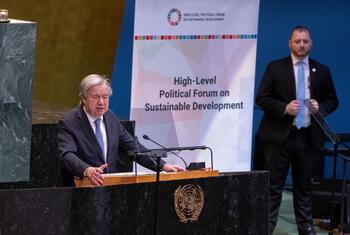
UN Secretary-General Lok Bahadur Thapa speaks at a podium during the High-Level Political Forum on Sustainable Development.
UN Photo/Eskinder Debebe Lok Bahadur Thapa, President of the UN Economic and Social Council, addresses the Ministerial Segment of the High-Level Political Forum on sustainable development.

Let us be judged by results,” Mr. Thapa said.

The speech marked the beginning of the top ministerial level meeting of the High-Level Political Forum on Sustainable Development (HLPF), the UN’s annual forum to assess progress on the Sustainable Development Goals (SDGs) which is convened by ECOSOC – the UN Economic and Social Council.

The High-Level Segment will conclude on Thursday with a negotiated declaration between government ministers and heads of State on concrete actions Member States will take to advance progress on the 17 Goals.

The latest draft of the 2026 ministerial declaration includes commitments to increase investment in the SDGs and develop international rules for transformative technologies such as artificial intelligence.

Tweet URL

By the end of the HLPF, 36 countries will have presented so-called Voluntary National Reviews (VNRs) on their progress in achieving the SDGs and shared best practices with other Member States.

As the HLPF kicked off last Tuesday in New York, the UN simultaneously released its annual SDG Progress Report, finding that coordinated action on the goals has succeeded but governments must urgently accelerate action if they are to be met by their 2030 deadline.

Goals need financing

Opening Monday’s session, Mr. Thapa, UN Secretary-General António Guterres and General Assembly President Annalena Baerbock, admitted that the SDGs were not on track.

At the same time, they emphasized that the UN and its Member States know what works to create sustainable development, but that financing remains the biggest obstacle to quick and effective action.

In fact, the principal finding of the SDG Progress Report – that only 36 per cent of SDG indicators with trend data are on track or making moderate progress – reflects a lack of effective financing rather than a lack of goodwill, according to Mr. Guterres.

He noted that developing countries pay borrowing costs several times higher than rich countries, and that many spend more on debt service than national services, making them ill-equipped to implement the SDGs without assistance.

“We need to increase the voice and participation of developing countries, reforming the global financial architecture to ensure those countries receive the support they need,” Mr. Guterres said.

To increase SDG financing, Mr. Guterres stressed the need for reforms to the multilateral development banks to unlock private investment and ensure equitable access for developing countries.

UN Secretary-General António Guterres speaks at a podium during the High-Level Political Forum on Sustainable Development at the UN Headquarters in New York.
UN Photo/Eskinder Debebe Secretary-General António Guterres delivers remarks at the opening of the Ministerial Segment of the High-Level Political Forum on sustainable development.

Jaewon Choi, leader of the DMUN Foundation, a youth-led, non-governmental organisation that empowers young people to engage in multilateral processes, also weighed in, demanding that young people be included in initiatives to achieve the Goals.

A revitalized UN must integrate meaningful youth engagement,” Mr. Choi told ministers.

Promise of multilateralism

The speakers urged Member States to prioritise SDG financing, debt relief, civil society partnerships and concrete collective action as they negotiate.

Mr. Guterres highlighted the Pact for the FutureSevilla CommitmentDoha Political DeclarationHigh Seas Treaty and Antigua and Barbuda Agenda for Small Island Development as evidence that multilateralism can still deliver.

“Development requires all hands on deck – businesses, development banks, innovators, civil society, community leaders and young people,” Mr. Guterres said.

General Assembly President Annalena Baerbock speaks at the High-Level Political Forum on Sustainable Development.
UN Photo/Eskinder Debebe General Assembly President Annalena Baerbock addresses the Ministerial Segment of the High-Level Political Forum on sustainable development.

The very first words of Ms. Baerbock’s address to ECOSOC – “We are not on track” – set the stage for the UN’s call to Member States at the HLPF: despite immense challenges, giving up on achieving the SDGs by 2030 is not an option.

On target

As a noted football fan, Ms. Baerbock ended her speech with a timely comparison between the SDGs and this year’s gripping football World Cup competition.

“It has told us very clearly one thing: to never give up at minute 80,” Ms. Baerbock said. “One goal at the right moment can change everything. And 17 goals at the same moment can change the world. It is up to us to play the last four years together.”


How MENA Is Reshaping the Global Energy Future Today

How MENA Is Reshaping the Global Energy Future Today

A striking solar power tower illuminated under the clear blue sky in Morocco. by pierre matile via Pexels

.

From Oil to Renewables: How MENA Is Reshaping the Global Energy Future

.

.

The Middle East and North Africa (MENA) is rapidly transforming from a fossil fuel-dominated region into one of the world’s fastest-growing clean energy markets. Governments are investing heavily in solar, wind, and green hydrogen while setting ambitious climate targets that are reshaping their long-term energy strategies.

The region’s combination of abundant sunshine, strong wind resources, competitive project costs, and supportive government policies is attracting billions of dollars in investment. As renewable projects move from planning to construction, MENA is positioning itself as a global leader in the clean energy transition.

Renewable Targets Are Driving a Regional Energy Shift

Climate ambition across MENA has accelerated significantly over the past few years. According to the International Energy Forum’s (IEF) Progress Report for MENA NDCs and Climate Action, most countries in the region have strengthened their renewable energy commitments under their Nationally Determined Contributions (NDCs).

As of 2024, 14 MENA countries had included explicit renewable energy targets in their climate plans. Twelve countries expressed these goals as a share of electricity generation, with many aiming for renewable electricity to account for at least 30% of their power mix by 2030. Four countries instead adopted capacity-based targets measured in gigawatts (GW).

Beyond their 2030 commitments, many governments have also introduced long-term strategies extending to 2050. These plans include net-zero emissions goals and higher renewable energy shares, signaling that clean electricity is becoming a central pillar of national economic development rather than simply a climate initiative.

Although each country follows its own pathway depending on its resources and existing energy system, the overall direction is consistent. Governments are working to diversify electricity generation, improve energy security, reduce emissions, and create new industries that support long-term economic growth.

Together, these commitments represent a structural shift in how the region plans its future energy system.

mena renewable outlook
Source: IEF

Solar Leads an Unprecedented Expansion

Solar power has become the engine behind MENA’s renewable energy growth.

  • The IEF estimates the region could install between 220 GW and 450 GW of solar photovoltaic (PV) capacity by 2035, allowing solar to provide roughly 25% of regional electricity generation.

This rapid expansion is supported by some of the world’s most competitive renewable energy markets. Public auctions held across the region have consistently produced record-low electricity prices.

In 2024, utility-scale solar projects achieved prices between $10 and $13 per megawatt-hour, while onshore wind projects secured bids ranging from $16 to $17 per megawatt-hour.

Several factors explain these exceptionally low costs:

  • Excellent solar irradiation across desert regions
  • Large-scale project development
  • Long-term power purchase agreements
  • Strong government support that lowers investment risk

The region is also home to several of the world’s largest renewable energy developments. Dubai’s Mohammed bin Rashid Al Maktoum Solar Park, for example, is expanding toward 5 GW of installed capacity, demonstrating how MENA countries are building renewable projects at a scale rarely seen elsewhere.

Solar MENA
Source: IEF

Project Pipeline Shows Strong Momentum

Recent data from Dii Desert Energy indicates that the region has entered what it describes as an “exponential growth phase.”

Operational renewable capacity reached 43.7 GW by the end of 2025, while the total development pipeline climbed to approximately 202 GW. This growing pipeline places the region much closer to achieving its renewable energy ambitions for 2030.

Renewable energy mena
Source: dii-desertenergy

Solar continues to dominate the expansion.

Installed solar PV capacity increased to 34.5 GW by the end of 2025, representing a sharp rise compared with previous years. Even more impressive is the development pipeline, where solar accounts for roughly 130 GW of future capacity.

Together, these figures suggest that renewable deployment across MENA is accelerating rather than slowing, with utility-scale projects driving most of the growth.

Saudi Arabia and the UAE Are Setting the Pace

Several countries are emerging as regional leaders, but Saudi Arabia has become the primary growth engine.

  • The kingdom nearly tripled its renewable capacity within a single year, increasing operational capacity to 11.7 GW.
  • Massive investments, supported by the country’s Vision 2030 strategy, continue to drive renewable deployment at an unprecedented pace.

Saudi Arabia also boasts some of the world’s lowest renewable electricity costs, helping attract both domestic and international investors.

The United Arab Emirates remains another major clean energy leader.

Construction is underway on a groundbreaking 5.2 GW solar project paired with 19 GWh of battery storage, designed to provide 1 GW of continuous baseload renewable electricity. The project demonstrates how large-scale battery storage is becoming an essential component of the region’s renewable energy strategy by improving grid reliability and reducing dependence on conventional power generation.

Wind Energy Continues to Gain Ground

Although solar dominates new installations, wind energy is steadily expanding across the region. Operational wind capacity reached 7.4 GW, while another 65 GW remains under development.


  • Egypt currently leads MENA with more than 3 GW of installed wind capacity, followed by Morocco with approximately 2.4 GW.

Much of the recent growth came from Egypt, where two major projects entered operation during 2025.

The Amunet Wind Farm added 505 MW, while the Red Sea Wind Energy Phase II project reached its full 650 MW capacity. Morocco also expanded its renewable portfolio by completing the 60 MW Dakhla Desalination Wind Farm.

  • Looking ahead, Saudi Arabia is expected to become one of the largest wind markets in the region. Several major projects have already secured financing, including the 2 GW Starah Wind Project and the 1 GW Shaqra Wind Project. Both developments are expected to begin operations between late 2027 and early 2028.

Although wind deployment is progressing more slowly than solar, the growing pipeline indicates that it will remain an important part of MENA’s diversified renewable energy mix.

solar and wind mena
Source: dii-desertenergy

Green Hydrogen Is Becoming the Next Growth Opportunity

Beyond electricity generation, MENA is increasingly positioning itself as a future global supplier of clean hydrogen.

The International Energy Forum notes that hydrogen has become a central feature of regional climate strategies since 2022. Governments increasingly view hydrogen as both a decarbonization tool and an opportunity to build entirely new export industries.

Hydrogen can help reduce emissions in sectors that are difficult to electrify, including steel production, chemicals, aviation, shipping, and heavy industry. It can also improve energy storage and strengthen long-term energy security.

Green hydrogen, produced using renewable electricity and electrolysis, dominates regional plans. According to the International Renewable Energy Agency (IRENA), more than 85% of announced hydrogen capacity across MENA involves green hydrogen projects.

However, several Gulf countries are also investing in blue hydrogen, which combines natural gas with carbon capture technologies. Policymakers see blue hydrogen as a practical transition pathway that can generate export revenues while renewable electricity capacity continues expanding.

Today, 17 MENA countries have launched hydrogen-related initiatives through national strategies, pilot projects, partnerships, or memoranda of understanding.

  • Many governments envision producing between 5 million and 10 million tonnes of clean hydrogen annually by 2040, aligning these plans with broader net-zero commitments extending to 2050.
Green hydrogen mena
Source: dii-desertenergy

Projects Are Advancing, but Challenges Remain

Despite ambitious announcements, commercial hydrogen deployment remains in its early stages. According to Dii Desert Energy, only two pilot projects are currently operational across the region. Both are located in the UAE.

DEWA Green Hydrogen Pilot Plant

The first is the DEWA Green Hydrogen Pilot Plant, which operates a 1.25 MW PEM electrolyzer. The second is the Masdar–Emirates Steel demonstration project, which uses green hydrogen to produce low-carbon steel.

By the end of 2025, only five hydrogen projects had reached financial close and moved into construction or early implementation.

NEOM Green Hydrogen Project

The flagship project remains Saudi Arabia’s NEOM Green Hydrogen Project, currently about 80% complete. Scheduled for commissioning during the first quarter of 2027, the facility will become the world’s largest green hydrogen project.

The project combines 4 GW of dedicated solar and wind power with 2.2 GW of electrolyzers to produce approximately 1.2 million tonnes of green ammonia annually, creating one of the largest renewable-powered industrial complexes ever developed.

saudi arabia neom
Source: IEF

Ambition Is High, but Execution Must Accelerate

While long-term goals remain impressive, implementation has not kept pace.

Current estimates place MENA’s planned electrolyzer capacity between 200 GW and 230 GW, although much of this is concentrated within a handful of mega-projects. The 17 largest projects alone account for approximately 118 GW of proposed capacity.

Developers are also scaling back some of the earliest announcements to improve project feasibility. Mauritania’s Project Megaton Moon, for instance, was originally proposed at 35 GW but has since been reduced to 6 GW, reflecting more realistic financing and construction timelines.

Regional hydrogen strategies still target around 10 million tonnes of annual clean hydrogen production by 2030, with green hydrogen expected to contribute the majority of output.

However, progress has been slower than expected. Limited final investment decisions, financing delays, regulatory uncertainty, and infrastructure challenges have pushed back several projects. As each year passes without significant construction activity, achieving the 2030 production target becomes increasingly difficult.

Even so, MENA’s overall clean energy trajectory remains firmly upward. Rapid solar deployment, expanding wind capacity, competitive renewable electricity costs, and growing hydrogen investments are steadily reshaping the region’s energy landscape.

.

Cities Can’t Afford to Keep Treating Trees Correctly

Cities Can’t Afford to Keep Treating Trees Correctly

A quiet urban street corner with sunlit trees and scattered autumn leaves. by Pexels User via pexels

Cities can't afford to keep treating trees like decoration
07-03-2026

Cities can’t afford to keep treating trees like decoration

GoogleFollow Earth on Google

Stand under a big old tree on a sweltering afternoon and you’ll understand something city planners are only now starting to take seriously: that shade isn’t decoration. It’s doing a job.

Trees are cooling the block, catching stormwater before it floods the street, and scrubbing pollution out of the air a person’s actually breathing.

A new study, written by more than 60 scientists spanning dozens of countries, makes the case that most cities still can’t quite bring themselves to treat trees like the infrastructure they clearly are.

The team behind it is led by Manuel Esperon-Rodriguez from Western Sydney University and Bangor University, with Mark G. Tjoelker from Western Sydney University as senior author.

Trees need time to grow

You can plant a sapling in twenty minutes. Growing an actual canopy, the kind that meaningfully cools a neighborhood though, takes decades.

So when a mature tree comes down, a city doesn’t just lose a tree. It loses thirty or forty years of accumulated shade, habitat, and carbon storage, and there’s no fast way to buy that back.

And yet trees keep losing these fights. Developers clear them because it’s cheaper and faster and penalties for illegal removal are often too weak to sting.

City budgets tend to fund the planting photo-op but not the years of watering, pruning, and pest management that actually keep a tree alive.

The researchers want stiffer enforcement, real tax incentives for landowners who keep mature trees standing, and minimum canopy requirements written into law rather than left to goodwill.

They even suggest big infrastructure projects, the kind that usually flatten everything in their path, could be redesigned to grow canopy instead of erasing it.

Not every neighborhood gets the shade

Wealthy neighborhoods, almost everywhere researchers have looked, tend to be noticeably leafier than poor ones.

Meanwhile, it’s the low-income neighborhoods that usually catch the worst of the heat and the dirtiest air.

The trees, in other words, tend to show up exactly where they’re needed least.

Closing that gap takes more than a citywide average that quietly hides the worst blocks.

Greening neighborhoods without displacing residents

The authors want targets set neighborhood by neighborhood.

They also want the people who actually live there, including Indigenous communities, involved in deciding what gets planted and where – rather than having greenery imposed on them from a planning office.

There’s a warning too: planting lots of trees without a plan can trigger green gentrification, raising rents and pushing out the very residents the trees were meant to benefit.

The only real fix, the researchers argue, is tying tree policy directly to housing policy instead of treating them as two separate departments that never talk.

Trees barely show up in climate policy

Given how much trees do, it’s almost strange how absent they are from the major climate and biodiversity agreements that actually move money and political will.

The authors want that fixed, with urban forests written explicitly into national climate plans, biodiversity strategies, and the commitments countries make under frameworks like the Paris Agreement.

Money remains the sticking point. Estimates put the global price tag for nature-based climate solutions, urban forests among them, at well over $500 billion a year.

Most current funding covers the ribbon-cutting moment of planting a tree and stops right there, leaving the decades of upkeep that actually determine whether that tree survives unfunded and, often, forgotten.

The study points to newer tools like green bonds, biodiversity credits, and tracking programs such as Tree Cities of the World as ways to start closing that gap, rather than continuing to fund trees like a one-time expense.

Many cities fail to keep record of trees

Maybe the most surprising finding here isn’t political, it’s logistical. Plenty of cities simply don’t keep good records on their own trees.

Nobody’s tracking which newly planted saplings actually survive their first few summers, which species are struggling, or how unevenly canopy is spread across town.

Without that information, cities are essentially guessing whether their tree policies work at all.

The scientists push for cheaper, sharper tools, satellite imagery, AI-assisted monitoring, to close that data gap, especially for less rich cities.

City trees should be diversified

The team also flags a quieter risk: planting the same few species block after block. It looks tidy, but it’s fragile.

One well-timed pest or disease can wipe out an entire city’s canopy in a single outbreak.

Instead, the researchers argue that cities should diversify their tree populations. Non-native species can be included where they are well suited to a hotter, drier future.

At the same time, cities should continue prioritizing native trees while respecting the ecological and cultural context of each place.

An urgent problem

A city’s trees aren’t a nice-to-have thing that gets funded once the “real” priorities are covered.

They’re already doing the work of public health policy, climate defense, and neighborhood fairness, whether or not anyone’s paying for it that way.

The authors don’t treat this as a distant problem. Cities keep growing and heatwaves keep getting worse.

Thus, the decisions being made right now – about which trees get to stay standing and which neighborhoods get to keep their shade – will quietly decide how livable those cities feel for decades after the people making those decisions are gone.

The study is published in the journal PLOS One.

—-

.


.

We Can’t Air-Condition Our Way Out of a Hotter Future

We Can’t Air-Condition Our Way Out of a Hotter Future

Beige concrete building with air conditioning units under a clear blue sky, showcasing minimalist urban architecture. by Abdelrhman Magdy via Pexels

.


We can’t air-condition our way out of a hotter future, says UNSW expert

UNSW Newsroom – 2 July 2026
Samantha Dunn
Samantha Dunn

A new global review argues passive cooling technology must become central to climate adaptation.

As temperatures rise around the world, air conditioning is saving lives. But a growing reliance on it is also placing unprecedented pressure on electricity grids, increasing greenhouse gas emissions and making cities even hotter.

A global review led by UNSW Sydney’s Professor Mat Santamouris AM – an expert in innovative heat mitigation technologies and strategies for cities, opens in a new window – argues that keeping buildings cool without relying solely on air conditioning will be critical for adapting to climate change.

Published in Nature Reviews Clean Technology, opens in a new window, the review examines the latest advances in passive cooling technologies, from emerging materials for radiative, evaporative and combined radiative/evaporative cooling to sophisticated solar control systems and personalised intelligent ventilation technologies that can help buildings shed heat without consuming electricity.

Prof. Santamouris says passive cooling should no longer be viewed as a niche architectural feature, but as essential infrastructure for a warming world, opens in a new window.

“Air conditioning saves lives and will remain essential during extreme heat,” he says. “But we cannot air-condition our way out of climate change. If every building depends entirely on mechanical cooling, we create enormous pressure on electricity systems while adding even more heat to our cities.”

 Summer street scene in Firenze, Italy, during a heatwave. People walking under the strong Tuscan sunlight with refreshing water mist in the urban atmosphere.

As European cities experience some of their hottest recorded temperatures over recent weeks the question about how to keep populations cool is front of mind.Photo: Richard Vanlerberghe / Unsplash

Demand for cooling is soaring

The review highlights the rapid growth in cooling demand worldwide, opens in a new window. Global electricity consumption for cooling has reached almost 10 per cent of total electricity use, opens in a new window, with around 10 new air conditioners sold every second, opens in a new window. By 2050, the number of residential air-conditioning units is projected to increase to almost 5.6 billion worldwide, opens in a new window.

At the same time, billions of people living in hot climates still lack access to affordable cooling, opens in a new window.

Cooling buildings without relying on air conditioning

Passive cooling technologies, opens in a new window offer a way to reduce energy demand while making buildings safer and more comfortable, particularly for vulnerable communities.

“The best cooling strategy is to stop unwanted heat entering buildings in the first place. Shading, reflective materials, opens in a new windowsmarter ventilation, opens in a new window and new cooling materials can dramatically reduce indoor temperatures before an air conditioner even needs to switch on,” says Prof. Santamouris.

Rather than replacing air conditioning, Prof. Santamouris and coauthor Dr Konstantina Vasilakopoulou from RMIT argue passive cooling should become the first layer of defence, with mechanical systems providing additional cooling only when required.

The review evaluates emerging innovative technologies, such as super-cool materials, combined radiative/evaporative coatings, sophisticated external shading systems and personalised ventilation, as well as known passive cooling technologies such as reflective cooling materials that release heat directly into the atmosphere and hybrid cooling systems that combine multiple passive approaches.

Integrating passive cooling strategies with efficient building design could reduce cooling demand by as much as 80 per cent, opens in a new window in hot climates while lowering peak electricity demand and improving resilience during power outages, according to the review.


The buildings we construct today will still be standing in 2050 and beyond. They need to be designed for the climate they will experience, not the climate we had in the past.
Professor Mat Santamouris AM

Cooler cities, healthier communities

Beyond reducing energy use, the researchers say passive cooling can make cities healthier and more resilient as extreme heat events become more frequent.

Keeping buildings and neighbourhoods cooler can reduce the risk of heat-related illness, ease pressure on electricity networks during heatwaves and improve comfort for people who cannot afford to run air conditioners. Passive cooling measures can also help buildings remain safer during power outages, when mechanical cooling systems are unavailable.

Prof. Santamouris says the greatest benefits will come from combining passive cooling with efficient air conditioning, rather than treating them as competing approaches.

“There is no single solution to keeping cities cool. We need a whole-system approach that starts with climate-responsive building design, shading and better materials, then uses the most efficient cooling technologies only when they are really needed.”

The review calls for stronger building standards and planning policies that encourage climate-responsive design, alongside investment in technologies that reduce heat entering buildings and lessen demand on electricity infrastructure as cities continue to warm.

Designing buildings for tomorrow’s climate

Buildings designed today will need to withstand a much hotter climate over coming decades, says Prof. Santamouris.

“The buildings we construct today will still be standing in 2050 and beyond. They need to be designed for the climate they will experience, not the climate we had in the past.”

In order to achieve this governments should strengthen building standards, support passive cooling technologies and improve access to affordable cooling for lower-income communities.

Prof. Santamouris says these measures could deliver significant benefits for public health, energy security and climate resilience.

“Cooling should not be a luxury available only to those who can afford rising electricity bills. Better building design can reduce costs, improve comfort and help protect the people most vulnerable to extreme heat,” he says.

.


.