Climate Models Are Missing the First Warning Signs

Climate Models Are Missing the First Warning Signs

A winding road stretches through the desert landscape of Aqaba, Jordan, under a clear sky. by Plastic Lines via Pexels

.

Climate models are missing the first warning signs of deadly Middle East heat waves, study finds

Climate models are missing the first warning signs of deadly middle east heatwaves, study finds

Geographical domains used in this study: Israel, Western Mediterranean, Eastern Mediterranean, Türkiye-Caspian, Türkiye-Loft, Sahel, and India. Credit: Weather and Climate Extremes (2026). DOI: 10.1016/j.wace.2026.100918


Geographical domains used in this study: Israel, Western Mediterranean, Eastern Mediterranean, Türkiye-Caspian, Türkiye-Loft, Sahel, and India. Credit: Weather and Climate Extremes (2026). DOI: 10.1016/j.wace.2026.100918

While the world’s most advanced climate models successfully reproduce heat waves once they are underway, they consistently miss key atmospheric processes that trigger these events, potentially limiting the ability to anticipate extreme heat several days in advance.

Published in Weather and Climate Extremes, the study analyzed 11 state-of-the-art climate models used in assessments by the Intergovernmental Panel on Climate Change (IPCC). The researchers compared model simulations with atmospheric observations across the Eastern Mediterranean and Middle East, one of the fastest-warming regions on Earth.

The findings reveal an important distinction: Climate models generally reproduce heat wave conditions themselves, but often struggle to capture the gradual atmospheric buildup that occurs in the days leading up to extreme heat events.

The study shows that the warning signs of major heat waves can begin thousands of kilometers (hundreds of miles) away. Heat waves in the Eastern Mediterranean are not isolated weather events but rather the result of a complex chain of atmospheric processes involving circulation patterns over Europe, Turkey, India and parts of Africa. Subtle shifts in wind patterns and high-pressure systems can emerge up to a week before temperatures peak, creating an atmospheric pathway that transports warm air into the region and gradually sets the stage for extreme heat.

However, the climate models examined in the study frequently delayed, weakened or failed to reproduce these precursor signals. This suggests that important early warning processes may not be fully represented in current climate simulations.

The findings have implications beyond climate science. Heat waves are among the deadliest natural hazards worldwide and are already placing growing pressure on power grids, water resources, agriculture and public health across the Middle East and Mediterranean.

One of the most important drivers of heat wave development identified in the study is a strengthening high-pressure ridge over Turkey. Models that represented this feature more accurately also tended to better reproduce the intensity of observed heat waves.

The researchers also identified a notable connection between the South Asian monsoon and Mediterranean heat waves. Observational data indicate that atmospheric changes over India help create conditions favorable for extreme heat in the Eastern Mediterranean. Yet none of the climate models successfully captured this relationship, pointing to a potentially significant gap in how interactions between tropical and midlatitude weather systems are represented.

The study does not suggest that climate projections are fundamentally incorrect. Rather, it highlights the importance of evaluating whether climate models accurately reproduce the physical mechanisms that generate extreme events, not just their overall frequency or intensity.

A key conclusion is that models can produce realistic heat wave statistics while still misrepresenting the atmospheric processes that lead to those events. Improving the representation of these mechanisms could increase confidence in future climate projections and enhance prediction capabilities.

To address this challenge, the researchers propose a process-based framework for evaluating climate models. Instead of focusing solely on temperature outcomes, the approach examines the atmospheric dynamics responsible for generating extreme weather events.

This framework could help improve both long-term climate projections and shorter-term heat wave forecasting systems. As climate change continues to increase the frequency and intensity of extreme heat worldwide, identifying the earliest warning signs of heat waves may become increasingly important for preparedness and adaptation efforts.

.


.

Planting the Seeds of Sustainability Through Education Initiatives

Planting the Seeds of Sustainability Through Education Initiatives

Teacher and student working together on colourful homework, focusing on zero-waste concept. by www.kaboompics.com via pexels

.

Planting the seeds of sustainability through education

.

.

.

EU-funded researchers are helping schools and universities put sustainability into practice by giving students and communities the tools to make real environmental change.


What if schools could do more than teach sustainability? What if they could test it, measure it and experience it in real time? Across Europe, students and teachers have been turning classrooms into small-scale laboratories for environmental change.

Over the past four years, schools and universities in Finland, Portugal, Romania and Spain trialled more than 60 practical interventions, from installing solar panels and monitoring energy use to planting biodiversity gardens and redesigning recycling systems.

At a primary school in Madrid, Spain, pupils and teachers turned sustainability into a hands-on challenge: saving water, cutting waste and reducing CO2 emissions through a lively second-hand clothes “market” at the school. The children even worked out the environmental savings themselves, turning maths into climate action.

Meanwhile in Tampere, Finland, secondary school students took a fresh look at what was on the lunch menu. From organising vegan food tastings to investigating the sustainability of school meals, they explored how small changes, including more vegetarian options, could make a big difference.

These initiatives were part of a wider drive across schools and universities in Europe, delivered through a four-year EU-funded research project called ECF4CLIM, which ended in December 2025.

Building momentum

What made the approach stand out was not just the initiatives themselves, but who designed them. Students, teachers, school leaders and members from the wider educational community (e.g. NGOs, municipalities, regional governments) worked together in “sustainability teams” and committees, creating solutions to challenges in their own communities.

“We developed an innovative approach that brought together citizen science and participatory research, actively involving students, teachers and the wider education community,” said Ana Prades, Head of the Sociotechnical Research Centre (CISOT) in Barcelona, part of the Spanish National Centre for Energy, Environmental and Technological Research (CIEMAT), who coordinated the work.

These teams and committees are important because they will help sustainability actions to continue well beyond the end of the project, added Dr Marta Almeida, environmental engineer at Instituto Superior Técnico at the Technical University of Lisbon, Portugal.

The aim was not simply to teach climate awareness, but to help educational institutions become places where sustainable thinking and action are part of daily culture. Children and adults alike were challenged to think critically about practical changes in everyday life that could improve sustainability.

Finding time in already packed curricula was not always easy. “The students are really loaded with a tight schedule in upper secondary school,” said Niina Mykrä, a researcher at the Finnish Institute for Educational Research (FIER) at the University of Jyväskylä.

The solution in Tampere was to introduce a “sustainability club” into the school day and award credit for those classes, opening up space for pupils and teachers to discuss new ideas together.

Students enjoyed the freedom to share their ideas, while a sense of teamwork encouraged discussion, creativity and fresh thinking. Rather than simply being told what to do, students and teachers learned side by side, exploring solutions together.

“It was really important for the children to have agency,” said Mykrä.

Sustainability education backed by research

An important part of the ECF4CLIM work was helping schools measure the environmental effects of their actions. Researchers gave students and staff practical advice on how to track energy use, waste, air quality and carbon footprints.

“We developed tools such as an environmental footprint calculator that allowed schools to evaluate their impacts in different categories,” said Yolanda Lechon, research professor at CIEMAT’s Department of Energy in Madrid, who co-coordinated the initiative.

The research team also provided energy efficiency kits and monitoring devices to measure temperature, humidity, indoor air quality and energy consumption inside school buildings.

For many students, the results were eye-opening. When pupils in Madrid calculated the environmental impact of producing clothing, they were shocked by the amount of water and carbon emissions it takes to produce a single T-shirt, said Lechon.

She believes this kind of hands-on learning can help sustainability feel more immediate and personal. “We felt like we were doing something with students that would help spread the message of sustainability more widely.”

Other activities turned environmental initiatives into games, with students competing to improve recycling rates or reduce waste. Digital tools, games and interactive materials were also developed to support learning.

A framework for lasting change

One of the researchers’ main goals was to help schools and universities sustain these efforts long into the future.

To support this, the ECF4CLIM team created a Roadmap to help educational communities become more sustainable in ways that fit their own local needs.

Developed through research, crowdsourcing and real-world testing in participating schools and universities, the Roadmap offers practical tools to help schools identify activities that support sustainability, as well as the barriers that may be holding them back.

It also encourages schools to think beyond isolated environmental projects and instead build a broader culture of sustainability involving students, teachers, school leaders and families.

“The youngest schoolchildren could communicate what they learnt to their families, while the university students can transfer the knowledge from the project to their future jobs,” said Almeida.

Beyond the classroom

The Roadmap builds on GreenComp, a European framework developed to help people acquire the knowledge, skills and attitudes needed to think and act sustainably in everyday life.

The ECF4CLIM researchers stress that the initiative was not only about changing individual behaviour.

“It is important to build collective competences, rather than depend just on the individual,” Almeida said. “We want to impact schools, but we also need changes to happen at a national level.”

The researchers hope the Roadmap will help other schools across Europe replicate and adapt initiatives like student-led sustainability teams, environmental monitoring and practical climate projects in their own communities.

In total, the project involved 13 schools and universities, 10 research partners and around 1 300 participants.

Schools and universities, researchers believe, can play an important role in helping younger generations respond to climate and environmental challenges – not only by providing information, but by giving students confidence that they can shape solutions themselves.

By turning schools and universities into living laboratories for sustainability, ECF4CLIM aimed to plant ideas – and habits – that could keep growing long into the future.

That momentum matters. Engaging younger generations in this way builds support for the European Green Deal among the people who will play a crucial role in turning Europe into a more climate-neutral, competitive economy by 2050.

This article was originally published in Horizon the EU Research and Innovation Magazine.

Research in this article was funded by the EU’s Horizon Programme.

.


.


Iran War May Have Transformed Asia’s Trade Dynamics

Iran War May Have Transformed Asia’s Trade Dynamics

Bustling indoor market scene with vendors selling goods, showcasing cultural heritage. by Bahram Yaghooti via Pexels

.

Beyond oil: Iran war may have transformed Asia’s trade architecture

While Strait of Hormuz transit may soon normalize, the broader fragmentation pressures it’s blockade exposed will be harder to unwind

.

The Strait of Hormuz blockade hit Asia’s economies particularly hard. Image: X Screengrab

The initial market reaction to US and Israeli military strikes on Iran was familiar: Brent crude surged in early Asian trading, equity markets slipped and headlines focused on the energy shock to come.

But months later, the conflict appeared to become much more than an energy disruption — it served as a stress test for Asia’s trade architecture, exposing vulnerabilities that run far deeper than elevated oil prices alone.

For corporates, logistics providers and policymakers across the Association of Southeast Asian Nations (ASEAN), the seemingly more consequential story unfolded in shipping lanes, compliance departments, export control registers and trade finance desks.

How the region responds could influence not just its near-term economic outlook, but the structure of Asian trade for years to come.

When Hormuz closes, Asia is among the first affected

The closure of the Strait of Hormuz — through which roughly a third of global seaborne crude oil and around 20% of global liquefied natural gas shipments pass — had near-term consequences for Asia’s most commodity-dependent economies.

Japan, South Korea, Taiwan, Singapore and Hong Kong all import more than 80% of their domestic energy needs. Nearly 90% of liquefied natural gas (LNG) exported through the Strait flows to Asian buyers. Asia generates two-thirds of global GDP growth and accounts for 40% of world trade while remaining heavily dependent on imported energy.

The disruption extended well beyond energy. A third of global seaborne fertilizer trade passes through the Strait of Hormuz, meaning that as gas prices rise, fertilizer costs follow and food prices with them. Some Asian exports have also faced delays or rerouting. India’s agricultural exports to Gulf markets have reportedly slowed as freight and insurance costs spike.

In addition, Qatar is the world’s second-largest producer of helium — a critical input for semiconductor manufacturing — and reports of disruptions at LNG facilities have raised the risk of interruptions in helium production

Euro-Mediterranean Cooperation is a Matter of Sovereignty

Euro-Mediterranean Cooperation is a Matter of Sovereignty

From above of modern loading harbor with cargo and infrastructure and seascape with ships floating on water in sunny day, by Talal Hakim via pexels

.

Emmanuel Noutary: Euro-Mediterranean cooperation is a matter of sovereignty and resilience

A strategic panel entitled ‘Made by Euromed: Europe MENA economic and partnership roadmaps for integration and shared sovereignty’ was held at EUROMED DAYS 2026, highlighting the importance of cooperation between Europe and MENA to strengthen resilience, competitiveness and sustainable development.

During his introductory statement, Emmanuel Noutary, General Delegate of ANIMA Investment Network and moderator of the discussion, referred to the significant geopolitical changes being recorded internationally, noting that new conflicts and new alliances are shaping a different global environment.

According to Noutary, within this new reality, strengthening cooperation between neighboring countries is not simply an option, but a necessity for strengthening the resilience and stability of the wider region.

At the same time, he emphasised that Europe is faced with increasing dependencies on critical technologies originating from other regions of the world, which makes cooperation with its partners in the Mediterranean and the Middle East even more important.

According to Noutary, the discussion on Europe’s economic and strategic sovereignty cannot take place without the participation of the countries of the wider Euro-Mediterranean region. As he noted, Europe and MENA are called upon to jointly examine how they can invest in their own collective resilience and sovereignty through joint initiatives and strategic partnerships.

Emmanuel Noutary also referred to the importance of relations with major global powers, pointing out that the relationship with China is one of the issues that directly affects the strategic planning and economic positioning of the region in the coming years.

The panel included Irene Piki, Deputy Minister to the President of the Republic of Cyprus, Tarak Chérif, President of ANIMA Investment Network, and Tarek Tawfik, President of BusinessMed as well as James X. Zhan, Chairman of the World Investment Conference.

EUROMED DAYS – Connecting Regions, Empowering Growth: Mediterranean-Europe Investment Partnerships for a Resilient Future Forum, was organised by Invest Cyprus and the ANIMA Investment Network.

(Source: InBusinessNews)

Gulf-to-Europe Railway to Ease Hormuz Disruption

Gulf-to-Europe Railway to Ease Hormuz Disruption

Gulf-to-Europe Railway to Ease Hormuz Disruption and land here. A Scenic sunset view of a metro train crossing Haliç Bridge in Istanbul with cityscape and water.  by Zeynep Sude Emek via Pexels

.

Gulf-to-Europe railway to ease Hormuz disruption

.

15 June 2026

Gulf-to-Europe railway to ease Hormuz disruption Gulf Times

.

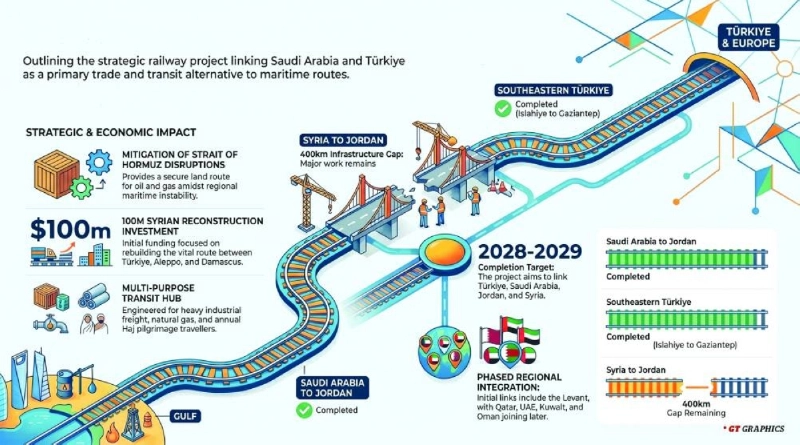
Turkiye and Saudi Arabia aim to build a railway to link the two countries with Jordan and Syria in the next three ‌or four years, Turkish Transport Minister Abdulkadir Uraloglu ​said Sunday, adding ‌other Gulf countries would also join the project.

Speaking ‌to Al ⁠Jazeera, ‌Uraloglu said the railway would ‌help alleviate in future the problems that have arisen from ⁠the disruption of the Strait of Hormuz caused by the war in Iran. The project is described in a memorandum of understanding signed between Ankara and Riyadh last week on logistics cooperation and the railway sector.

In the initial phase, a rail link would allow ​for the transport of goods, oil, natural gas and people between Saudi Arabia, Turkiye, Jordan, Syria and Europe, Uraloglu said, adding that the ‌Qatar, UAE, Kuwait, ⁠Oman, ​and possibly Yemen would be included later too.

“A ​train leaving from Saudi Arabia, from Riyadh already reaches several regions of Saudi Arabia. So this is a project for it to reach Turkiye via Jordan and Syria. We are talking about a route that will carry every type of freight via this route to Europe,” Uraloglu was cited as saying. He said the route from Saudi Arabia to Jordan’s ‌border had been finished and ‌on the Turkish side, ⁠the link was completed from Islahiye to Kilis and ⁠Gaziantep in southeastern ⁠Turkiye, near the border with Syria.

That leaves a gap of some 400km between Syria and Jordan, he said.

In addition to commercial trade, Uraloglu said the railway could also be used by people on the annual Haj pilgrimage.

Turkiye, ​which neighbours Syria, has built close ties with the government in Damascus after the fall of President Bashar al-Assad at the end of 2024 and has said it will help the country rebuild.

Uraloglu told Al Jazeera a financial plan would be drawn up for the rail project. The investment would include some $100mn to rebuild the route ‌between Turkiye ​and Syria’s Aleppo, creating a direct link to Damascus.

.


.