Higher Education Fosters Sustainable Development in the GCC

Higher Education Fosters Sustainable Development in the GCC

Desert mountains and palm trees under a vibrant blue sky. by Tayssir Kadamany via Pexels

.

Higher education fosters sustainable development

.


.

The publication by Springer Nature covers themes including university governance, institutional sustainability, education for sustainable development, innovation, and community partnerships


.

.

MUSCAT: Springer Nature has recently published a scientific book titled: ‘Higher Education and Sustainable Development in the Arab Gulf States: Practical Approaches and Institutional Strategies.’
The book is edited by Dr Khalaf bin Marhoon al Abri, Associate Professor and Head of the Educational Foundation and Administration Department at the College of Education, Sultan Qaboos University and Dr Elizabeth Buckner from the University of Toronto, Canada.
The book provides an in-depth scholarly analysis of the role of higher education institutions in the Gulf Cooperation Council countries in fostering sustainable development pathways.
This is achieved by showcasing the experiences and practices of several universities and academic institutions across the region, and by analysing policies, programmes, and initiatives that help align Higher Education with Sustainable Development Goals at both the institutional and national levels.

The publication features a set of research studies conducted by scholars from universities and research centres both within and outside the region. It covers a wide range of themes including university governance, institutional sustainability, education for sustainable development, innovation, and community partnerships.
Additionally, it addresses the main challenges and opportunities facing higher education institutions in the GCC countries as they seek to enhance their contribution to sustainable development.
Dr Khalaf explained that the idea of the book originated during the 13th Gulf Research Meeting, hosted by the University of Cambridge, UK, in 2023, before evolving into a scientific project in which many researchers from various universities and academic institutions participated.
He added that the book aims to enrich the scholarly literature on Higher Education in the Gulf countries by offering insights and experiences grounded in the Gulf context, supporting researchers, policymakers, and university leadership in developing institutional policies and practices.


This publication represents a valuable scientific contribution to SQU, enhancing its presence in global knowledge production in the fields of Higher Education and sustainable development. It also highlights the contribution of Omani researchers to addressing key national and regional priority issues.
The book’s content aligns with national directions supporting the achievement of Oman Vision 2040 and the United Nations Sustainable Development Goals, particularly regarding the advancement of education, the promotion of innovation, and the establishment of more sustainable and impactful educational institutions.
Dr Khalaf specialises in education and higher education policies and systems, education for sustainable development, educational governance, quality assurance, and academic accreditation.
His work focuses on developing educational policies and aligning them with sustainability issues and the Sustainable Development Goals. He has authored numerous research and scholarly publications in these fields, actively participating in various international scientific committees and initiatives related to education and sustainable development.
He also contributed to numerous published studies that examine the development of education systems and their role in achieving sustainable development.

.

.


.

.


Green Wall as an Investment: Myths and Facts

Green Wall as an Investment: Myths and Facts

Stunning view of Dubai’s modern skyscrapers under a clear blue sky. by Joerg Hartmann via Pexels

.

“Green Wall” as an Investment: Numbers vs. Marketing

.

PRAGMATIKA  / Urbanism / 

.

Green Wall as an Investment: Myths and Facts

Vertical gardening has become a symbol of modern and sustainable architecture. However, are “green walls” really an effective investment, or is it more of a successful marketing image? In her column for PRAGMATIKA.MEDIA, Natalia Korotka, a leading architect and general planner at the architectural and design company AIMM, analyzes common myths about vertical gardening, based on international research, real cases, and economic calculations, and explains under what conditions such solutions really work.

No visualization in a metropolis attracts as much as a facade covered with plants. Vertical gardening has become the visual language of sustainable development: it appears in every second concept of a new quarter, in every third presentation for an investor. The problem is that between the render and the real operation there is a chasm that the industry rarely shows to the client.

I am an architect-general planner, and my job is to evaluate solutions not at the moment of completion of the facility, but over the horizon of decades. From this perspective, vertical gardening is worth examining for some myths, each of which has its own digital reflection.

Myth 1: It’s cheaper than traditional landscaping

No. A systematic review of the cost-effectiveness of green walls (World Construction Symposium) shows that the life-cycle cost of a living wall can be more than ten times that of a green facade on cables or mesh, and the maintenance of a living wall is on average twelve times more expensive than simple facade greening. The classic study by Perini and Rosasco, which remains one of the basic studies on the subject, states bluntly that for some systems, the benefits—energy savings, increased property value—simply do not cover the costs of installation and maintenance over the life cycle.

A prime example is the Bosco Verticale in Milan, the most cited vertical gardening project in the world. It is not a wall, but a balcony garden of trees and shrubs, and it requires a team of professional climbers-gardeners who descend the facade on ropes to prune and inspect the plants.

Green Wall as an Investment: Myths and Facts

Bosco Verticale is a residential complex consisting of two towers, 110 and 76 meters high. The two skyscrapers were built in the Porta Nuova district of Milan between 2009 and 2014. The authors of the project are Italian architects Stefano Boeri, Gianandrea Barreca and Giovanni La Varra.

It is estimated that residents pay an additional seven euros per square meter of housing each year just for the care of the plants – this is a separate item of home maintenance, comparable to full-fledged cleaning or security.

Myth 2: Plant it once, and it grows on its own

Living systems require continuous management of irrigation, nutrition, and drainage. Bosco Verticale uses about 3,5–5,7 thousand cubic meters of water per year for irrigation, and this is in a project with centralized humidity sensors and automated irrigation — that is, in a system designed as competently as possible.

A counterexample is the Qiyi City Forest Garden complex in Chengdu. Eight towers with balcony gardens were to become a “vertical forest” for 826 apartments. The developer planted the plants in advance, but did not lay down a system for constant care and drainage.

Green Wall as an Investment: Myths and Facts

Qiyi City Forest Garden in Chengdu

When the apartments were not immediately occupied, the plants on the abandoned balconies grew out of control, water stagnated in the pots, and the building became a mosquito breeding ground, which is why most of the owners at that time refused to move in at all. This is not a story about a “bad idea” – it is a story about landscaping designed without answering the question “who will take care of it in five years and how?”

In European cases, we see the same pattern: companies that install green walls admit that the cause of degradation of living facades is almost always not the climate or plants, but management. Maintenance contracts cost an average of about 10% of the cost of the wall itself each year, and this is where customers often try to save first.

Myth 3: It significantly cools the city

The effect is there, but it is greatly exaggerated compared to how it is presented in marketing materials. A study in temperate European climates showed that green walls reduce air temperature by at most 1–1,2°C. This is significantly different from the indicators in tropical or subtropical climates, where, due to higher humidity and more intense transpiration, cooling reaches 2–5°C, and in some modular systems with a substrate – even 10–14°C.

In other words: a technology that works great in Singapore or Barcelona gives many times weaker results in the climate of Kyiv or Lviv. This is not a reason to abandon landscaping altogether – it is a reason not to rely on vertical systems as a tool to combat the urban heat island where ordinary trees and shading are more climatically effective.

Myth 4: Plants thrive equally in different zones

Even in the mild climate of Madrid, the creator of the most famous “green wall” in Europe – the CaixaForum facade – selected almost 300 species of plants specifically for contrasting seasons: hot summer and cold winter. This is a design at the level of botanical research, not decorative landscaping. In a climate with sharp temperature drops, spring frosts after thaws and unstable humidity – which is exactly the characteristic of the climate of most of Ukraine – the selection of species and the system of root zone protection become a determining factor in the survival of the system.

What does this mean for projects in Ukraine?

Vertical gardening is not a universal solution, but a highly specialized tool with high operational requirements. It is justified where there is a customer who is ready to finance professional care for years in advance, a climate zone that does not destroy the system with frost and humidity drops, or a careful selection of plants adapted to this zone, and a realistic understanding of the effect of such gardening.

Photo: Daniel Funes Fuentes/Unsplash

In our projects at AIMM, we treat vertical gardening as an engineering system with an operating budget, not as a final touch to the presentation. If the customer is not ready to lay the cost of maintenance for decades to come, it is more honest to talk about traditional gardening right away – it is less spectacular on the render, but it really lives longer than until the first winter without watering.

Sustainability is not measured by how impressive a solution looks on opening day, but by whether it continues to work five years later without extraordinary effort. By this criterion, most vertical gardens fail the test long before the first plants appear, so every solution must be balanced and harmonious.

.


.

Sustainability Written into Qatar Projects and Developments

Sustainability Written into Qatar Projects and Developments

Stylish curved skyscrapers amidst trees in a modern urban setting during the day. by Nature Beauty via pexels

.

Cliché to code: sustainability written into Qatar projects

.

Gulf Times
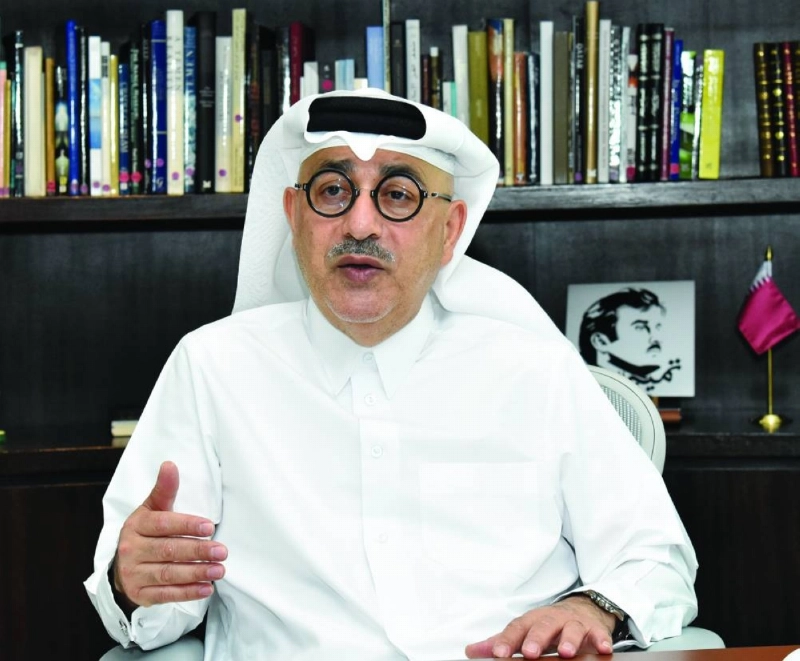
Ibrahim Mohammed Jaidah. PICTURE: Thajudheen.

Ibrahim Mohammed Jaidah. PICTURE: Thajudheen.

.

Sustainability in Qatar has crossed from marketing language into law, with every government project now required to pass a sustainability assessment before it proceeds, according to one of the country’s best-known architects.


“In the past, the word sustainability was just a cliché and a marketing tool. But now in Qatar, I am so happy to see sustainability becomes a regulation. It is a practice and it is actually a legislation. Now, any government project has to have a sustainability assessment system,” said Ibrahim Mohammed Jaidah, Group CEO and founder of Arab Engineering Bureau, one of the country’s oldest and largest home-grown architectural firms.


Speaking to Gulf Times, Jaidah said the discipline now runs through the whole pipeline of national infrastructure. “Development projects in Qatar are well studied and based on the whole concept of sustainability and it is a key focus in Qatar’s projects,” he said.


Jaidah, who is well known as the architect of some of the iconic public and private buildings and projects in the country, including Al Thumama Stadium and Place Vendome among others, noted that sustainability should be the hallmark of an entire project.


“If your building is sustainable, you get to build more in such style. And that is why all the developers are very keen to get more stars in sustainability to gain more reputation. In my opinion, sustainability is not only needed for an individual building but for the entire project or the whole town. We should be developing a city that is very sustainable,” he continued.


He commended the GSAS programme developed by Gulf Organisation for Research and Development, an initiative to measure and assess the sustainability compatibility of a project, and cited the Lusail development as a perfect example of sustainability.


Jaidah underlined that the growth taking place in the country is not a random one. “What is happening is not just taking place like some random growth. It is all very well-studied projects and each and every aspect of it has been well taken care of and it gives a solid step towards the future,” he described.


Jaidah said development is a continuous process and that Doha has one of the best infrastructures any city could dream of.


He stated: “The country is still moving towards new development and the expansion. A bit of slowdown happened after the World Cup, which is natural as a lot of massive infrastructure development took place prior to the event.


“I think it is natural for any city to grow seamlessly. Now we hear about several projects that are happening in Simaisma. I think it is being expanded up there. So it is like the next stage of development. It will not be like a big city, yet it will be developed more for tourism, for apartments among others. I think the population is moving northwards and southwards and these are the areas that can be developed in the coming years,” he continued.


The veteran architect highlighted the life of people in the country before the introduction of electricity and modern amenities.


“Our ancestors lived here without electricity, without any of the modern facilities. But they managed to live well because they were doing their buildings that were responsive to the environment. Small openings, even about the wind, they would study how it moves. Buildings were close to each other, they created shades to each other. And this is the lesson learned and implemented in some of the modern constructions in the country,” he highlighted.


“However, with more greenery and with the landscaping and the use of proper and advanced materials, we are making the projects more environment-friendly and sustainable,” he added


.

.


.

.

A New Energy Era: Full Renewable Energy Supply

A New Energy Era: Full Renewable Energy Supply

Combine harvester in wheat field with wind turbines, showcasing renewable energy and agriculture. by Anton Klyuchnikov via Pexels

.

A new energy era: full renewable energy supply is possible

.

Solar power, battery storage and digital energy technologies are converging into an integrated energy system that could deliver reliable renewable electricity around the clock, writes The smarter E Europe

.

Suddenly, everything happened very quickly: while solar power expanded only gradually in the early years of its commercial deployment, it has since become the world’s leading source of electricity generation. The rise of renewable energies is linked to a broader systemic shift that is driving and accelerating the growth of other cleantech sectors, most notably battery storage, electromobility and heat pumps. Flexibility has also emerged as a key priority and can serve as a balancing factor for the variability of renewables. The electrification of all sectors is widely considered a fundamental prerequisite for an efficient, cost-effective and resilient energy system.

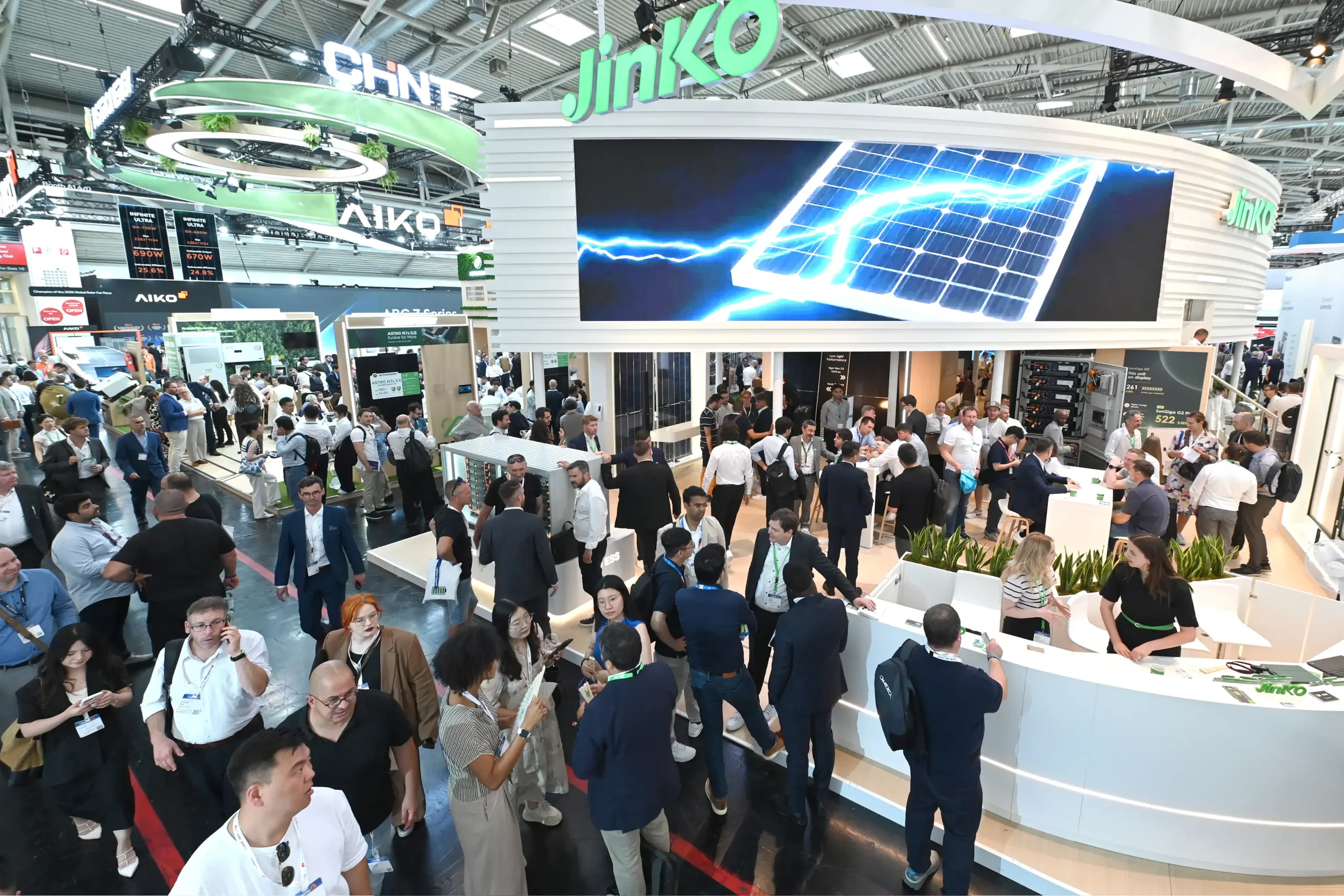
At the recent The smarter E Europe 2026, Europe’s largest alliance of exhibitions for the energy industry, 2,650 exhibitors offered around 105,000 visitors a glimpse into the components that can help make an integrated energy system successful. The Renewables 24/7 special exhibit, organised by Solar Promotion GmbH and Freiburg Wirtschaft Touristik und Messe GmbH & Co. KG, demonstrated how a round-the-clock renewable energy supply can work.

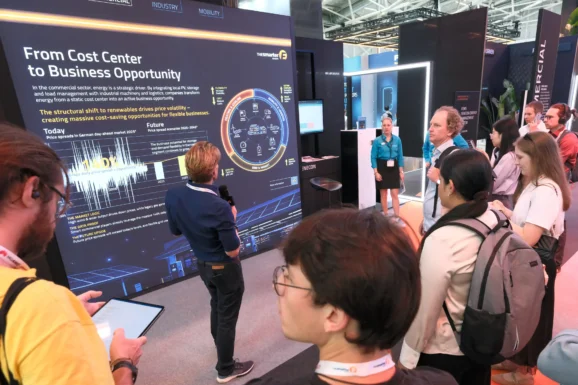
Delegates attend a presentation at the Renewables 24/7 special exhibit, exploring how flexibility, storage and smart energy management can support a fully renewable electricity system. Credit: Solar Promotion GmbH

Photovoltaics and battery storage: from niche to industry standard

According to Jaran Rystad, founder and CEO of the research and consulting firm Rystad Energy, speaking at The smarter E Europe, forecasts for photovoltaic expansion have consistently underestimated the pace of deployment, including those produced by his own company, although they were often regarded as overly optimistic when they were published. According to SolarPower Europe’s Global Market Outlook for Solar Power 2026–2030, a record 664 gigawatts (GW) of new photovoltaic capacity were installed worldwide in 2025, bringing global installed solar capacity above the three terawatt (TW) mark for the first time. The milestone carries symbolic significance: In 2025, solar power produced more electricity worldwide than wind power for the first time, becoming the largest single driver of global growth in energy generation, ahead of natural gas, oil and coal.

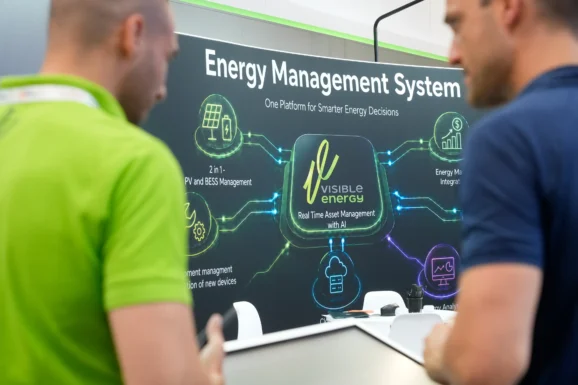
An energy management platform on display at The smarter E Europe 2026, illustrating how digital systems are being used to integrate solar power, battery storage and flexible electricity demand. Credit: Solar Promotion GmbH

China remained the world’s largest solar market, adding 382 GW of new capacity, equivalent to 57 per cent of global installations, although policy changes are expected to result in a temporary slowdown in 2026. Europe continued to be on course for growth: In 2025, the EU-27 once again installed more solar capacity than in the previous year, reaching approximately 67 GW. Solar power has become firmly established as a cornerstone of Europe’s electricity supply. In June 2025, photovoltaics temporarily covered more than 22 per cent of total electricity demand across the EU.

Europe’s battery storage market is expanding just as rapidly. SolarPower Europe’s European Battery Market Outlook 2026–2030 reports that 36 gigawatt hours (GWh) of new storage capacity were installed in 2025, a 48 per cent increase over the previous year, bringing Europe’s total installed storage capacity above 100 GWh for the first time. Utility-scale storage accounted for more than half of all new installations, also a first. This growth has been driven in no small part by the sharp decline in battery costs: Production costs for lithium-ion battery cells have fallen by around 85 per cent since 2010. By 2030, annual installations are expected to reach 138 GWh, almost four times the 2025 level. “We are entering the battery age,” said Markus Elsässer, CEO of Solar Promotion GmbH, at The smarter E Europe.

Together, these trends – driven by rapidly expanding solar output and growing storage capacity – are laying the foundation for a round-the-clock renewable energy supply. This vision was at the heart of the Renewables 24/7 special exhibit at the recent The smarter E Europe.

Economically viable, technically feasible: 24/7 renewable energy

Too expensive. Too unreliable. Technically impossible. These are among the most common misconceptions surrounding a fully renewable energy supply. The Renewables 24/7 special exhibit at The smarter E Europe 2026 addressed these misconceptions. The exhibit was based on the study Cost-Optimal Transformation of the German Energy System by 2045, prepared by the Fraunhofer Institute for Solar Energy Systems ISE. Both the study and the special exhibit demonstrate how an industrialised country such as Germany can achieve a completely climate-neutral energy system powered entirely by renewable energy in a way that is technically feasible, economically viable and socially manageable.

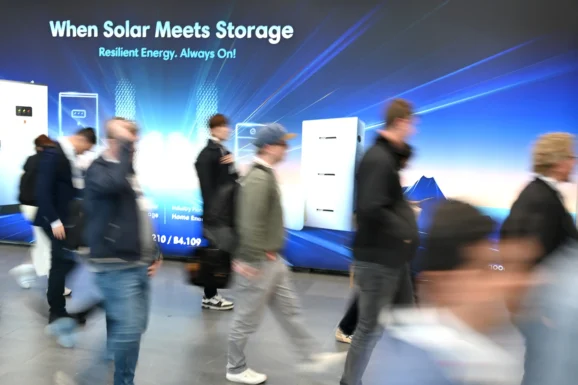
Visitors pass an exhibition highlighting the combination of solar generation and battery storage, technologies increasingly seen as central to round-the-clock renewable electricity. Credit: Solar Promotion GmbH

Through exhibits, expert presentations and practical examples, the special exhibit presented evidence challenging the assumption that extended periods of low wind and limited sunshine, often referred to as ‘dark doldrums’, represent an obstacle to a renewable energy system. Dr. Charlotte Senkspiel, one of the study’s lead authors at Fraunhofer ISE, explained: “The ‘dark doldrums’ account for only about one per cent of the year. Yes, we still need 100 gigawatts of dispatchable power generation for these periods, and seasonal hydrogen storage is the key to operating it.” The models used in the study and their visualisation at the special exhibit were based on the considerable expansion of storage capacity and increasing utilisation of flexibility. Examples include peak shaving in industry and commerce, demand-side flexibility across all consumption sectors and bidirectional charging of electric vehicles.

At Renewables 24/7, visitors saw to great effect how the individual technologies and applications underpinning the energy transition can efficiently work together as an integrated system. “Solar power, energy storage, e-mobility, power grids and digitalisation are not developing independently. They are converging into an integrated energy system,” said Markus Elsässer at the opening of the special exhibit.

A strong alliance of associations and industry backing the special exhibit

A broad coalition of leading industry associations supported the initiative. Supporters included the German Renewable Energy Federation (BEE), the German Association of Energy Market Innovators (bne), the German Solar Association (BSW-Solar), the German Solar Energy Society (DGS), the German Hydrogen Association (DWV), the Biogas Trade Association, VDMA (German Engineering Federation) Photovoltaics Equipment and VDMA Power Systems. It was also internationally backed by E-Mobility Europe, Energy Storage Europe (ESE), Smart Energy Europe (smartEn) and SolarPower Europe.

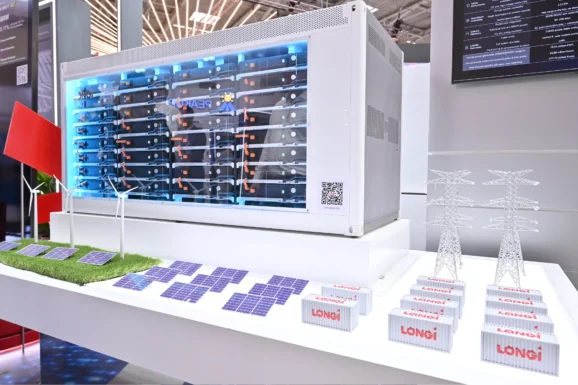
A utility-scale battery storage system exhibited at The smarter E Europe 2026, reflecting the rapid expansion of energy storage alongside solar power. Credit: Solar Promotion GmbH

Leading technology solution partners contributed to the special exhibit, presenting technical and commercial solutions. These included CATL, Energy3000, Fenecon, FoxESS, GE Vernova, Maxsolar, Octopus Energy and Siemens AG. Together, they showcased the technologies and solutions that can enable a fully renewable, round-the-clock energy supply.

Next steps: the solutions are here; policy must follow

The smarter E Europe 2026 and its Renewables 24/7 special exhibit demonstrated that the industry is already providing many of the technologies and products needed for a resilient, climate-neutral and cost-effective energy system. What is needed now is appropriate incentives from policymakers and institutions, as well as a consistent commitment to change. This is essential to address bottlenecks such as insufficient grid capacity and regulations that do not yet adequately support an integrated energy system.

.


.

MENA Power Sector Enters a Decisive Phase of Investment

MENA Power Sector Enters a Decisive Phase of Investment

Silhouettes of power pylons stand tall against a vibrant sunset in the countryside. by Devesh Kumar via Pexels

.

MENA power sector enters a decisive phase

.

04 August 2026

Population growth, urbanisation, gigaprojects and industrial demand are driving record investment in generation, transmission and smart grids. MEED

.


The Middle East and North Africa (Mena) power sector stands at a historic crossroads in 2026. Navigating a landscape of complex regional geopolitical tensions and shifting global dynamics, the region’s energy ecosystem is demonstrating remarkable resilience.

Far from slowing down, Mena nations are accelerating their energy transitions, proving that secure, sustainable infrastructure is the ultimate foundation for long-term economic stability.

Driven by visionary national strategies, the region is successfully transforming these macroeconomic headwinds into unprecedented commercial opportunities. Mena continues to break global records in low-cost utility-scale solar and wind deployment, while pioneering cross-border grid interconnections that fortify regional energy security.

.

Contract awards

Power project contracts worth $315.7bn have been awarded in the Mena region (across 14 countries) between 2016 and April 2026, with an annual average of $28.7bn.

Saudi Arabia holds the largest share in awarded value with just more than $135.2bn, followed by the UAE with $49.7bn.

Total contract values increased from approximately $12.8bn in 2016 to a peak of over $80bn in 2024, before moderating to around $66.9bn in 2025 and a projected $10.4bn in 2026. After an initial rise in 2017, awards declined in 2018-19, followed by a steady recovery from 2020 onwards, accelerating significantly in 2023 and reaching a historic high in 2024.

Sector-wise, generation projects consistently accounted for the majority share of investments ($215.2bn), while transmission projects with $100.5bn contributed a smaller but stable portion, with noticeable growth during peak investment years.

Power infrastructure now sits at the centre of economic transformation across the region

Installed capacity in the region continued to grow in 2026, driven by increasing power demand from the population and industrial growth. In absolute terms, Saudi Arabia was the leader in the Mena region, with an installed capacity of nearly 121.4GW in 2024, followed by Egypt, with nearly 63.5GW, and the UAE, with 45.5GW.

Although Saudi Arabia led in terms of total installed capacity, Morocco witnessed the largest increase in installed capacity between 2023 and 2024. With a 7.4% growth in electricity installed capacity, Morocco is driven by the National Energy Strategy that mandates 52% of total installed power capacity come from clean energy by 2030.

Download sample pages from MEED’s Mena Power Projects Market 2026 report here

.


.