Gulf-to-Europe Railway to Ease Hormuz Disruption and land here. A Scenic sunset view of a metro train crossing Haliç Bridge in Istanbul with cityscape and water. by Zeynep Sude Emek via Pexels
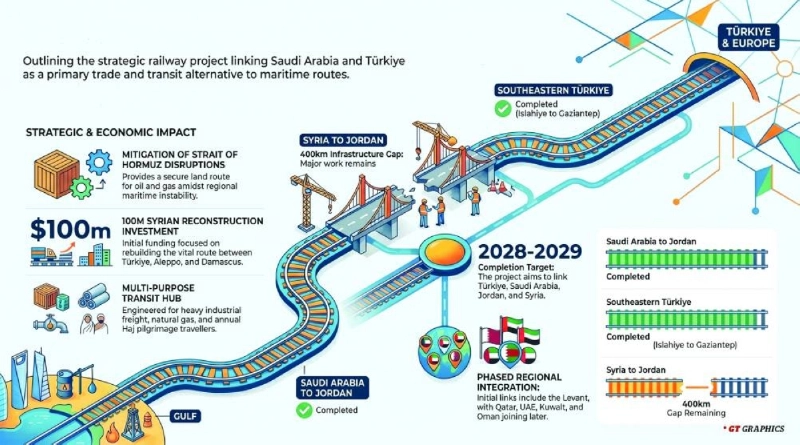
Turkiye and Saudi Arabia aim to build a railway to link the two countries with Jordan and Syria in the next three or four years, Turkish Transport Minister Abdulkadir Uraloglu said Sunday, adding other Gulf countries would also join the project.
Speaking to Al Jazeera, Uraloglu said the railway would help alleviate in future the problems that have arisen from the disruption of the Strait of Hormuz caused by the war in Iran. The project is described in a memorandum of understanding signed between Ankara and Riyadh last week on logistics cooperation and the railway sector.
In the initial phase, a rail link would allow for the transport of goods, oil, natural gas and people between Saudi Arabia, Turkiye, Jordan, Syria and Europe, Uraloglu said, adding that the Qatar, UAE, Kuwait, Oman, and possibly Yemen would be included later too.
“A train leaving from Saudi Arabia, from Riyadh already reaches several regions of Saudi Arabia. So this is a project for it to reach Turkiye via Jordan and Syria. We are talking about a route that will carry every type of freight via this route to Europe,” Uraloglu was cited as saying. He said the route from Saudi Arabia to Jordan’s border had been finished and on the Turkish side, the link was completed from Islahiye to Kilis and Gaziantep in southeastern Turkiye, near the border with Syria.
That leaves a gap of some 400km between Syria and Jordan, he said.
In addition to commercial trade, Uraloglu said the railway could also be used by people on the annual Haj pilgrimage.
Turkiye, which neighbours Syria, has built close ties with the government in Damascus after the fall of President Bashar al-Assad at the end of 2024 and has said it will help the country rebuild.
Uraloglu told Al Jazeera a financial plan would be drawn up for the rail project. The investment would include some $100mn to rebuild the route between Turkiye and Syria’s Aleppo, creating a direct link to Damascus.
In sport, fairness matters. But when it comes to buying tickets to watch the world’s biggest ever sporting event, money matters too.
Attending the men’s Fifa World Cup 2026 will be much more expensive than any previous World Cup. And that’s not what fans were promised.
In fact, when the US, Canada and Mexico set out their original bid to host the tournament, they said a seat at the final would cost a maximum of US$1,550 (£1,174).
But by April 2026, the cheapest standard final ticket had reached US$5,785. The most expensive seats hit US$10,990 and later tripled. Just two days before the start of the tournament there were reports of 180,000 unsold tickets.
Politicians in New York and New Jersey have launched a formal investigation into allegations that Fifa has confused fans and inflated prices. Fans have complained of a lack of clarity, with many waiting hours in online queuing systems with no idea of the amount they’d have to pay when (and if) they were allocated tickets.
The increase in costs may remind some music fans of the 2024 scandal over Oasis concert tickets when customers watched prices more than double from £148 to £355 as they waited in online queues.
“Dynamic pricing”, when prices go up and down depending on levels of demand, will also be familiar to anyone who has been surprised by swift changes in the price of flights before a holiday. The same seat can cost more today than it did yesterday simply because more people want it.
Fifa denies that it is has engaged in dynamic pricing, saying that they use “variable pricing” instead. But from a consumer’s point of view, it amounts to the same result – the price of tickets that they want to buy changes, usually in an upward direction.
In response to the Oasis dynamic pricing episode, UK regulators later forced ticket sellers to commit to showing price ranges before fans join a queue. By using a “variable” system, Fifa positions itself outside that regulatory precedent entirely.
It faces no obligation to disclose prices in advance and no requirement to explain how they change.
A game of monopoly
But dynamic pricing isn’t always a bad thing for consumers. In fact, it can help them to get a better deal. Economists studying airline markets found that dynamic pricing can reduce prices as different airlines compete for passengers.
The trouble is that Fifa operates in a market with zero competition. No rival sells World Cup tickets. No substitute product exists.
The work of Nobel prize-winning economist Jean Tirole demonstrated that when a single firm controls an essential platform and operates at every level of the market, competitive discipline on pricing disappears. The operator stops seeking an efficient price and starts trying to extract the very maximum that the consumer will tolerate.
For football World Cups, Fifa sets the primary price. It runs the only sanctioned resale marketplace. It pockets 30% on every secondary transaction when unwanted tickets are sold on. It makes money on the first sale, and earns a bit more on the second.
No outcome costs Fifa money. No regulators intervene. But not everyone is prepared to pay out.
Adjusting for inflation, World Cup ticket prices have been stable for 30 years. Then Fifa introduced its new model and the entire pricing architecture shifted. This would explain all the unsold tickets.
For example, England’s semi-final and final allocations failed to sell out. Every fan who applied got a seat.
After the backlash, Fifa introduced a US$60 “Supporter Entry Tier” for every match, including the final. It amounts to roughly 10% of each national association’s allocation, a few hundred seats in stadiums holding up 80,000. As a pricing intervention, it changes nothing apart from an attempt to absorb criticism.
The day before the World Cub began Fifa president Gianni Infantino defended the level of ticket pricing, claiming that if they were cheaper the majority would have been resold on the black market. He added that the money generated was required to fund football development across the world.
Consumer research explains exactly what went wrong. When people buy a service rarely and can’t understand how the price was set, they don’t just feel frustrated, they feel cheated.
And when they feel cheated, they walk away. Fifa treated fan loyalty as guaranteed demand. Supporters’ reaction proved it isn’t.
Then, at the start of June, Fifa quietly slashed prices across all 104 matches and returned 70% of its block booked hotel rooms due to low demand – a last minute change of tactics probably designed to save face and avoid empty seats. But to many, desperately chasing lost fans after trying to extract more revenue than any World Cup in history already looks like foul play.
GlobalData’s Construction Projects Momentum Index for April 2026 shows the region in third place globally, with execution-stage activity recovering even as the Israel-Iran conflict weighs on the pipeline
The Middle East and North Africa’s construction project pipeline has demonstrated considerable resilience in the months since the military conflict between the US, Israel and Iran began in late February, although the regional performance has softened from its early-year highs and the full effects of the geopolitical shock continue to ripple through the project market.
GlobalData’s Construction Projects Momentum Index (CPMI) for the Mena region recorded 0.86 in April 2026, placing the region third globally behind North-east Asia and South Asia. The Mena score represents a 12% decline from 0.98 in March, which itself was unchanged from February. The regional three-month moving average eased modestly to 0.96 in April from 0.97 in March, suggesting that while momentum has nudged lower, the pipeline has not experienced the kind of sustained deterioration that might have been expected given the severity of the geopolitical disruption.
The resilience partly reflects the composition of the regional project market. The Mena region’s largest markets, the UAE and Saudi Arabia, have both continued to record solid momentum in the months following the start of hostilities in February. The UAE led the region in April with a CPMI of 1.20, easing only slightly from 1.30 in March, while Saudi Arabia recorded 0.94.
Mixed performance
The impact of the conflict is most visible at the country level, where a sharp divergence has opened up between markets directly exposed to the fighting and those insulated from it. Israel recorded the lowest CPMI score in the region in April at -3.26, reflecting substantial delays to major projects. The East Mediterranean Gas Pipeline was among the most significant casualties, with its Final Investment Decision pushed well beyond its original timeline. Iran, another direct participant in the conflict, registered a markedly weaker score of 0.53 in April, a stark reversal from its position as one of the region’s strongest performers in January, when it posted 1.31.
The conflict’s first major imprint on the index appeared in March, when the CPMI data reflected the initial shock of the escalation. Execution-stage momentum in the region dipped from 1.06 in February to 0.89 in March, while pre-execution activity slipped from 1.02 to 0.95. Infrastructure, which had been a strong performer earlier in the year, fell sharply to 0.53 in March from 1.06 in February, with the institutional sector also pulling back from 1.27 to 0.78. These moves are consistent with the channels through which conflict typically disrupts construction activity — cost inflation driven by energy price volatility, supply chain disruption and elevated risk premiums that delay investment decisions.
Stability signs
By April, some of these pressures had begun to ease, at least at the index level. Execution momentum recovered to 1.01, reversing the March dip, and infrastructure returned as the top-performing sector with a CPMI of 1.13. Commercial and leisure activity also remained solid at 0.94, building on gains that have been sustained throughout the conflict period.
Pre-execution momentum, however, continued to soften, falling to 0.86 in April from 0.95 in March. This is significant because the pre-execution stage — which captures project planning, design development and procurement preparation — is where investor caution and risk reassessment typically show up first. A sustained decline in this segment would signal a thinning of the future project pipeline, even if near-term execution activity holds up.
Kuwait offers a specific illustration of how supply chain and procurement disruptions linked to the conflict can affect individual markets. In January, Kuwait had recorded a CPMI of 0.27, depressed by delays to tender packages on Kuwait Oil Company developments including the SGC1, SGC II, SGC III and JLO Export Facility projects. The country recovered strongly to 1.43 in February and 0.90 in March, before falling back to 0.55 in April, with delays reported on Dorra Field developments. The oscillation reflects the vulnerability of projects with complex procurement requirements to the kind of supply chain uncertainty the conflict has generated.
Future pipeline
The Mena region entered 2026 from a position of strength, having ranked first globally in January with a CPMI of 1.05 — a 16% jump from December 2025’s 0.90. That momentum reflected broad-based gains across infrastructure, residential and institutional sectors, with Qatar, the UAE and Iran all posting scores above 1.20.
The conflict began when the region’s project pipeline was strong, and the data suggest that the buffer of accumulated momentum has helped absorb the initial shock. Whether that buffer holds through the remainder of 2026 will depend on how the conflict develops and, in particular, whether the more cautious behaviour visible in pre-execution activity translates into a deferral of new project launches. GlobalData’s data through April suggest the region is maintaining momentum, but the direction of the pre-execution trend is a forward-looking indicator to be watched in the coming months.
In the early 1970s, a trip to the beaches of Naples, Italy was a roll of the dice.
The city’s coastal waters were so flush with sewage and industrial waste, that one summer nearly 20 per cent of Belgian and French tourists claimed they contracted an infectious disease after taking a dip.
While the situation in Naples grabbed headlines, similar environmental disasters were unfolding across the Mediterranean Sea in the early 1970s. A combination of rapid industrialization, breakneck population growth and lax environmental laws had turned the sea into one of the world’s most-polluted bodies of water.
But that would soon start to change. In 1974 The United Nations Environment Programme (UNEP) brought together nearly two dozen nations to hash out a plan for saving the Mediterranean. The work was made possible by contributions to the Environment Fund, UNEP’s core source of flexible financing, which had been established a year earlier.
The result of the talks was the Barcelona Convention, a 1976 pact that placed strict limits on pollution in the sea. The deal celebrated its 50th anniversary earlier this year.
“The convention was a landmark achievement,” says Alberto Pacheco Capella, Chief of the Regional Seas Branch at the United Nations Environment Programme (UNEP). “It came at a critical moment for the Mediterranean and set the template for decades of environmental diplomacy.”
The Barcelona Convention marked the first success of the fledgling Regional Seas Programme, which has since evolved into a globe-spanning effort to protect the world’s saltwater bodies. The programme was founded on the idea that international cooperation is vital for protecting seas, which provide food and jobs to hundreds of millions of people around the world.
“Over the decades, the Regional Seas Programme has demonstrated what’s possible when countries work together” says Pacheco Capella. “It also shows how this kind of international cooperation can improve the lives of people who live near seas and who depend on them for their livelihoods.”
The success of the Regional Seas Programme is also a testament to the importance of the Environment Fund, says Soomi Ro, the Director of UNEP’s Corporate Services Division. Along with underpinning the diplomacy of the 1970s and UNEP’s convening power to have nations to work together, the fund supported what would become regional seas programmes around the world, from the Caribbean, to the Indian Ocean to East Asia.
Today, the Environment Fund supports the development of technical guidance and the implementation of targeted activities across the Regional Seas Programme. It contributes to the creation of strategic action plans for the various conventions, the most recent of which cover the period from 2026 to 2029. And it backs technical work, such as the Regional Seas Indicators Framework, which strengthens the ability of countries to generate policy-relevant data and insights on issues of concern.
“Core funding to the Environment Fund is pivotal for carrying out efforts, like the Regional Seas Programme, that transcend borders and decades,” Ro says. “It gives UNEP the flexibility it needs to conduct science, raise public awareness and bring nations together.”
The world’s seas remain under pressure from a range of human-caused threats. In many places, overexploitation risks the future of crucial fisheries. Climate change could wipe out virtually all warm water corals this century. And every day, the equivalent of 2,000 garbage trucks full of plastic are dumped into the world’s oceans, rivers and lakes.
But in some places, like the Mediterranean Sea, things are improving. The arcing Gulf of Naples – once a haven for typhoid and hepatitis – now has a dozen beaches that have been internationally recognized for their cleanliness and sustainability.
“The Mediterranean is showing that it is possible to reverse the fortunes of flagging seas, and that development and sustainability can go hand-in-hand,” says Pacheco Capella.
About World Ocean Day
Held on 8 June each year, World Ocean Day unites the world to protect and restore the blue planet.
Shukri and her children live in a new earth-based home in the Doolow district, Somalia. Photo: IOM/Raber Aziz
Doolow, Somalia – In Doolow’s Ladan community, Hawo and Shukri remember the years of uncertainty that followed their displacement.
“When we came here, we lived in a tent,” Hawo says. “The heat was unbearable and we never felt truly safe.”
Hawo and Shukri are two of thousands of Somali families displaced by the adverse impacts of climate change, mainly prolonged droughts and environmental degradation that continue to drive displacement across Somalia.
In Doolow, where searing winds sweep through settlements often built from plastic sheets and tarpaulins, families once displaced by drought and conflict are finding new hope in homes built from the earth itself.
Their new shelters, sturdy, naturally cooler, and built with locally made mudbricks, are part of IOM’s effort to introduce vernacular earth-based, climate-adaptive construction across Somalia’s arid areas.
The approach replaces temporary plastic shelters with durable, sustainable materials and designs that respond to cultural needs and Somalia’s environmental pressures while restoring dignity to families who have lived too long in crisis.
Workers upgrade a shelter unit from tarpaulin and plastic sheets to locally sourced, earth-based materials. Photo: IOM/Raber Aziz
“This house is much better,” Shukri says. “It protects us and keeps my children safe, and it is cooler and more comfortable to live in. Compared to the shelters we had before, this one feels stronger, easier to maintain, and more secure for my family.”
As recurrent droughts and environmental degradation continue to act as drivers of displacement and put growing pressure on already fragile resources, the need for scalable and environmentally sustainable shelter solutions has become increasingly urgent in the face of climate change. For IOM, shelter is not a product, but a process, one that helps communities adapt, recover, and rebuild in a safe and sustainable way, while reducing pressure on the environment.
Hawo and her daughter stand outside their mudbrick shelter in Doolow. Photo: IOM/Yusuf Abdirahman
To bring this vision to life, the International Organization for Migration (IOM) partnered with the International Centre for Earth Construction (CRAterre), a research institute for earthen architecture. Since 2022, the partnership has provided several rounds of training to local masons, authorities, and shelter partners to build knowledge and capacity in earth construction techniques.
“Earth is the most accessible, affordable, and climate-responsive building materials we have in Somalia,” explains Abdikarin Adan Salad, an IOM engineer involved in the programme. “By using local materials and training local builders and community members, communities are not only building shelters, they are building resilience against future climatic shocks.”
“Unlike temporary shelters often built from imported sheeting and short-term materials, earth-based shelters use locally sourced soil and natural materials with lower environmental impact while providing better insulation against heat,” says Manuel Marques Pereira, IOM Chief of Mission in Somalia.
Trained workers replace plastic sheets and tarpaulin with mudbricks on a shelter unit in Doolow. Photo: IOM
Previously, IOM upgraded 42 of Ladan’s 1,500 Improved Emergency Shelters. But in October 2025, work began on 50 additional mudbrick shelter upgrades through an owner-driven approach that incorporates a cash-for-shelter modality, empowering families to manage their own construction with guidance from IOM engineers and trained local masons.
“With the cash support we received, we were able to buy the materials needed to build our own shelter together with others in the community,” says Bisharo, a mother of five. “Being involved in building in the process made a big difference because it felt like we were creating a home.”
Bisharo uses her cash-for-shelter grant to hire trained masons from the displaced community and build a shelter tailored to her family’s needs. Photo: IOM/Raber Aziz
With the cash for shelter grant, Bisharo hired trained masons from the community and ensured the shelter unit matched her preferences. The approach, developed jointly with the authorities of Jubaland State and the Ministry of Public Works, Reconstruction and Housing, transfers ownership to displaced households while strengthening community skills.
Families reuse existing frames, upgrade shelters gradually as resources allow, and hire trained labour from within their communities, creating jobs and reducing costs. Refresher trainings support successful upgrades, from soil testing and brick making to structural design and shelter maintenance.
Local masons trained by IOM work on a mudbrick shelter upgrade in Doolow. Photo: IOM/Yusuf Abdirahman
This sustainable, environmentally friendly technique echoes what Somali and international experts also envision for the future of Somalia’s shelter and housing approaches to resolving displacement. In November 2025 in Mogadishu, the Ministry of Public Works, Reconstruction and Housing announced winning proposals under the Homegrown, Sustainable, and Scalable Shelter Solutions in Somalia initiative, a collaboration between IOM, the Ministry, CRAterre, and global design partners including YACademy Bologna.
Since April 2025, university students, architects, and diaspora experts have worked to develop a new generation of shelter designs. Their proposals blended Somali cultural aesthetics with environmental functionality, creating homes that breathe with the climate, conserve energy, and can be built affordably using local materials.
In Mogadishu, students showcase their proposed designs for low-cost, sustainable housing in Somalia. Photo: IOM/Yusuf Abdirahman
Back in Doolow, as the afternoon sun glows over the red soil, the new homes stand firm, cool inside, with smooth mud walls that tell a story of resilience, reinvention, and hope.
“These shelters are more than just structures,” Bisharo says, looking at her children playing outside their home. “They give us a sense of stability and remind us that we have a place to call home.”
From the soil beneath their feet, Somalia’s displaced families are building their future, one brick at a time.
This story was written by Raber Aziz, Media and Communications Officer with IOM Somalia.
We use cookies on our website to give you the most relevant experience by remembering your preferences and repeat visits. By clicking “Accept”, you consent to the use of ALL the cookies.
This website uses cookies to improve your experience while you navigate through the website. Out of these cookies, the cookies that are categorized as necessary are stored on your browser as they are essential for the working of basic functionalities of the website. We also use third-party cookies that help us analyze and understand how you use this website. These cookies will be stored in your browser only with your consent. You also have the option to opt-out of these cookies. But opting out of some of these cookies may have an effect on your browsing experience.
Necessary cookies are absolutely essential for the website to function properly. This category only includes cookies that ensures basic functionalities and security features of the website. These cookies do not store any personal information.
Any cookies that may not be particularly necessary for the website to function and is used specifically to collect user personal data via analytics, ads, other embedded contents are termed as non-necessary cookies. It is mandatory to procure user consent prior to running these cookies on your website.



You must be logged in to post a comment.