How do you define a smart city, including the role of its key pillars and infrastructure?
AL THANI: Smart cities are often associated with technology, but technology alone does not make a city smart. The core pillars include governance, connectivity, mobility, health and safety, sustainability, quality of life and economic development. What distinguishes a smart city is the integration of these elements to serve its people efficiently. Ultimately, a smart city is not defined by the deployment of technology, but by how effectively data and information are used to improve the urban experience overall. Digital infrastructure forms the backbone of smart city systems. This includes fibre networks, data platforms, sensors, mobility systems, utility networks and integrated communications infrastructure. When designed and embedded from the outset, these systems enable improved service delivery and stronger interoperability across sectors.
Which are the main challenges involved in implementing large-scale smart city programmes?
AL THANI: One key challenge is prioritisation, as cities must balance competing areas such as mobility, public services, sustainability, safety and real estate while integrating them into a coherent system. A second challenge is investment, given the significant upfront capital required for smart city infrastructure. While efficiencies and cost savings emerge over time, cities must manage the initial transition period. The most important challenge is translating technology into tangible user value. Residents and businesses are less concerned with the technology itself and more focused on whether services are simpler, faster, safer and more reliable.
In what ways does a smart city improve urban life while safeguarding privacy, security and trust?
AL THANI: The purpose of a smart city is to enhance the urban experience. The key measure is not the visibility of technology, but whether services function seamlessly for users. The most effective systems are those that are invisible to the end user. For example, an efficient airport journey may appear simple to the traveller, but is enabled by coordinated data systems and operational processes working in the background. The same applies to cities: success is reflected in smoother mobility, improved access to services, safer environments and greater convenience. Data governance is central to smart city success. While data enables better urban services, it must be protected through strong safeguards for privacy, security and ethical use. Interoperability is also key, allowing data to flow across systems under clear rules on access, sharing and use, ensuring consistency and accountability.
What role do data-driven systems and smart cities play in advancing sustainability and enabling innovation in emerging technologies?
AL THANI: Data enables cities to move from broad efficiency targets to precise, real-time optimisation. For example, in irrigation systems, the integration of weather data, sensors and water management platforms allows operators to adjust usage based on actual conditions. While these improvements may appear incremental, they accumulate into significant reductions in water and energy consumption as well as operating costs. Similar approaches can be applied across district cooling, lighting, waste management and transport systems. These efficiencies support environmental sustainability and long-term operational savings.
Smart cities can act as living laboratories, providing access to real-world data and testing environments that are often difficult to obtain elsewhere. They enable pilot projects in areas such as artificial intelligence, mobility systems, predictive maintenance and digital public services. This allows solutions to be tested and refined under real operating conditions. As a result, cities shift from being passive users of technology to active platforms that enable and accelerate innovation.
DOHA: United Nations Under-Secretary-General and Executive Secretary of the United Nations Economic and Social Commission for Western Asia (ESCWA) Dr Rania Al Mashat has hailed Qatar’s leadership in advancing sustainable development, digital transformation, and multilateral cooperation while calling for deeper collaboration between ESCWA and the country to accelerate progress across the Arab region.
In an interview with QNA, Dr Al Mashat described Qatar as a key regional partner in promoting sustainable development and reaffirmed ESCWA’s commitment to expanding cooperation in areas such as social protection, digital transformation, innovation, strategic planning, artificial intelligence, statistics, and the achievement of the Sustainable Development Goals (SDGs).
She said her visit to Doha reflects the longstanding partnership between ESCWA and Qatar and included meetings with senior Qatari officials to discuss advancing the sustainable development agenda at both regional and international levels. The discussions also focused on enhancing the exchange of expertise and technical knowledge to support development initiatives across the Arab world.
Dr Al Mashat praised Qatar’s active role in fostering multilateral cooperation and highlighted its continued support for the Palestinian cause and efforts to promote peace and regional stability. She stressed the importance of sustaining initiatives that address shared challenges while strengthening regional cooperation.
Commenting on Qatar’s development achievements, she said the country has made significant progress in implementing its sustainable development agenda and has demonstrated a strong commitment to solidarity and multilateral action despite the complex challenges facing the region.
The Diriyah Biennale Foundation launched a new international architecture competition at the iconic Western Hajj Terminal that celebrates the architectural legacy of Muslim societies. The AlMusalla Prize reimagines future spaces of worship as modular, empowering, and transient. It not only pushes the paradigms on sustainable design and cutting-edge technology, but also emphasizes opportunities for dialogue and community building, reclaiming the true essence of a musalla space. The winning proposal by EAST Architecture Studio in collaboration with artist Rayyane Tabet and engineers AKT II features a structure inspired by regional weaving traditions and relies on waste materials derived from local date palm trees. The design consists of an open central courtyard and prayer spaces that form a structure that resembles a loom, addressing togetherness and proximity, which are core dimensions of prayer in Islam. This adaptable structure will be accessible to all visitors throughout the Biennale’s run.
On Weaving, winner of the Diriyah Biennale Foundation’s inaugural AlMusalla Prize, reconciles the historic and contemporary, giving new life to the ancient architectural traditions of Islamic prayer.
It brings together the legacy of courtyard typologies in places of worship, the tradition of using date palm trees as a building material in Saudi Arabia, and the art of weaving, referencing ancient textile making techniques that are indigenous to the Gulf region.
Set within the Western Hajj Terminal at King Abdulaziz International Airport in Jeddah, the gateway for pilgrims to Mecca and Medina, the design of the modular musalla; meaning a space for prayer; is an exemplary study in materiality, craft, contextuality and communality.
Created for the Islamic Arts Biennale in January 2025, the musalla is designed and engineered by EAST Architecture Studio in collaboration with international engineering firm AKT II, and Beirut and San Francisco-based artist Rayyane Tabet.
Not shy in scale to the vast semi-conical vents of the Hajj Terminal’s roof above, designed by Skidmore, Owings & Merrill, the musalla’s grand, modular date palm structure pays homage to Saudi Arabia’s culture and climate. Date palm, one of the region’s most prevalent natural resources, usually a waste product, is here used in abundance – creating a truly carbon-negative structure.
Drawing on regional craft and the tradition of weaving, the structure’s open central courtyard and woven-like prayer spaces evoke a loom, while its facades weave together palm fronds and fibers. Gaps in the translucent facades conduct and diffuse the light.
Set within a landscape grid inspired by the layout of palm-tree plantations, used for shade by local populations for millennia, the musalla is in dialogue with the wider desert environment.
Conversations continue back in the generous, communal central courtyard, whilst the prayer spaces, more contained, create a meditative atmosphere. Modular and multifunctional, the musalla, which can be dismantled and reassembled, will have a future life after the Biennale in Jeddah and beyond.
Among the countless architectural elements that have shaped Iranian architecture over more than three millennia, none is as structurally significant or culturally expressive as the arch. More than a solution for spanning openings, the arch became a language through which Iranian builders articulated space, distributed loads, manipulated light, and expressed spiritual and aesthetic ideals. While columns symbolize vertical authority and walls define enclosure, arches create a transition. They connect spaces, frame views, distribute forces, and establish rhythm within buildings.
Iranian architecture developed one of the richest vocabularies of arches in the world. Unlike many architectural traditions that relied heavily on a limited number of arch profiles, Iranian architects continuously experimented with geometry, proportions, and structural logic, producing dozens of distinctive forms. These arches evolved alongside political dynasties, technological advances, and religious transformations, from the Achaemenid and Sassanian periods through the Islamic era.
The remarkable diversity of Iranian arches demonstrates a sophisticated understanding of mathematics, construction techniques, material behavior, and visual perception. Every archetype emerged to satisfy particular structural requirements while simultaneously enriching architectural beauty. Rather than separating engineering from art, Iranian builders fused the two into a single architectural language.
Although early Persian architecture employed columns and timber beams extensively, true arches began to flourish during the Parthian and particularly the Sassanian periods (224–651 CE). The widespread use of brick encouraged experimentation with curved structural forms because brick naturally lends itself to compression.
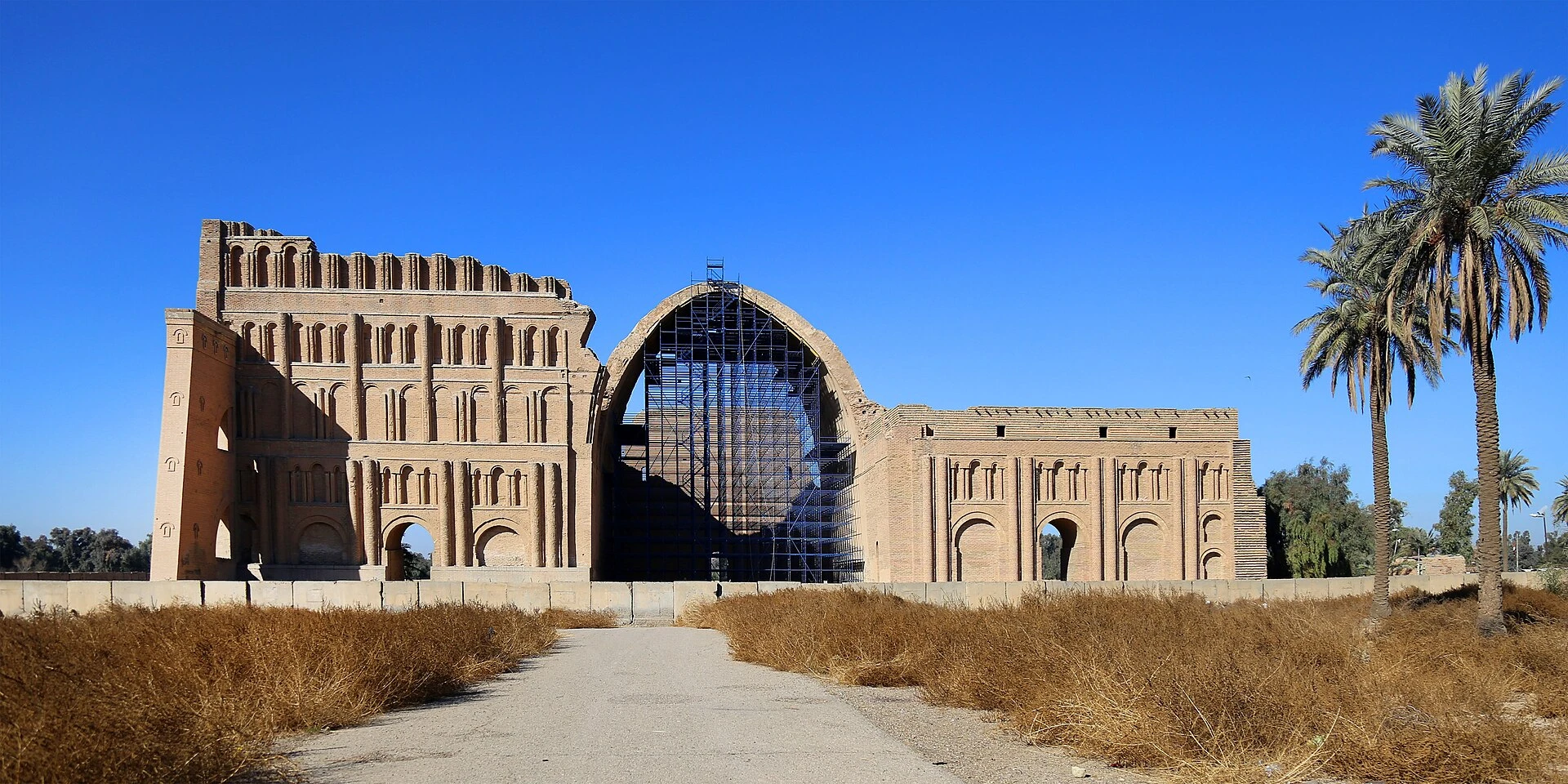
The Sassanian Empire revolutionized architectural construction by developing monumental vaulted spaces supported by enormous arches. The famous Taq Kasra (Arch of Ctesiphon) remains one of the largest unreinforced brick arches ever constructed, demonstrating remarkable engineering without steel or reinforced concrete. Its monumental scale established the arch as a symbol of imperial authority and technological mastery.
Following the Islamic conquest, Iranian architects did not abandon these structural innovations. Instead, they refined them. Islamic architecture integrated the arch with geometric ornament, calligraphy, domes, iwans, and courtyards, creating an architectural vocabulary unique to Iran.
The success of the arch lies in its ability to transform vertical loads into compressive forces that travel along the curve toward the supports. Since brick and stone perform exceptionally well under compression but poorly under tension, arches provided an ideal structural solution. Iranian architects intuitively understood concepts that modern structural engineers now describe mathematically:
· Compression paths
· Thrust lines
· Load distribution
· Buttressing
· Material optimization
Rather than increasing wall thickness unnecessarily, carefully designed arches reduced material consumption while increasing structural stability. This intelligent use of geometry allowed Iranian builders to construct enormous spans centuries before modern engineering calculations existed.
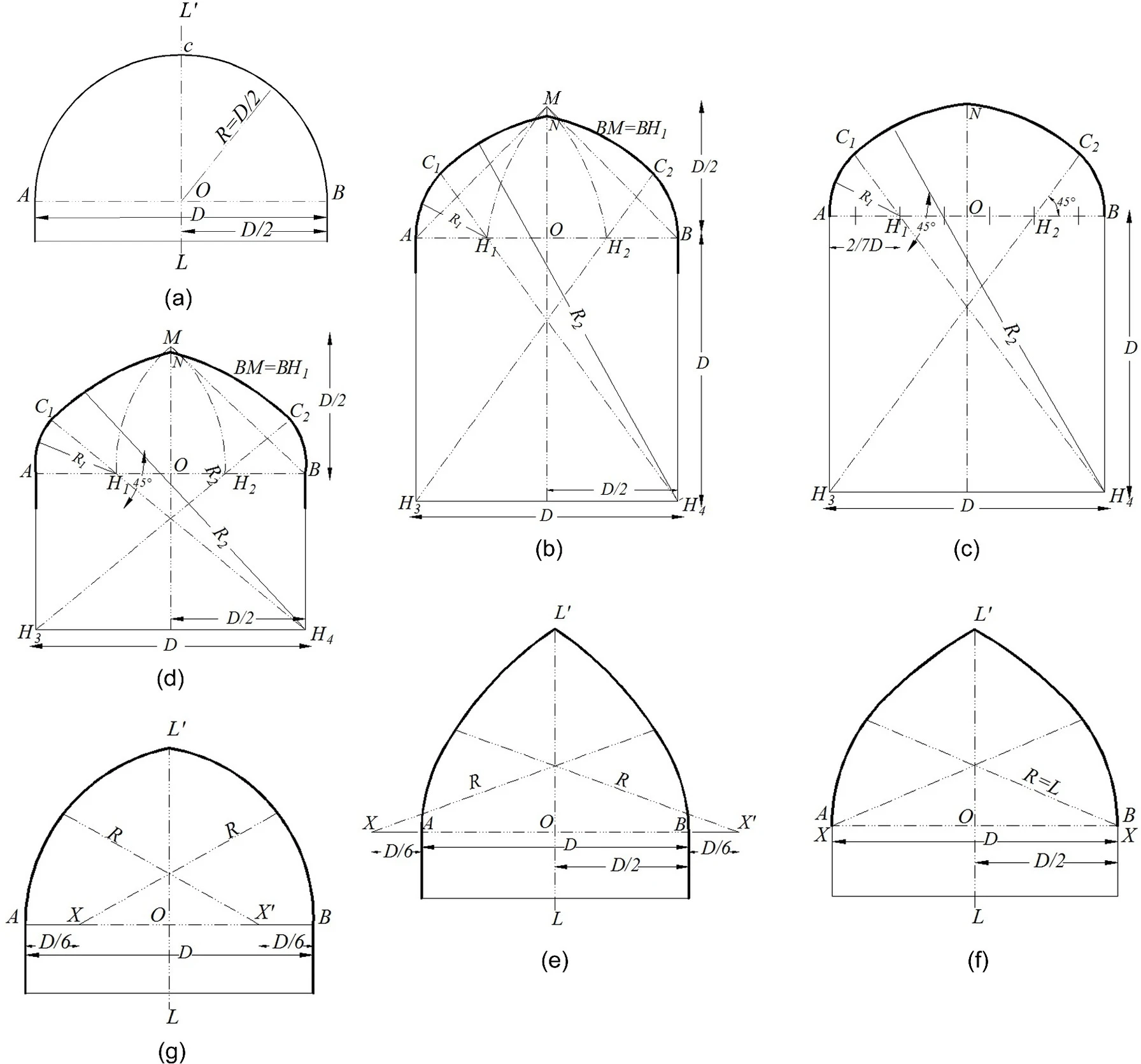
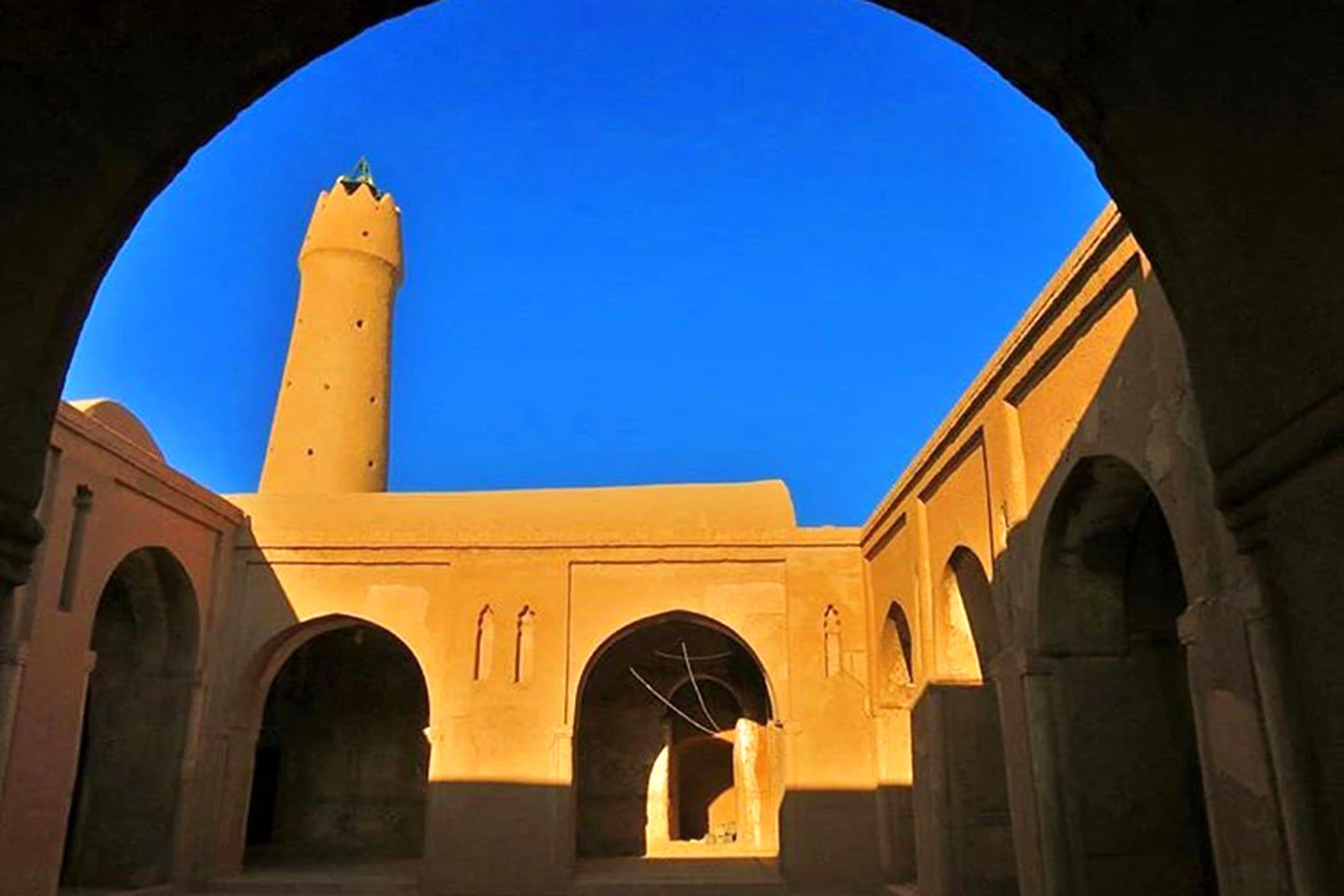
The semicircular arch is among the oldest arch forms used in Iran. Derived from Roman and Mesopotamian precedents but adapted through Persian construction methods, it consists of half a circle whose center lies on the springing line. Semicircular arches appear frequently in:
· Bridges
· Caravanserais
· Early mosques
· Water reservoirs
· Historic bazaars
Although structurally reliable, their relatively low height limits their ability to create dramatic vertical spaces.
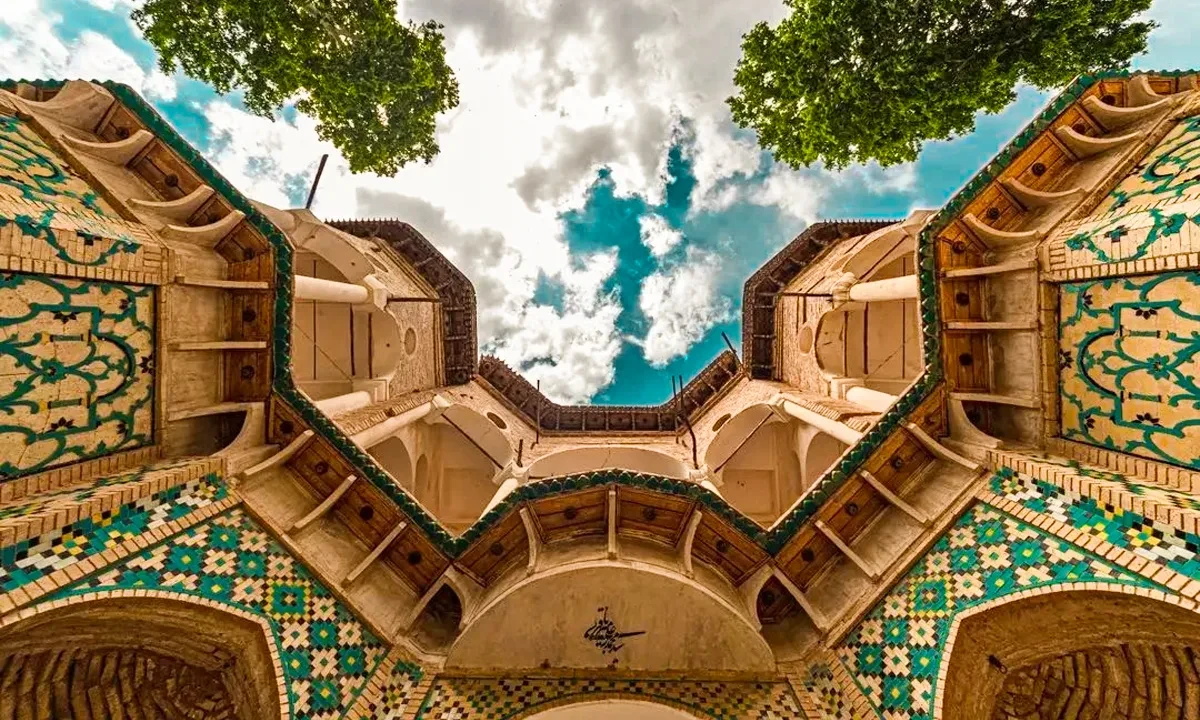
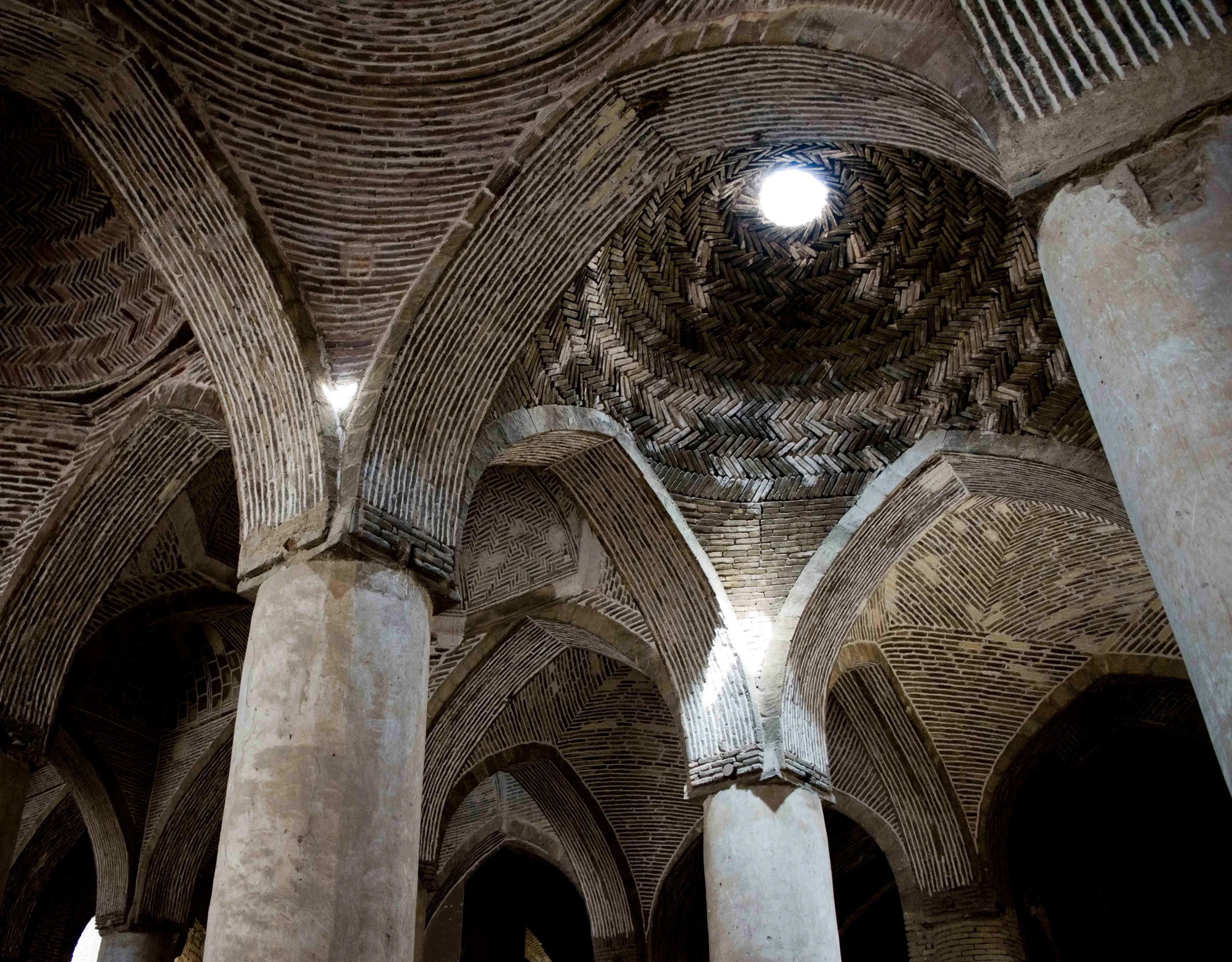
The pointed arch represents one of the greatest innovations of Iranian architecture. Long before Gothic cathedrals popularized pointed arches in Europe, Persian architects were employing them throughout the Islamic world.
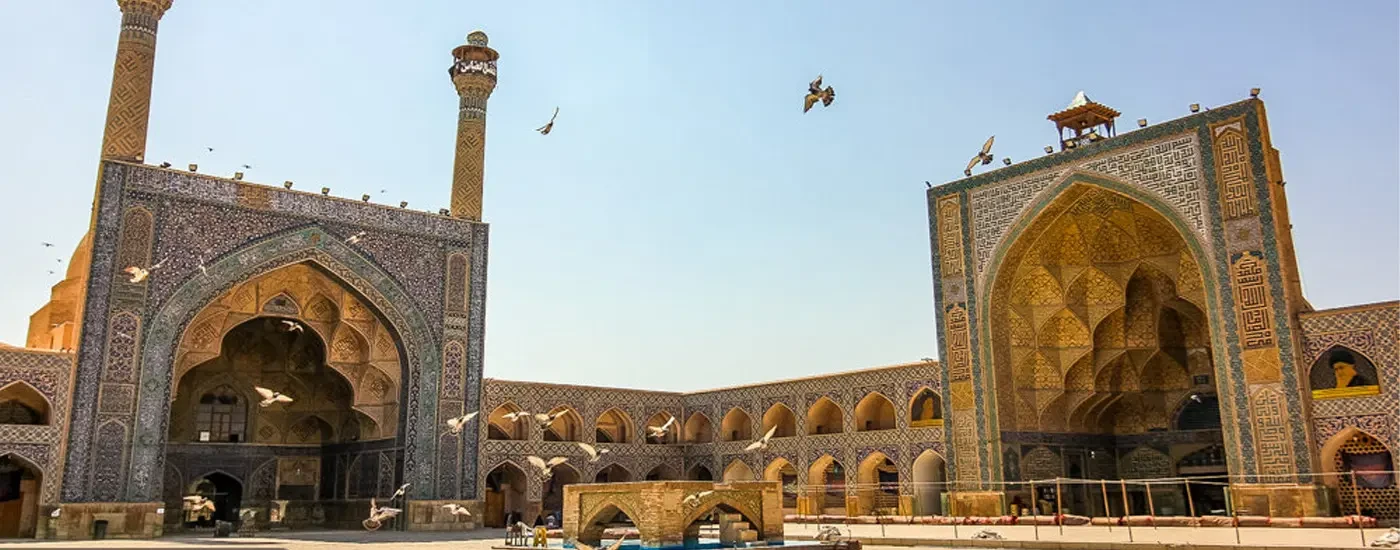
Pointed Arch, The Jameh Mosque of Isfahan, Iran. Source: Wikipedia
Unlike the semicircular arch, the pointed arch reduces lateral thrust by directing more forces downward. Consequently, walls require less reinforcement, allowing buildings to become taller and lighter. Pointed arches became dominant in:
· Mosques
· Madrasas
· Palaces
· Caravanserais
· Garden pavilions
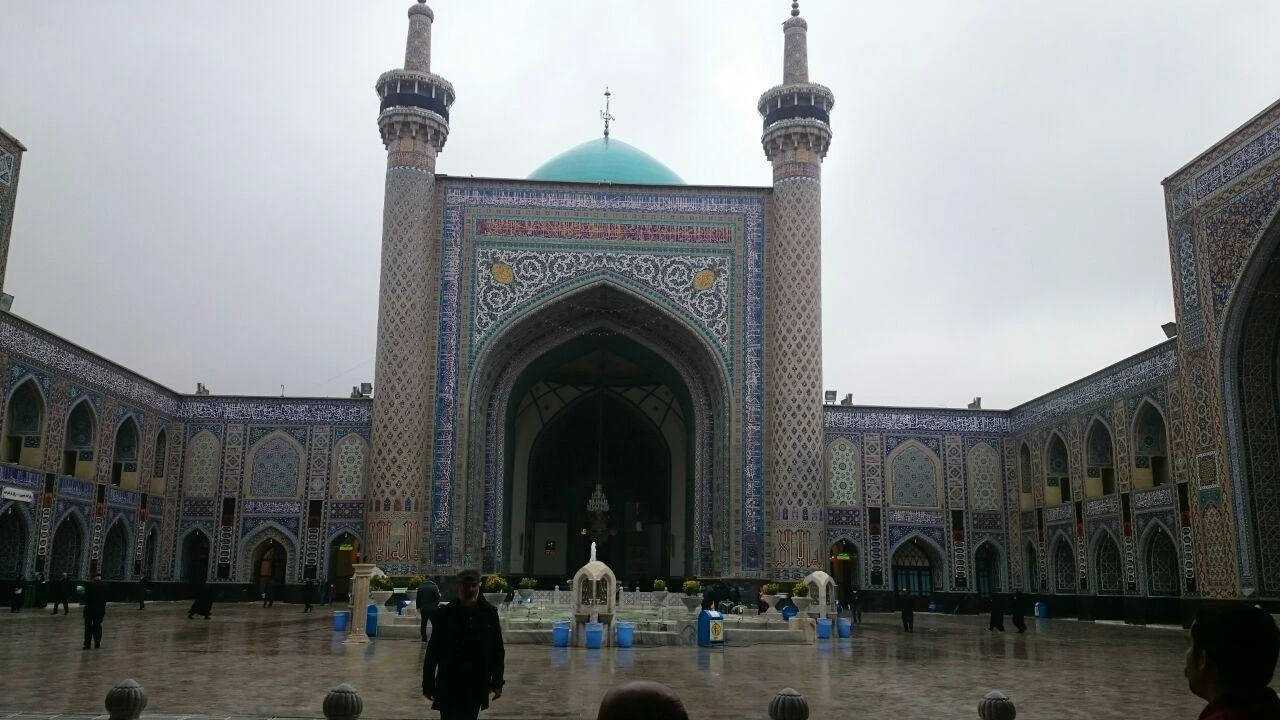
The pointed arch also emphasizes verticality, symbolically directing attention toward the heavens.
Pointed Arch, Goharshad Mosque, Mashhad, Iran. Source: Wikipedia
Five-Centered Arch (Panj-o-Haft)
Among the most characteristic forms of Persian architecture is the Panj-o-Haft or five-centered arch. Unlike simple circular arches, this profile is generated through multiple geometric centers connected seamlessly. The resulting curve combines strength with refined proportions.
Five-centered arches became especially popular during the Safavid period, appearing extensively in Isfahan’s monumental architecture. Because the curvature changes gradually, these arches generate a calm architectural rhythm while maintaining impressive structural performance.
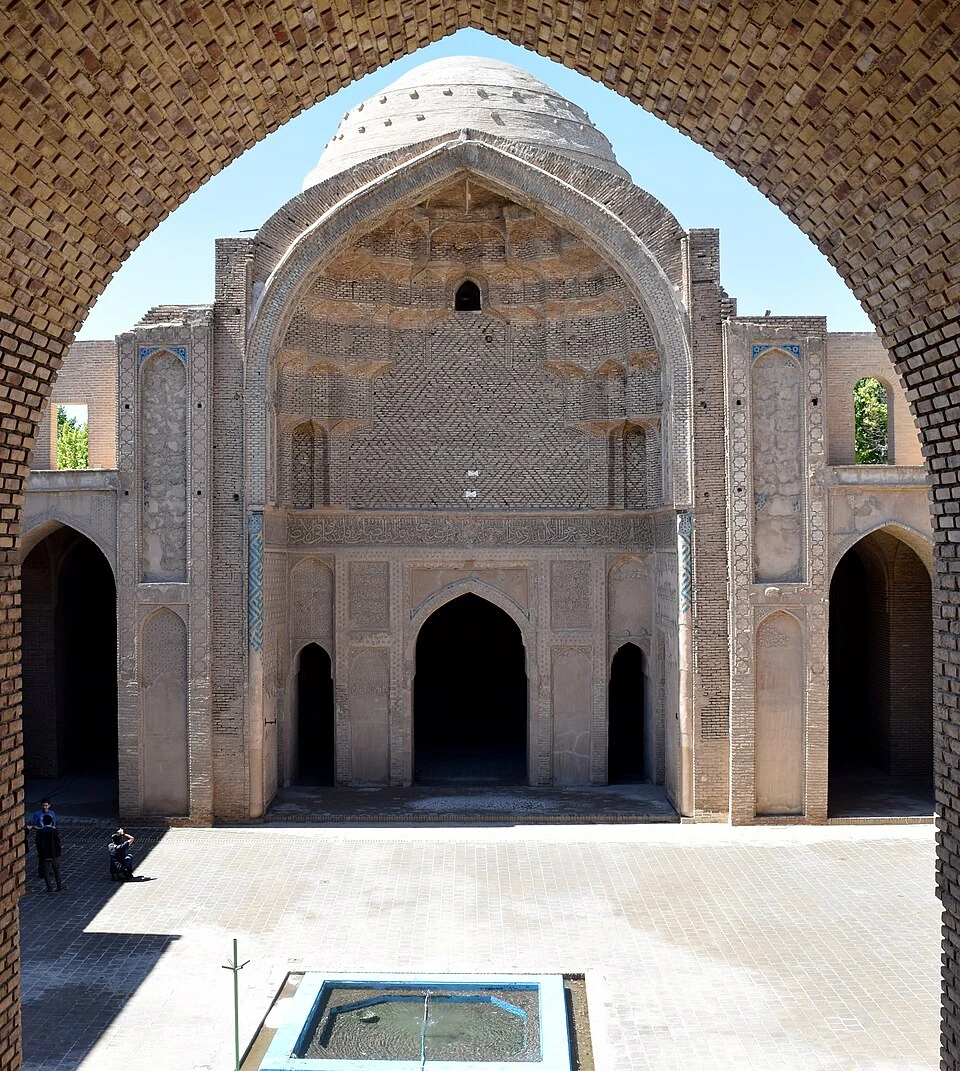
Although commonly associated with later European architecture, four-centered arches were already well established in Persian design. This arch appears flatter than a pointed arch while maintaining structural efficiency.
Four-Centered Arch, Jameh Mosque of Varamin, Iran Source: Wikipedia
Many residential buildings employed four-centered arches because they accommodated broad rooms without excessive wall height.
Four-Centered Arch, Jameh Mosque of Varamin, Iran. Source: Wikipedia
Horseshoe Arch
The horseshoe arch extends below the springing line, creating a curve that narrows before widening. Although often associated with Andalusian Islamic architecture, horseshoe arches also appeared in parts of Iran and neighboring regions.
Horseshoe Arch, Taq Kasra, Sasanian-era, Iraq Source: Wikipedia
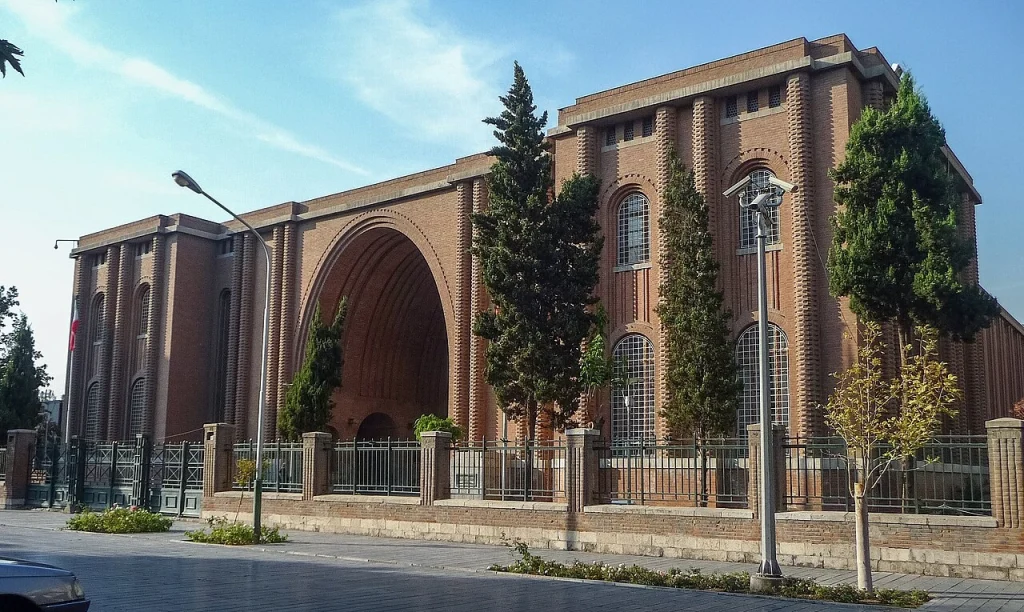
Their unusual proportions generate dramatic shadow effects, particularly under intense sunlight.
Horseshoe Arch, The National Museum of Iran, Tehran, Iran. Source: Wikipedia
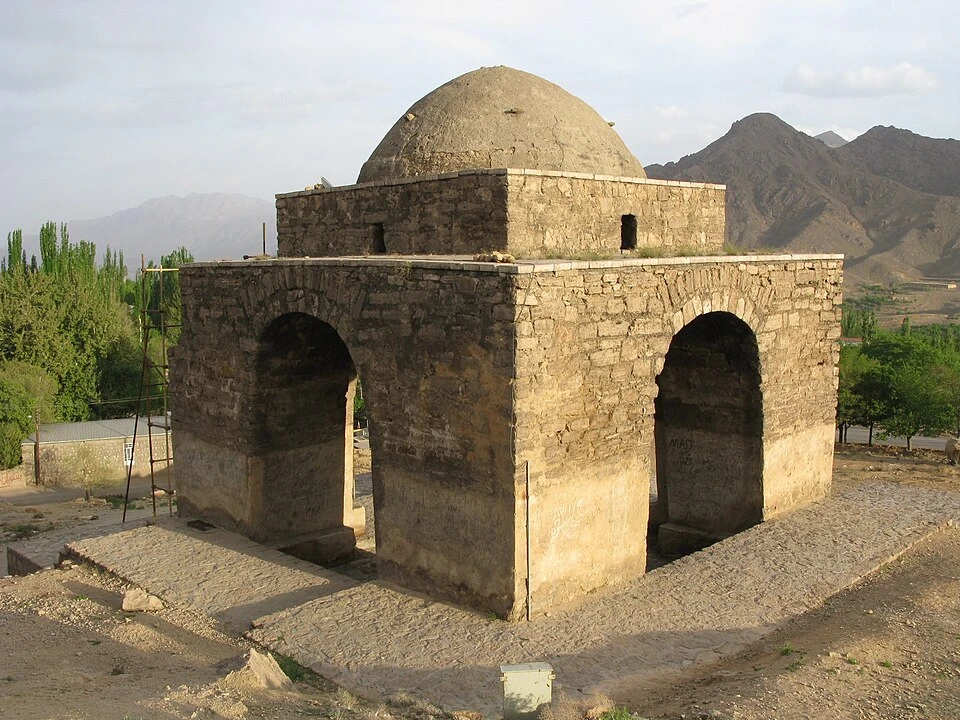
Elliptical Arch
The elliptical arch emerged where wider spans required lower profiles. Unlike circular geometry, elliptical curves distribute loads differently while creating more horizontal emphasis. Elliptical arches proved useful for:
· Bridges
· Market halls
· Covered passages
· Caravanserais
Their flatter geometry allows broad circulation spaces while maintaining structural continuity.
Elliptical Arch, Niasar Chahartaghi, Kashan, Iran. Source: Wikipedia
Basket Arch
Basket arches consist of several interconnected circular arcs, producing a flattened profile. They became increasingly common during later historical periods, when interior flexibility became important. These arches often appear in commercial architecture where movement and openness are priorities.
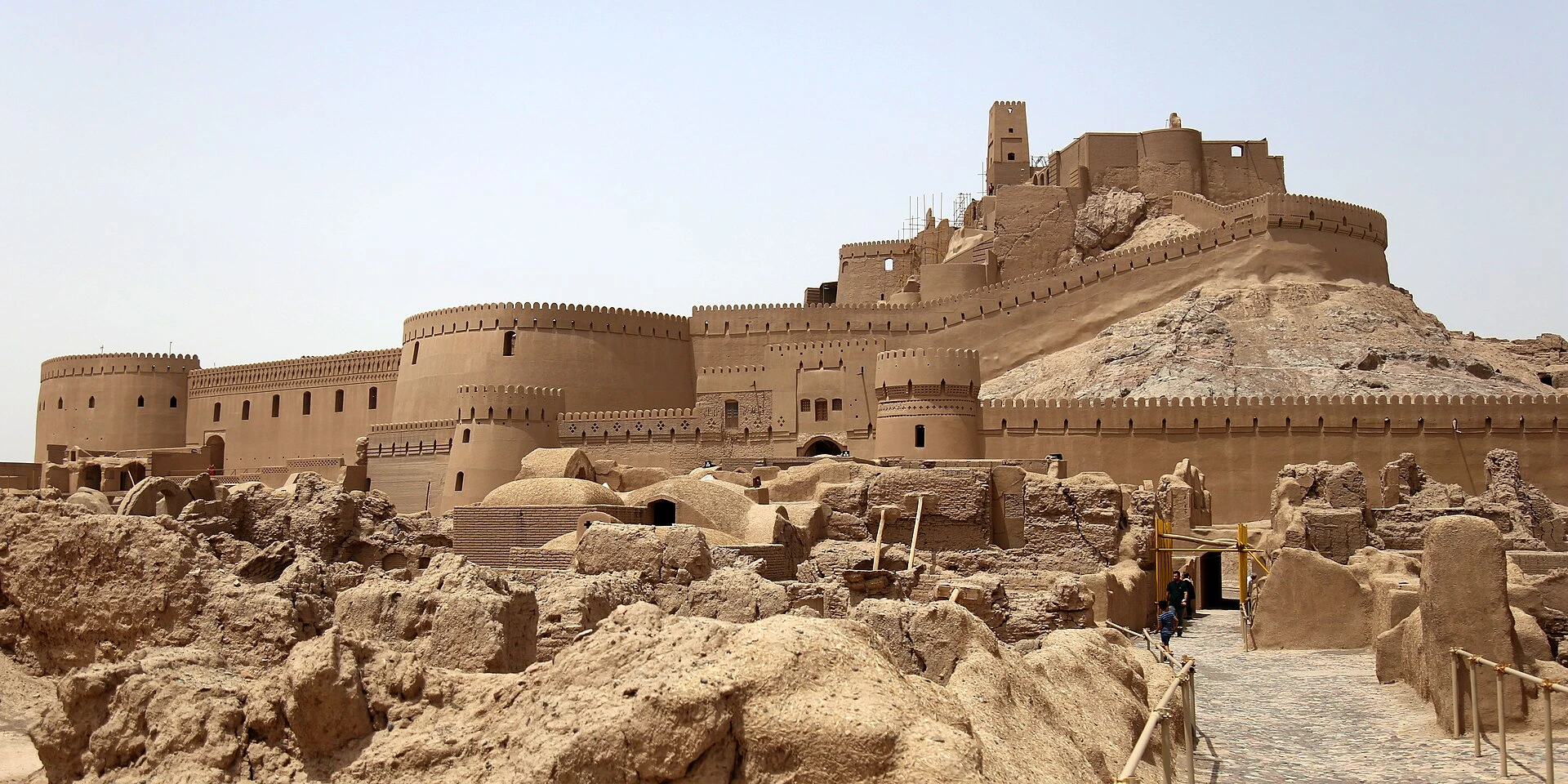
Elliptical Arch, Arg-e Bam (Bam Citadel), Iran Source: Wikipedia
Parabolic Arch
Although true mathematical parabolas rarely appeared intentionally in historical construction, many Iranian arches closely approximate parabolic geometry. Modern structural analysis demonstrates that parabolic curves align remarkably well with natural compression paths under uniform loading.
Consequently, some historical Persian arches exhibit outstanding structural efficiency despite being designed centuries before analytical mechanics. This reveals the extraordinary empirical knowledge accumulated by traditional master builders.
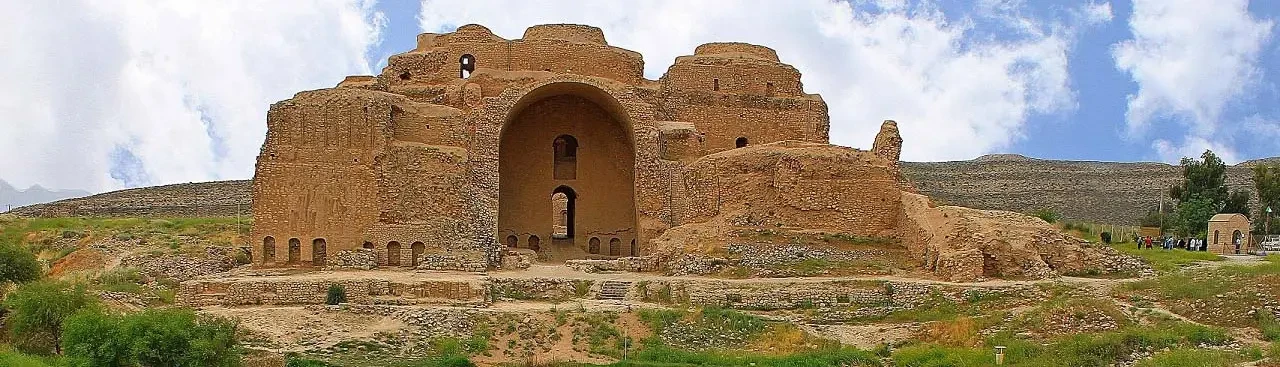
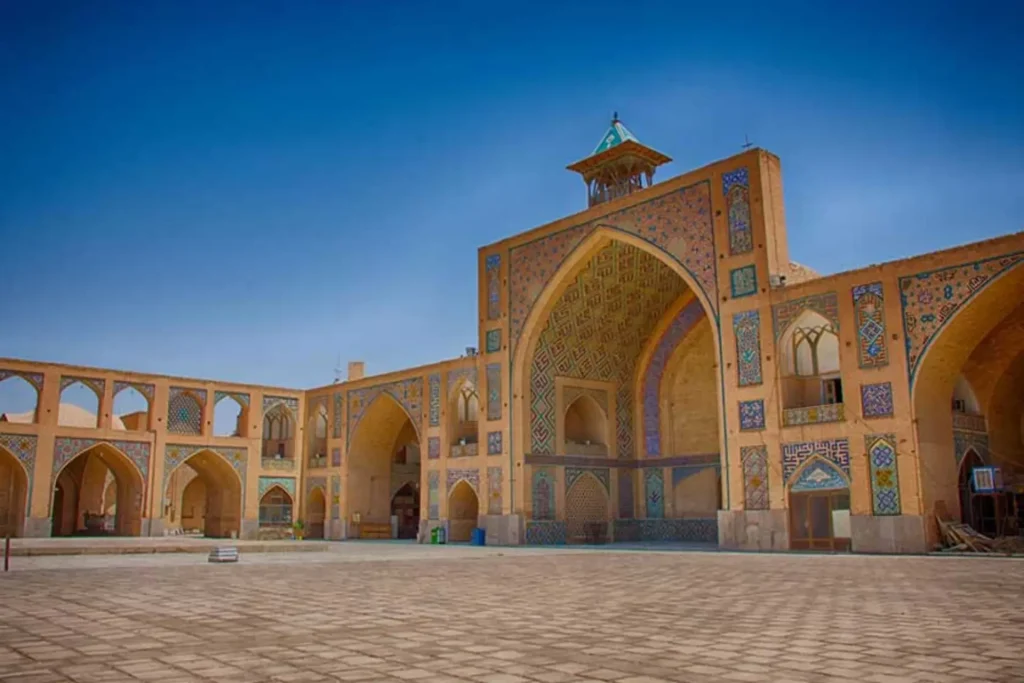
The Iwan Arch
Perhaps no architectural feature defines Iranian architecture more clearly than the iwan. An iwan is a vaulted hall open on one side through a monumental arch.
Rather than functioning merely as an entrance, the iwan creates an intermediate spatial condition between interior and exterior.
Its arch serves multiple roles:
· Structural support
· Climatic moderation
· Ceremonial framing
· Symbolic threshold
The four-iwan mosque became one of the defining typologies of Persian Islamic architecture, influencing architecture from Central Asia to India.
Decorative Arches
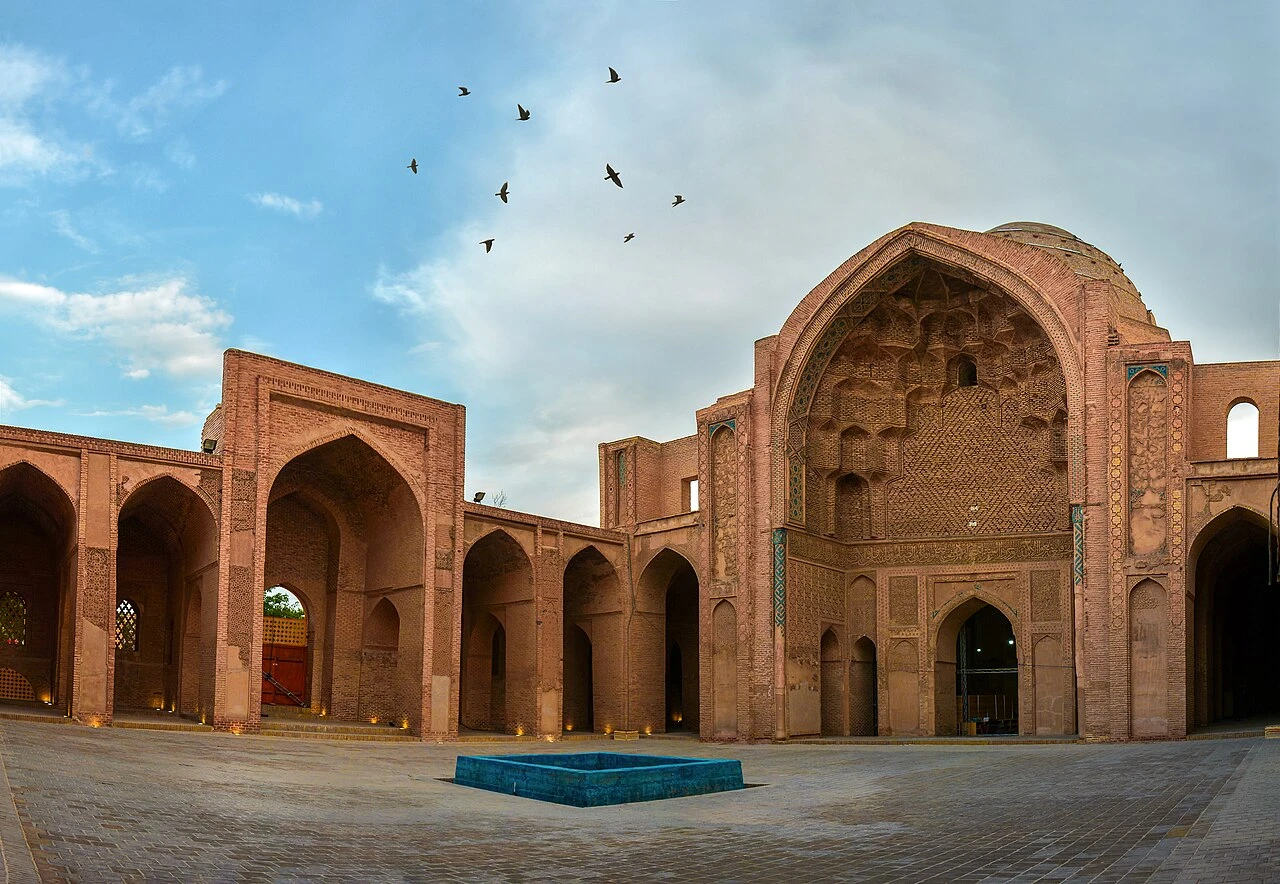
Not every Persian arch carries structural loads. Many arches function as visual compositions: Blind arches, Recessed arches, Layered arches, and Muqarnas-framed arches. These decorative forms establish rhythm across façades while reducing visual monotony.
Through carefully proportioned repetition, architects transformed flat brick walls into dynamic surfaces animated by light and shadow.
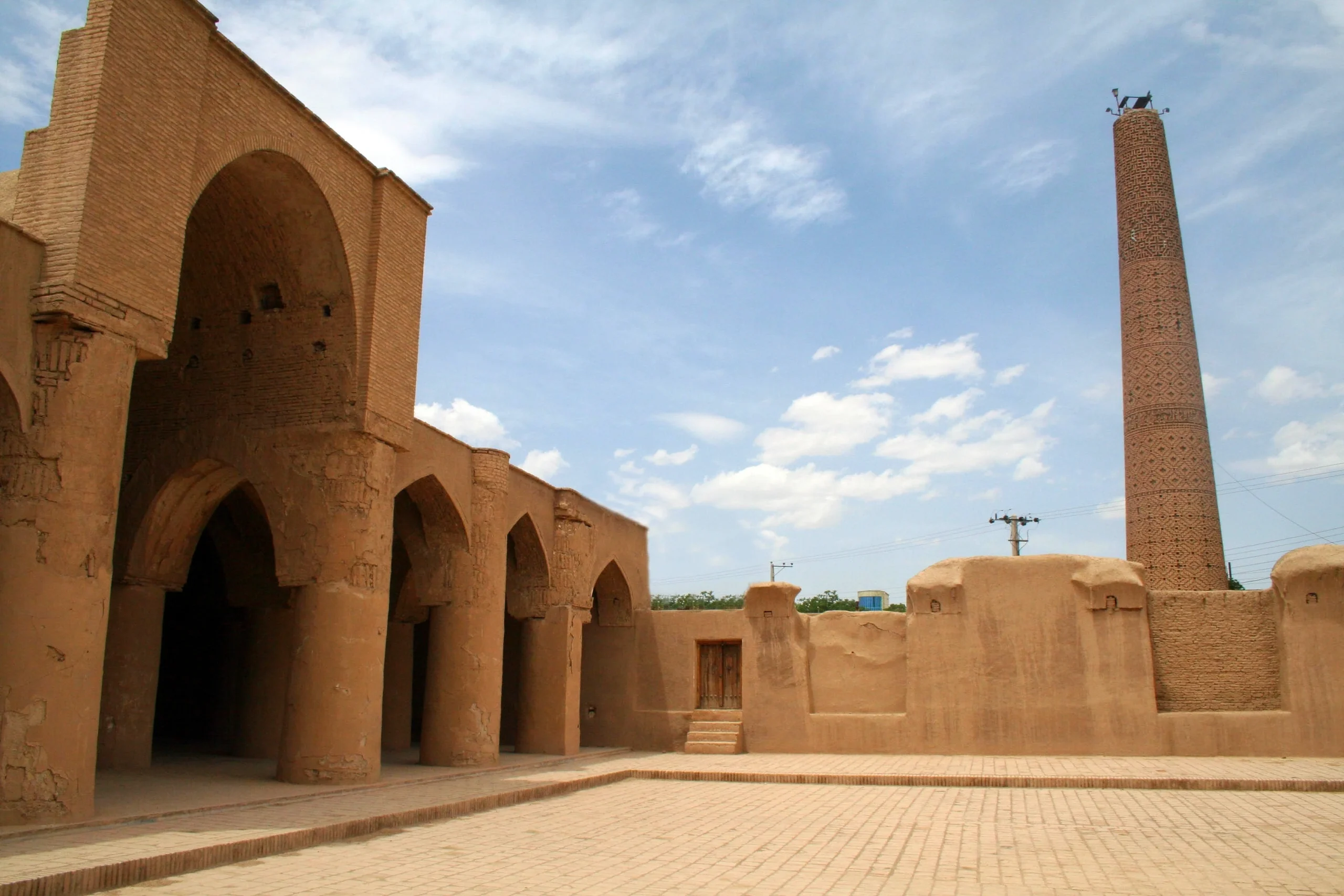
Elliptical Arch, Tarikhaneh, Damghan, Iran. Source: Wikipedia
Brick and Geometry
The remarkable diversity of Iranian arches owes much to brick. Unlike stone, brick consists of relatively small modular units. This modularity permits precise curvature, complex geometries, minimal waste, and flexible construction.
Persian masons developed sophisticated bonding techniques, allowing arches to emerge almost seamlessly from surrounding walls. Every brick contributes to compression, making structure and ornament inseparable.
Symbolism of the Arch
Beyond engineering, arches possess profound symbolic meaning. Within Iranian architectural philosophy, the arch often represents transition: Earth to heaven, exterior to interior, public to private, human to divine. Passing beneath an arch becomes both physical movement and symbolic transformation.
Mosques frequently employ progressively larger arches leading worshippers toward the prayer hall, reinforcing spiritual hierarchy through spatial experience. Similarly, palace architecture uses monumental arches to express political authority while gardens employ graceful arches to frame nature as paradise.
Regional Adaptations
Iran’s varied climate encouraged regional interpretations of arch design. In desert cities such as Yazd and Kashan, pointed arches improved ventilation while reducing heat gain.
In humid northern provinces, lower arches often accompanied timber construction.
Mountainous regions favored heavier masonry arches capable of resisting snow loads and seismic activity.
These regional adaptations demonstrate that Iranian architecture was never stylistically uniform but always responsive to local environmental conditions.
Legacy in Contemporary Architecture
Modern Iranian architects continue to reinterpret historical arches rather than merely copying them. Contemporary projects frequently abstract traditional arch geometry into minimalist forms using reinforced concrete, steel, glass, and parametric design.
Architects such as Nader Ardalan, Kamran Diba, and several younger Iranian designers have demonstrated that the arch remains relevant when understood as a structural principle rather than simply a historical ornament. Digital modeling has further enabled the recreation of complex Persian geometries with unprecedented precision.
The Iwan Arch, The Jameh Mosque of Isfahan, Iran. Source: Wikipedia
Geometry, Structure, and Cultural Identity
The arches of Iranian architecture represent one of humanity’s most sophisticated syntheses of engineering, geometry, craftsmanship, and cultural expression. Far from being repetitive structural devices, they constitute an extensive family of forms, each developed in response to specific spatial, structural, climatic, and symbolic needs. From the monumental Sassanian vaults to the refined five-centered arches of the Safavid era, Persian builders demonstrated an extraordinary command of material behavior and geometric construction long before the advent of modern structural science.
Perhaps the most remarkable aspect of Iranian arches is their refusal to separate utility from beauty. Every curve carries weight, but every curve also carries meaning. It shapes movement, frames light, directs attention, and creates emotional atmosphere. Even today, computational architects continue to rediscover principles that traditional Persian master builders had mastered through centuries of accumulated experience.
In an age increasingly dominated by standardized construction systems and globalized aesthetics, the study of Iranian arches offers more than historical knowledge. It reminds contemporary architects that geometry can be both rational and poetic, that structural necessity can generate artistic richness, and that architecture achieves its highest form when engineering, culture, climate, and craftsmanship become inseparable. The enduring legacy of Iranian arches is therefore not merely their impressive durability, but their demonstration that the most successful architecture is built simultaneously with mathematics, memory, and imagination.
In a moment of brazen hubris in the Oval Office last year, US President Donald Trump railed at Ukrainian President Volodymyr Zelensky. He accused Zelensky of not being thankful for US support in Ukraine’s existential struggle against invading Russian forces, and famously told him: “You don’t have the cards”.
Now, more than a year later, it is Trump who doesn’t have a winning hand in his standoff with Iran.
Iran may be no match for the United States militarily, but it’s been very successful in exerting what leverage it does have over the Strait of Hormuz. Trump can declare the strait open to commercial shipping as much as he wants, but he cannot make it so.
The US has resumed bombing Iran this week to try to wrest control of the strait from Iran, but Trump could go even further if he finds himself backed into a corner.
How Iran is wielding its leverage
Iran’s leverage over the strait comes down to playing a spoiling role – one of the key tactics in asymmetric warfare.
And as evidenced by its actions over the last week, the Islamic Revolutionary Guard Corps (IRGC) can threaten commercial traffic with drones or missile strikes anytime it likes. Despite heavy US bombardments since the war began, most of Iran’s missile sites along the strait are operational again.
Given this, shipping insurers, such as Lloyd’s of London, will either refuse to insure transits through the strait or charge hefty, nonviable premiums as long as the war continues.
Not only can the IRGC threaten shipping, it can also strike sites in every single Gulf state, as it has been doing at scale this week. Many US military bases across the region have been severely damaged. And the myth that having America as a house guest guaranteed security for Gulf states has been completely blown apart.
Why escalation is possible
The reality is there is no military pathway to reopening the Strait of Hormuz.
At the same time, neither the Iranian regime nor the Trump administration want to return to a significant escalation of hostilities. Both have much to lose – the military operations alone may have already cost the US more than US$100 billion – and nothing to gain from a prolonged war.
But the hardliners in Tehran, emboldened by an emotional week of national mourning for the martyred Supreme Leader Ali Khamenei, have a much larger appetite for conflict than more pragmatic leaders in other countries. Analysts believe they could withstand a US naval blockade and bombardments for many more months.
As unpopular as it might be with the majority of the Iranian people, the regime appears to be in a stronger position now than it was when the war began.
Trump, meanwhile, wants desperately to be seen as a winner. And now that many of the conventional checks and balances that constrain a president’s power have been weakened, there is a real risk of reckless escalation.
For instance, Trump has long threatened to strike Iranian civilian infrastructure, such as electric and desalination plants, which could trigger a similar response by the Iranian regime on Gulf state energy infrastructure.
This happened earlier in the war, when Iran targeted energy sites in several Gulf states. If these sites are targeted again, it could have lasting impacts on the global economy.
Should the escalation go further and involve direct strikes on the 400 desalination plants the Gulf states depend on for their drinking water, the consequences would be devastating.
The Iranian regime could also pressure the Houthis in Yemen to escalate from merely blocking Israeli ships from transiting the Bab el-Mandeb Strait at the southern end of the Red Sea to returning to attacking vessels in the chokepoint. About 10% of global trade passes through that strait.
So far, the Houthis have held off on further attacks, in part because after years of war, they have achieved a detente with their neighbour, Saudi Arabia.
Iran warned that its campaign to throttle global energy markets could expand beyond the Strait of Hormuz to the vital Red Sea route if US attacks continue, a threat that would depend on its Houthi allies in Yemen https://t.co/eXKTmx0Okppic.twitter.com/B0Nrk9BGOw
However, this ceasefire now appears shaky, after an airport attack this week that the Houthis blamed on Saudi Arabia.
A ground campaign would be disastrous
The larger reality is that military campaigns from the air have never achieved regime change. Another reality: America, for all its formidable military might, has failed to win a major war in the past 80 years.
Any serious military escalation against Iran would require US “boots on the ground”, similar to Iraq two decades ago. But an international coalition force of hundreds of thousands of military personnel proved to be insufficient in bringing stability to that country after the 2003 invasion. And Iran is almost four times the size of Iraq. It is inconceivable the vastly larger force that would be required to take control of just the mountainous southern coast of Iran could ever be assembled.
With the advent of modern drones, we have also entered a new era of warfare – one Iran is better positioned to exploit than the US. Iran possesses a remarkable depth of industrial military capacity, which has produced a more even match than might have been expected against the world’s most powerful military.
The implications for a US ground campaign are clear: any forces attempting an occupation of even a limited part of the Iranian coast, or Kharg Island, would face formidable opposition.
The risk of a much more serious escalation, though, remains. This includes the very small, but not negligible, risk of tactical nuclear weapons being deployed by the US, opening a Pandora’s box of global consequences.
What is Trump’s best option, then? Allowing Iran to retain a new level of control over the Strait of Hormuz establishes a terrible precedent, but it might be the least worst of all possible outcomes.
Greg Barton, Chair in Global Islamic Politics, Alfred Deakin Institute for Citizenship and Globalisation, Deakin University
We use cookies on our website to give you the most relevant experience by remembering your preferences and repeat visits. By clicking “Accept”, you consent to the use of ALL the cookies.
This website uses cookies to improve your experience while you navigate through the website. Out of these cookies, the cookies that are categorized as necessary are stored on your browser as they are essential for the working of basic functionalities of the website. We also use third-party cookies that help us analyze and understand how you use this website. These cookies will be stored in your browser only with your consent. You also have the option to opt-out of these cookies. But opting out of some of these cookies may have an effect on your browsing experience.
Necessary cookies are absolutely essential for the website to function properly. This category only includes cookies that ensures basic functionalities and security features of the website. These cookies do not store any personal information.
Any cookies that may not be particularly necessary for the website to function and is used specifically to collect user personal data via analytics, ads, other embedded contents are termed as non-necessary cookies. It is mandatory to procure user consent prior to running these cookies on your website.




You must be logged in to post a comment.